
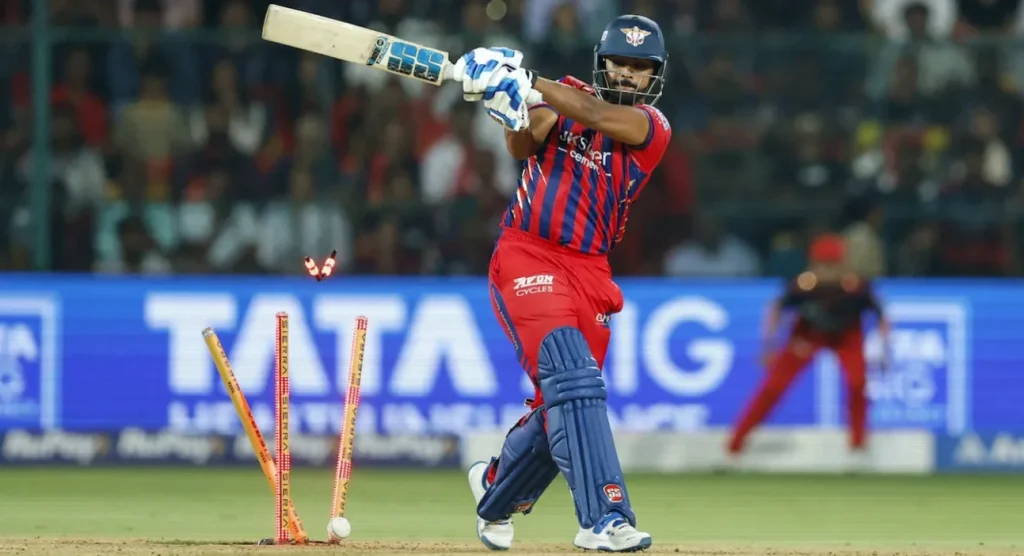
Lucknow Super Giants (LSG) have endured a miserable stretch at their home base in Lucknow, losing all three of their matches there this IPL season. Their latest setback came on Wednesday, when they suffered a 40-run defeat at the hands of Rajasthan Royals (RR), extending what has become a worrying run of home results in IPL 2026. While LSG coach Justin Langer blamed the side’s inability to “adapt” to what he described as “a brilliant cricket pitch,” Faf du Plessis and Dale Steyn pointed to deeper issues—questioning the team’s decision-making and highlighting Nicholas Pooran’s form as a key trigger for the collapse.
In the chase on Wednesday, LSG set off with Mitchell Marsh and Ayush Badoni at the top. Aiden Markram fell to number four, after Rishabh Pant and Pooran—both placed at five in the batting order. The same top three had been used in the previous match as well, but before that, Markram had started the innings alongside Marsh, while Badoni had been batting at number five. LSG have shuffled the roles of Pant, Pooran, and Badoni more than once, but the changes have not translated into sustained success.
Du Plessis, speaking on ESPNcricinfo’s TimeOut show, urged the team to keep things simple and trust what has worked. “What is your strength? What has worked for us? Stick with it,” he said. “So what’s worked for them is that they had a strong opening combination last year [Marsh and Markram]. And now you’re trying to plug every gap, and it’s difficult. It’s like trying to satisfy everyone. You can’t make everyone happy. So stick to your strengths and make it as straightforward as possible. They’re trying to bat Markram in the middle order to steady things, but then you end up losing two wickets in the powerplay. It’s just too much.”
Steyn zeroed in on Pooran as the turning point. “Pooran. Pooran is the catalyst in this,” he said. “If Pooran’s not scoring runs, it forces you to shuffle and rearrange good batters, trying to manage the situation. I also feel there’s a hint of doubt in the coach’s thinking—because they know they need to back him, given what his potential is.”
Steyn added that the problem grows when Pooran fails to deliver. “But if he isn’t contributing with runs, somebody has to be in there who makes an impact. So Markram is being pushed around—from where he should bat as an opener to the middle order—because the team wants stability there. The issue is they’re too hesitant to drop Pooran because they don’t have the confidence that someone like [Matthew] Breetzke could come in and do the job.”
Pooran has featured in all seven matches so far, but his impact has lagged behind expectations. His best score in the tournament so far is 22, in the match on Wednesday, and his 73 runs have come at a strike rate of 82.02. Markram, Badoni, Marsh, and Pant have also not been at their sharpest, but their returns have been markedly better than Pooran’s. Last season, Marsh crossed the 600-run mark, Pooran reached 500 runs, and Markram finished with close to 450 runs—numbers that underline how far the current campaign has drifted from the heights LSG previously reached.
Langer, who has now overseen five defeats in seven games, finds himself navigating a season that has already taken a sharp turn for the worse.
“Yeah, we haven’t quite clicked, have we,” Langer said at the post-match press conference. “Last year, our numbers were incredible, and we were disappointed that a lot of our bowlers were either injured, returning from injury, or not fully fit. This year, our bowlers have really been a strong point. Mohsin Khan, again, was outstanding. Prince Yadav—both of them are players who have the quality to play for India. They’re super talents. Mayank [Yadav] came back today, which was really good. He’s been away for some time after his back surgery, and it’s great to see him return with courage. He’ll be better over the run of games. [Mohammed] Shami does what he does—he’s a very crafty bowler. I also thought Digvesh Rathi bowled well today, and our fielding was excellent.”
He then pointed to the batting as the main concern. “But our batting just isn’t quite coming together. If you’d told us at the start of the season—after how many games we’ve played now, seven—that our batting wouldn’t click despite the calibre of players we have, we’d never have imagined it. We’re working hard on it.”
Discussing the adjustments to the batting order and the need to compensate for the Pooran situation, Langer explained, “We felt at the start of the season that they can do it. [But] just because it worked last year doesn’t automatically mean it will work this year. That said, Aiden is a selfless kind of player. We felt from the first few games that we needed that cricket intelligence in the middle. And we thought, with Nicky and Aiden—two of our most experienced players—it’s often the toughest place to bat in T20 cricket. That’s why we’ve adjusted it.”
He added that the team has been thinking deeply about the batting approach. “There’s a lot of thought going into it. Interestingly, the last game against Punjab [Kings] was probably our best batting display, and tonight obviously wasn’t. When you lose wickets, everyone knows that if you lose wickets in the powerplay, you end up chasing your tail. Tonight we were chasing our tail. It’s really frustrating. It’s frustrating for our fans. It’s frustrating for everyone in the dressing room. Everyone’s working hard.”
