
Suryakumar Yadav has become a growing concern for Indian cricket fans. Not so long ago, he looked like the inevitable face of T20 batting in the country—one of India’s standout specialists in the format and, for stretches, the top name in the ICC T20I rankings. Yet the signs now point to a sharp decline, and questions are starting to surface about whether the peak version of his batting is behind him.
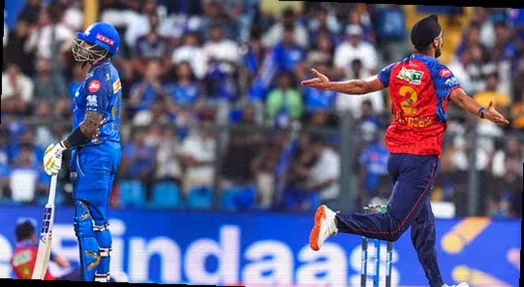
On Thursday night, Surya’s struggles continued in the MI vs PBKS clash, where he was dismissed for a first-ball duck. Arshdeep Singh struck early to end his stay at the crease again, and while scores can fluctuate for any batter, what has stood out is the overall pattern of his recent performances—particularly in the way he has looked when he gets set, and how often he has failed to build innings.
It has not been a story of simply “not getting runs”; it has been the manner of those innings over recent months. The one notable exception came during the home series against New Zealand, when he appeared to find his rhythm again.
Earlier this year at the T20 World Cup, Surya managed only a single fifty across the tournament. That knock mattered, especially as India struggled in their match versus the USA, but by his standards, it was far from the kind of impact he usually delivers in big events. He did contribute in other games, but the overall picture suggested he was not at his sharpest when it counted most.
Since Surya took over the captaincy role from Rohit Sharma in 2024, his output with the bat has been inconsistent. His batting drought appeared to ease shortly before the T20 World Cup, during the run-up against New Zealand, where he produced three fifties. In that stretch, he amassed 242 runs at a strike rate of 196.74, and the early signals looked promising—like he was returning to the version of himself that had defined his rise.
However, looking back, that revival may have been a false dawn. The key question now is whether Surya is already beyond his prime, and whether India should begin planning to move on from him rather than waiting for a full return to form.
There is also an argument that if India had not gone on to win the T20 World Cup, his chances in the T20I setup could have taken a decisive hit. The relief for him was that India did lift the trophy. Since then, he has spoken about wanting to be part of the next T20 World Cup in 2028, and also about featuring in the Los Angeles Olympics in the same year.
But the evidence for a long runway is limited. In the ongoing IPL, Surya’s numbers read 16, 51, 6, 33, and 0 so far. His fifty against Delhi Capitals came off 36 deliveries. That detail feels especially stark for those who remember his earlier peak years—when a batter like him could normally turn even a brief start into a far more substantial score, quickly and repeatedly. For many, imagining a time when he might “only” get to 51 off 36 balls seems almost unimaginable compared to the batting dominance he displayed earlier in his career.
Why the batting looks different now
- The clearest indicator that Surya is not the same batter is his inability—especially recently—to land his ramp shots with the same authority as before.
- Earlier, going for a ramp shot would often come with an almost certain expectation that the ball would be placed where he wanted it. That certainty is no longer there.
- Bowlers have also started to slow the pace and change the rhythm against him, and he has struggled to find a workable answer to that adjustment.
- Even his boundary-hitting through the covers—once a hallmark of his attacking language—has not looked the same. The inside-out option is appearing far less frequently than it used to.
Continuing with Surya for the sake of continuity could also be unfair to other India-contenders who have been putting pressure on selection in the IPL. Shreyas Iyer and Rajat Patidar, in particular, have been performing exceptionally well across recent seasons, and they are among the most dangerous batsmen in the league right now. There are hardly any matches where they do not deliver innings of real impact, which makes the argument for giving them more responsibility stronger.
In July, India are scheduled to play five T20Is against England in England. That tour could become a turning point in the bigger conversation about what the next phase of India’s T20 batting group should look like. At 35 years of age, it is difficult to expect a full return to the very top level, especially when the current signs point in a different direction. After Virat Kohli and Rohit Sharma, Surya may be among the next to face a phase-out. For now, it remains hard to imagine him reversing the trend quickly enough to secure his T20I future with confidence.
