
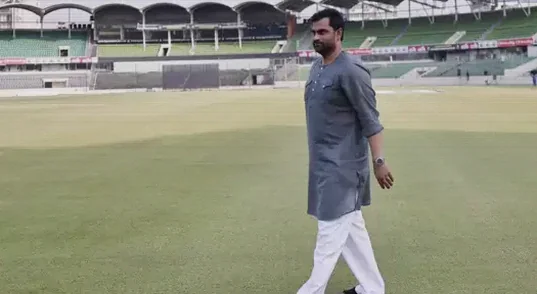
The Bangladesh Cricket Board (BCB) is set to add another tier to its domestic structure, with president Tamim Iqbal announcing on Thursday that the board plans to launch a 2nd XI Championship within the National Cricket League (NCL), Bangladesh’s traditional first-class tournament. The idea mirrors the reserve-team pathway long familiar in English county cricket, where a separate competition for second elevens helps clubs keep developing fringe and young players in competitive match conditions.
The proposed 2nd XI Championship, as Tamim explained, would initially begin with the three-day format, before the tournament is expanded later. In the England-style model, reserve sides from the 18 first-class counties play matches across multi-day and one-day formats, and it functions as a crucial route for players trying to break into higher-level cricket. Tamim’s argument was that Bangladesh has not offered enough consistent opportunities for cricketers outside the main stream of the national pathway, and that this new structure is meant to close that gap.
Speaking to reporters, Tamim said Bangladesh’s cricket ecosystem has been heavily concentrated around a relatively narrow group of players. “If you look at the design of Bangladesh cricket, you will see that maximum cricket is centered around just one segment of players. Those who play for the national team are the ones playing BPL, BCL, and NCL. One segment of players are getting the chance to play 5-6 tournaments,” he said. He added that players operating in the second or third tier have had far fewer opportunities, which has limited the chances of talent rising from those levels.
Tamim noted that historically there have been very few instances of a player moving up to the national team from lower divisions, largely because the necessary competitive platform was missing. “Because of this, there are very few instances in our cricketing history where a player has made it to the national team from the second or third division. This is because we could never create that platform,” he said. He then described the decision as collective and framed it as a step the board intends to implement immediately. “So, we have all collectively made a decision and, Inshallah, we will start from this season,” he added.
Under the plan, when the NCL season begins, both Chittagong and Dhaka will field two teams each—an arrangement meant to ensure every side has a First XI as well as a Second XI. Tamim explained that this will effectively broaden the pool of active cricketers at the domestic level. “From now on, when the NCL starts, Chittagong will have two teams – First XI and Second XI. Dhaka will also have two teams. In this way, every team will have a First and Second XI,” he said. He further clarified the scale of the expansion: “When we start the Second XI, you are basically engaging another 100-150 or 200 cricketers.”
Beyond more participation, Tamim argued the 2nd XI setup would also make it easier for teams to tailor match selections to specific needs. He gave an example involving squad balance and player roles. “The advantage here is, for example, Dhaka is playing an NCL match, and two days later they have a game against Rajshahi. Suppose Rajshahi has four left-handed batsmen and Dhaka doesn’t have an off-spinner in the team. What do we do then? We pick up an off-spinner from here or there and make him play,” he said. In his view, the National League has sometimes been associated with a lack of depth and planning—what he referred to as “picnic cricket”—and the board bears responsibility for changing that culture.
Tamim said the new structure should reduce the need to source players from outside their base and instead keep the talent pipeline internal. “The term ‘picnic cricket’ arises regarding the National League. It’s not just the cricketers, we are also responsible for that. Because we are the ones who created that culture. Now, no one will have to be picked up from their home; that off-spinner will be playing in the 2nd XI, and the first XI can give him an opportunity in the National League based on his performance,” he stated. He also emphasized that the BCB will ensure Second XI players receive proper support, including standard facilities and match fees, calling it the board’s obligation to provide the competition.
To underline how the 2nd XI championship could benefit players returning from injury, Tamim referenced fast-bowler Jofra Archer and also discussed the practical management of workloads. “Let me give another example: when Taskin Ahmed gets injured, after returning from injury, we send him to a first-class match and tell him not to bowl more than 6 overs. Why should we have these rules and regulations in a first-class match? Taskin Ahmed will go to the second XI; there, he can do his buildup in a relaxed way,” he said. Tamim added that the approach gives players an appropriate competition to build rhythm without squeezing restrictions into first-class bowling spells.
He then pointed again to the Archer case as further evidence of the value of this pathway. “If you look at the example of Jofra Archer, after returning from injury, his first match was for the second XI,” Tamim said. For him, the underlying objective is long-term development of Bangladesh cricket, even if future leadership changes. “These things we are doing are for the development of Bangladesh cricket. There will be elections in the future, and anyone might come in, but if we can leave this system established, I hope it will be good for Bangladesh cricket. From our side, we have completed the process and the budgeting,” he added.
Tamim also touched on infrastructure and energy plans linked to Bangladesh’s main venue. He said the Sher-e-Bangla National Cricket Stadium will include a 27,000 square feet canopy shade, and the board is planning to install solar panels at the stadium to save energy. Alongside cricketing upgrades, he outlined his expectations for the political and administrative roadmap of the board, including timing for election-related steps.
He said he anticipates an election roadmap by May 3, when members of the BCB ad-hoc committee are scheduled to meet, and after receiving input from the legal team about the next board election. The BCB’s current situation follows a major decision from the National Sports Council (NSC): on April 7, the NSC officially dissolved the Aminul Islam Bulbul-led Bangladesh Cricket Board, citing “huge-scale irregularities” in the previous board election.
After the dissolution, an 11-member ad-hoc committee was formed with Tamim at the helm to run the board and oversee fresh elections within 90 days. In that context, Tamim confirmed he intends to contest the president’s post in the upcoming BCB election. He explained his plan to begin the process by discussing the election procedure in the board meeting scheduled for Sunday, May 3.
“Regarding the election, I will talk with everyone in a board meeting next Sunday (May 3) and start the process. If the process starts the election will be held within 30-45 days, which is two-three weeks ahead of the deadline,” he said. Tamim added that the board is seeking legal guidance on how best to proceed, particularly around how representatives are selected from districts and divisions. “We are taking a legal opinion on how to move forward. I had a lot of complaints with regards to the way representatives are taken from districts and divisions. Whatever is right constitutionally, we will conduct the election that way,” he said, while also making it clear that he does not plan to step down from his role as head of the ad-hoc committee.
