
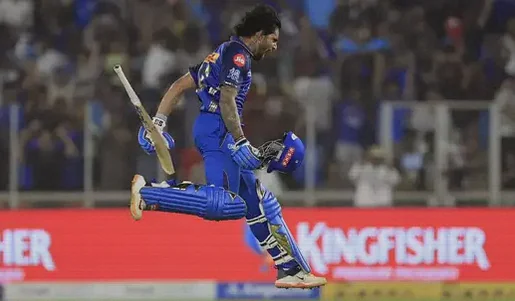
Tilak Varma, riding the momentum of a stunning unbeaten hundred versus Gujarat Titans, explained that during a difficult spell he sought guidance from Mumbai Indians captain Rohit Sharma. The advice, Varma said, was simple: spend time in the middle first, then let your attacking instincts take over once you’ve seen enough deliveries.
Speaking ahead of Mumbai Indians’ clash with Chennai Super Kings, Varma described how Rohit’s counsel helped him steady his approach after runs had dried up. “I was carrying a lot of pressure and I felt I wasn’t in great form,” he said. “I was especially talking with Rohit bhai. He told me, ‘You play 15 or 20 balls and you’ll understand what you can do—just trust it. After those 15 balls, what you can manage is something we know and everyone knows. So just do this. Don’t focus on the situation and don’t look at anything else. First play 15 balls, and then we’ll see what happens after that.’”
Varma added that the message stayed with him as he built his innings. “That gave me confidence,” he said. “I had it in my mind that I would play 15 balls and only then think about the rest. Once I had done that, I knew I could take on anyone. It’s natural—once you play more, you get used to the ball, you adjust to the wicket. Those are the basics. Then the game started flowing, and after that the result came.”
Ravichandran Ashwin later described Varma’s knock as one of the best centuries in IPL history, crediting it for pulling Mumbai Indians back on track in a season that had been wobbling. Prior to that match against Gujarat Titans, Varma had scored 43 runs in five outings. At the Narendra Modi Stadium, however, he looked completely settled, accelerating to a 45-ball century.
Just as important, Varma’s impact continued after the batting timeout in Mumbai’s innings. Of the 96-run target chase total’s final 83 runs, Varma was directly responsible for 83 off his own bat, underlining how decisive his spell at the crease was.
Reflecting on why the century mattered, Varma—now 23—said it was significant both for his team and for him personally. “To be honest, it was very important for the team and for me as well,” he stated. “In a couple of innings, I wasn’t taking that time in the middle. So I was just thinking about staying at the wicket for a few balls, and then I kept going according to the situation. I’m happy it worked out for me.”
With the unbeaten hundred, Varma became only the fourth batter to score a century at No. 5 in IPL history. Even so, he reiterated that his preferred batting spot is No. 3. “This question has been asked to me for the last three years,” he said. “As I’ve said before, I would always love to bat at No. 3, but I’m ready wherever the team needs me—whether it’s 4, 5, 6, or 7. Anywhere, I’m prepared.”
Varma also explained that experience across different positions has helped him understand how to manage his innings. “Because I’ve batted in different spots over the last three years, I know what situations call for,” he said. “I know how to behave, which bowler I can go after, and how the wicket plays. When the innings goes deeper, the ball gets a bit softer and comes on differently. So I adjust my plans accordingly. I have my game plan, and wherever the team needs me to bat, I’m ready.”
The T20 World Cup winner further opened up about his practice routine, saying he doesn’t simply overwork his batting when runs aren’t coming. He described a recent conversation with his childhood coach as a key part of his self-assessment during the lean period. “I always think about what is needed at that moment,” Varma said. “Sometimes I feel like I have to practise more; sometimes I feel like I have to stay away from the game. In my mind, before going to sleep, I think about how I’m feeling. Because it’s not always the same—when you’re not scoring runs, it doesn’t mean you just have to practise more to fix it. It doesn’t work like that.”
He added that even during the World Cup, his approach shifted based on how his early matches went. “Even in the World Cup, my first two or three matches were (not) decent, and at that time I felt I had to practise more, so I was practising a lot,” he said. “Then when I didn’t do well in the next two or three matches, I felt I needed to stay away from the game, so I didn’t practise much.”
Varma said the person he wanted to speak to was his childhood coach, as he wanted to discuss his batting in detail. “I wanted to share a few things about my batting with him, so I spoke to him,” he recalled. “After that conversation, I felt relaxed. I didn’t practise much, but I knew it was just a matter of one innings and I would be back. At the right time, it came together—God helped me,” Varma concluded, describing his mindset through both difficult and confident phases.
