
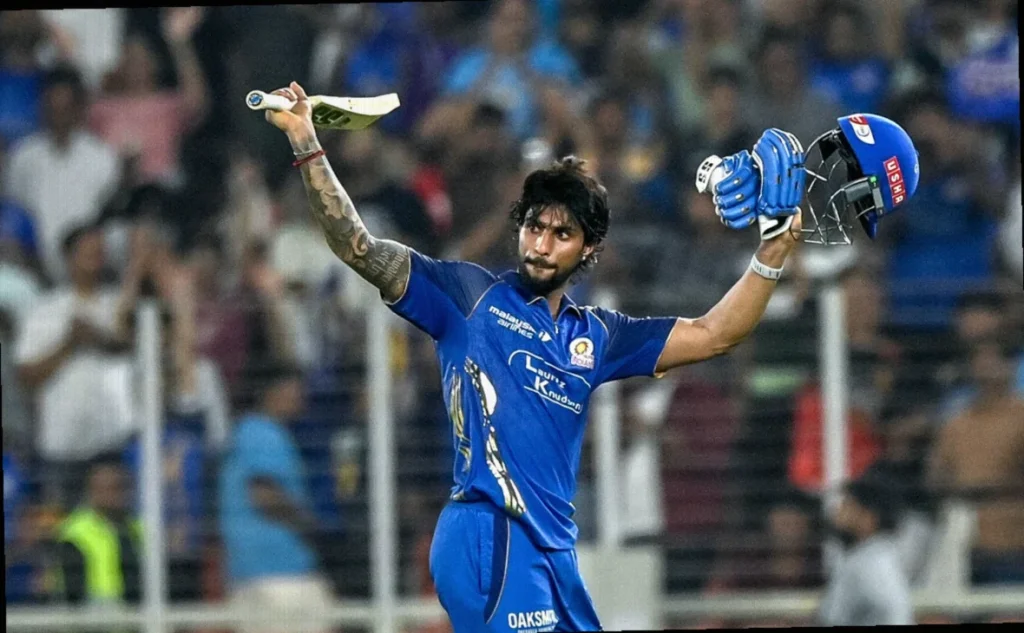
Mumbai Indians batter Tilak Varma left the cricket world reeling after firing a century from just 45 balls in the IPL 2026 clash against Gujarat Titans on Monday. The left-hander looked utterly destructive from the outset, taking aim at the GT attack and finishing with a stunning tally that included eight fours and seven sixes. In doing so, he matched the record for the quickest hundred by an MI batter in IPL history. The feat also echoed Sanath Jayasuriya’s milestone in 2008, when he had struck a century off 45 deliveries against Chennai Super Kings. Varma marked the occasion with a distinctive celebration that has already spread rapidly across social media.
Ball-by-ball landmark
Driving the innings forward was a clear message from captain Hardik Pandya during the strategic break. With Tilak asked to step on the accelerator, Varma responded in the best possible way—producing the most electrifying innings of his IPL career and cracking his maiden league hundred. His innings powered Mumbai Indians to 199/5, giving the five-time champions some crucial breathing space against Gujarat Titans.
Tilak’s 101 not out off 45 balls included a spectacular burst of scoring: 81 runs came from only 23 deliveries, a surge that looked unlikely even after the powerplay. Much of the early pressure had come from Kagiso Rabada, who delivered a hostile first spell and kept the batters from settling.
At the strategic timeout following the 14th over, TV cameras captured Pandya urging Tilak with intensity. By that stage, Tilak had worked his way to 19 off 22 balls, and at times the Motera crowd even booed him as the innings had not yet found its rhythm.
However, once the break ended, the batter fans were familiar with returned. Tilak launched a full-scale assault on Gujarat Titans’ quickest bowling, hitting hard and scoring at will. Prasidh Krishna conceded 19 runs, while new pace sensation Ashok Sharma was targeted for 26.
Before Monday’s innings, questions had been raised about Tilak’s form. In his previous five matches, he had managed just 43 runs in total, making what followed all the more remarkable. On the day, he struck eight boundaries through the air and cleared the ropes repeatedly, with his hitting ranging from over-cover efforts to shots launched down the ground.
Although Pandya tried to keep Tilak company, his contribution—15 off 16 balls—did not substantially alter the tempo. The pair added 81 runs together, but they did so in only 38 balls, highlighting how quickly Tilak took control even with the captain not fully converting his opportunities. The final six overs brought 96 runs, largely driven by the inconsistency of Prasidh Krishna, who finished with figures of 1/54 in four overs but leaked 41 in his last two.
Rabada’s early strike and MI’s push back
That late surge came after Rabada had set the tone early. With the new ball, the South African pacer found pace and movement, striking through the powerplay and dismantling the top order. For a team that had looked out of sorts at times, this spell threatened to keep Mumbai’s total below par.
Rabada, often spoken about in the same breath as the great fast-bowling names of his era—Pat Cummins, Jasprit Bumrah and Josh Hazlewood—bowled with Test-match lengths, then attacked with pace, fullness, and relentless stumps. His efforts yielded three wickets and put Gujarat firmly on course.
Danish Malewar (2) showed the gap between domestic cricket and world-class bowling. He struggled to get his bat down in time as Rabada struck him on the pads plumb in front.
Quinton de Kock (13 off 11 balls) offered a brief flash of intent. When Rabada gave him width, de Kock cut hard, but a short ball ended up being too much—he ballooned a pull shot and the bowler had no trouble collecting the catch.
The most impressive dismissal came in the form of a key wicket of India T20I captain Suryakumar Yadav (15 off 10 balls). Suryakumar had already shown his timing, having clipped Rabada for a six into cow corner and then driving him to the boundary. But Rabada returned with a sharp, quick ball that forced a breakthrough.
152 kmph that changed the spell
Rabada delivered a 152 kmph bouncer pitched up on the fourth stump line that cut back sharply. There was no clear footwork to meet it, and the bat came away from the body. The ball breached the defence and struck the stumps, leaving the batter helpless.
Naman Dhir’s resistance
Naman Dhir, who had scored a fifty in the previous match, helped keep the innings alive. He made use of Ashok Sharma’s pace to find a couple of boundaries and kept nudging the scoreboard forward, even though he never fully dominated the opposition attack.
The turning point arrived only after the strategic break, when Tilak suddenly changed gears and produced the most memorable innings of his IPL career. It was also the fastest hundred ever recorded by a Mumbai Indians batter in the tournament.
