
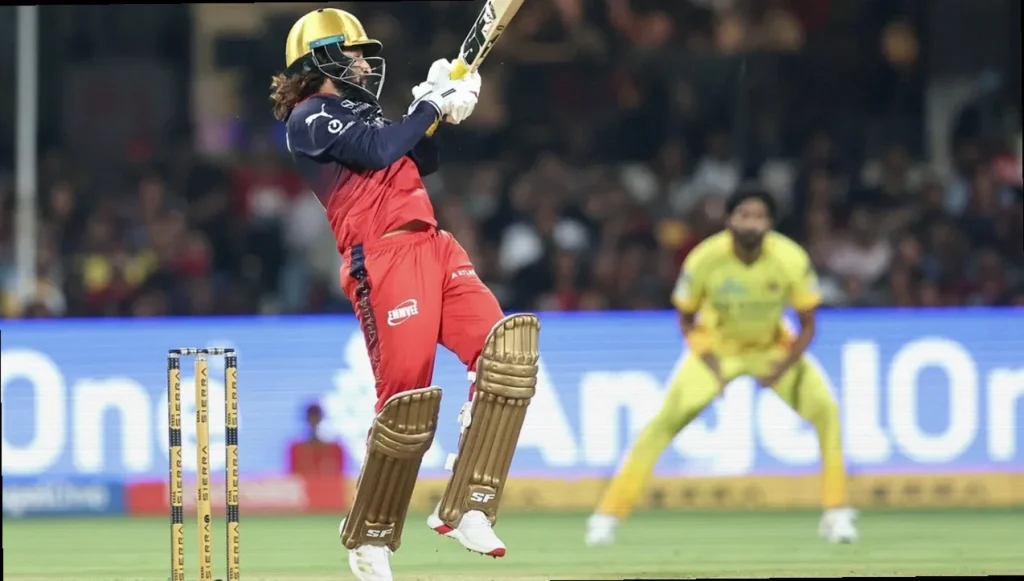
Tim David struck at a brutal pace as the 19th over began, racing to 35 off just 17 balls. Then came a flurry that felt almost unfair: Jamie Overton was struck for 6, then 2, followed by 4, and then a run of three more sixes to finish the sequence in one of the most relentless end-over spells IPL fans are likely to see in the 2026 season. Still, it took until the fifth ball of that burst for David’s strike rate to finally edge past the batter at the other end.
RCB’s late acceleration after a slow start
That batter was Rajat Patidar, whose push was exactly the kind of transformation Tim David was now taking to its peak. Before Patidar arrived at number four, Royal Challengers Bengaluru (RCB) had managed 93 runs from the first 64 deliveries of their match against Chennai Super Kings (CSK). However, once Patidar stepped in, RCB’s momentum shifted dramatically—adding 157 runs off 56 balls after his entry.
In the end, David finished unbeaten on 70 off 25 balls, while Patidar closed the innings on 49 off 19. Patidar struck six sixes compared to David’s eight, and the balls-per-six numbers stood at 3.17 for Patidar and 3.13 for David—both reflecting how consistently they turned good deliveries into boundaries.
Why the chase changed—and why RCB needed a statement
RCB’s decision-making also mattered. When Patidar walked in, the team had been sent in, and the pitch at M Chinnaswamy Stadium had started tacky—holding the ball up and making it bounce awkwardly when it was pitched on a good length. Phil Salt, Virat Kohli, and Devdutt Padikkal all struggled to time the ball during that opening period.
But somewhere along the line, the surface began to settle into the more familiar Chinnaswamy character. CSK had also secured a toss that looked increasingly beneficial, and batting later on in the chase would likely be easier than it had been for RCB during the powerplay. RCB, sensing that the window to dominate was narrowing, would have felt the urgency to post a total that compensated for conditions easing as the match went on.
That urgency sharpened further when Patidar joined Padikkal, who was on 17 from 16 balls at the time of Patidar’s arrival.
Patidar’s defining shot, then an innings built on control
RCB’s captain provided the spark immediately. Patidar faced only one delivery before producing what looked like the standout shot of the innings at that stage. The ball came from Noor Ahmad—wide of the off stump, released by left-arm over at around 98kph—and it required Patidar to go hard at the longer square boundary, an area with a sweeper positioned to protect it. Patidar stepped up, freed his arms, and launched the ball over the boundary cushions to the right of that fielder.
The hits kept arriving, each one eye-catching in the way Patidar’s batting often is. From a pure visual standpoint, one of the most pleasing was his effortless flick-drive over long-off when Matt Henry strayed slightly too full. From a difficulty perspective, the carve over extra-cover off Khaleel Ahmed stood out even more—especially because Ahmed got extremely close to pinning the wide yorker perfectly.
This wasn’t a one-off either. It was the kind of innings Patidar typically performs, and he has been doing it at a level that stands out even across IPL seasons.
Middle-overs dominance since the start of 2024
- Since the beginning of the 2024 season, Patidar has struck at 174.03 in the middle overs (7–16) of IPL matches.
- Among batters who have scored at least 200 runs in that phase, only Abhishek Sharma, Sunil Narine, Nicholas Pooran, M Shahrukh Khan, and Phil Salt have managed a faster strike rate than Patidar.
- Against spin in the same 7–16 window, he has a strike rate of 180.64. Only Nicholas Pooran has gone quicker among the same 200-run cut-off.
- Against pace in the 7–16 window, his strike rate is 167.04. Only Suryakumar Yadav, Riyan Parag, Jos Buttler, and Nicholas Pooran are ahead of him with the same cut-off.
What it could mean for India’s T20I middle order
Patidar’s profile is unusual in its balance. He has shown destructive intent in the middle overs against both pace and spin, and it’s uncommon for a batter to consistently tick all those boxes while sustaining that threat over a longer stretch of time.
Within the RCB XI, that skill set fits neatly at number four. With serious hitting ability down to at least number eight, Patidar can play the role of a precise accelerant—handling hard lengths from fast bowlers, dealing with different kinds of spin, and backing himself to attack as soon as he arrives at the crease.
There are other reasons he is being watched closely. He captained his franchise to an IPL title last season, and he is highly regarded by national selectors—already having made his Test and ODI debuts. With India looking ahead after winning the T20 World Cup, he could be seriously pushing for a middle-order position in their T20I plans.
However, Patidar will be nearly 33 by the time the next phase of selection becomes clearer, and India have at least two other strong contenders for that role from outside the World Cup squad: Shreyas Iyer and Riyan Parag. They are younger than Patidar and also captain their IPL sides, leaving Patidar likely further back in the current pecking order.
Even so, that queue doesn’t currently suggest an obvious shake-up. It’s difficult to imagine selectors discussing anything like phasing out Suryakumar Yadav, an all-time T20 great who has just captained India to a world title.
Still, if such a hypothetical conversation were to arise, Patidar could force his way into it over the coming weeks—provided he continues turning in innings of the kind he produced on Sunday night.
