
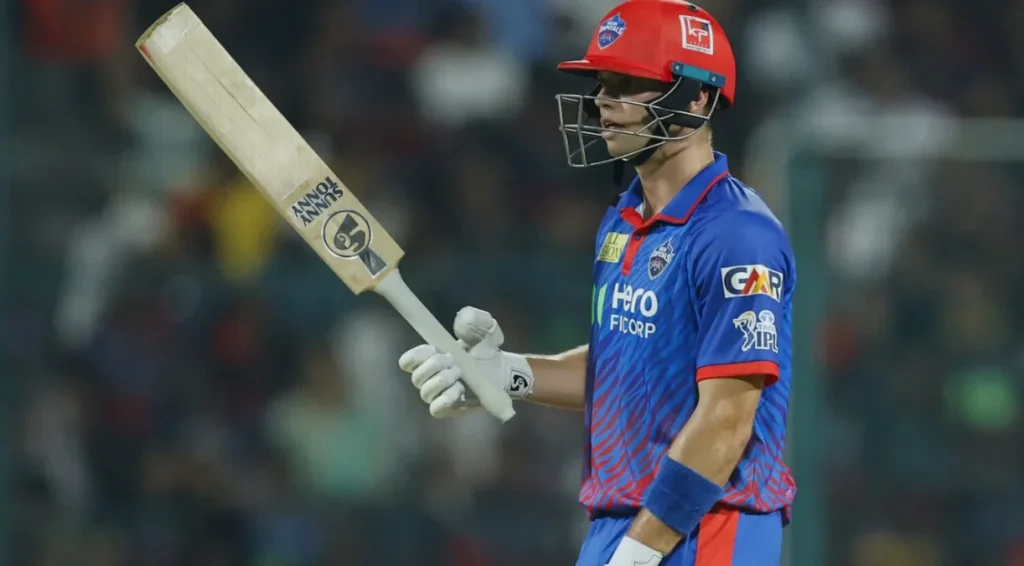
Being Tristan Stubbs for Delhi Capitals can look glamorous from the stands, but the reality is a tightrope act. He is the franchise’s go-to closer at the death, yet he is often expected to change gears within a couple of overs—especially when early wickets turn a chase into a scramble. If the top order stumbles, Stubbs doesn’t just swing; he has to steady the innings, find gaps, and give his team a platform from which the finishing role still makes sense.
On Saturday in Bengaluru, the assignment was two-fold: steer DC to safety after they slipped early, and then chase a target set after RCB posted a competitive total. Stubbs delivered on both counts, turning pressure into composure and a difficult situation into a successful chase.
DC were already under strain when Stubbs walked in. The side had limited Royal Challengers Bengaluru to 175, but Bhuvneshwar Kumar immediately flipped the momentum. In a fiery powerplay burst, he dismantled the DC batting order and had them reeling at 18 for 3 by the end of the third over.
Stubbs arrived into a full-throttle cauldron—his fifth time batting in the powerplay in IPL cricket, and also the earliest he’d come to the crease for DC across 33 matches. The Bengaluru crowd, which had been muted during RCB’s innings, found its voice again. Chants of “Bhuvi, Bhuvi” echoed around the stadium as Virat Kohli, stationed at gully, looked visibly fired up and exchanged a few words with Stubbs. The field closed in and the next ball delivered a familiar kind of threat: Bhuvneshwar sent down an outswinger, similar to the one that had beaten Sameer Rizvi’s outside edge on the previous delivery. Stubbs’ response was to stay completely still, watch the ball with precision, and then open the bat late to lift a crisp drive straight through covers for four—an instant that seemed to quiet the entire ground.
After that early boundary, Stubbs didn’t find another one for the next 20 balls. Across the other end, KL Rahul took the attack to RCB’s bowlers, but Stubbs remained content to play the role that the situation demanded. He kept the strike rotation ticking, absorbed the pressure, and let partnerships do the heavy lifting.
Speaking after the game, Stubbs explained his mindset: “I wasn’t quite ready in the changing room. Through the middle there, the way he [KL Rahul] batted was magnificent. He really kept us going. And we spoke before as a team to bat in partnerships. So I thought, he’s going well, so just give him the strike.”
What followed was a controlled blueprint for chasing in tricky conditions. At one point, Stubbs was on 19 from 21 balls, yet he never allowed the moment to push him into reckless decisions. This was not the easiest Chinnaswamy surface—Stubbs described it as a track where the ball tended to stay “a little bit slow, a little bit low.” His plan was straightforward: settle in, assess, build partnerships, and take the game deeper rather than forcing everything immediately.
He then combined effectively with Rahul, adding 69 runs off 44 balls, before linking up with Axar Patel for a 47-run stand. In both phases, Stubbs accepted his role as the stabiliser without losing his ability to accelerate when the time was right. During his unbeaten 47-ball innings, he took 26 singles and hit six twos, a spread that prevented him from being trapped at one end for too long. The turning point came when Axar was forced to retire hurt. From there, Stubbs shifted gears decisively—waiting for RCB to use up their main bowling options, even though the required run rate had climbed beyond 12 an over across the final three overs.
In the 18th over, he struck Bhuvneshwar with a pull over deep midwicket. Shortly after, he hammered Rasikh Salam down the ground to bring up his half-century, reached off 41 balls. With 15 runs required in the last over and RCB’s frontline bowlers already spent, David Miller brought Romario Shepherd into the firing line to complete what had escaped him in a previous meeting against Gujarat Titans.
Stubbs remained calm under the final-overs spotlight and finished on 60 off 47 deliveries. His control metric—93.6—was the best among any batter who faced more than ten balls in the match.
When asked about the chase as DC needed 37 off 18 balls, Stubbs said, “I kept thinking three sixes and we’re straight back in it. They bowled their guns out quite early. So then I always thought, worst case, the last over we can get whatever we need. I didn’t want to take it to the last over, but thankfully we got over the line.”
The storyline carried an uncomfortable resemblance to DC’s opening match of the season against Lucknow Super Giants. In that game, chasing 142, DC had slipped to 26 for 4 in the fifth over. Once again, Stubbs—this time batting at No. 6—acted as the anchor that kept the middle order from collapsing. Alongside Rizvi, he stitched an unbroken 119-run partnership for the fifth wicket to guide DC home.
Stubbs has also been in exceptional form in 2026 beyond the IPL. He started the year by captaining Sunrisers Eastern Cape to a third SA20 title, with his 41-ball 63 not out helping them seal the final in another demanding chase. At the T20 World Cup, he amassed 135 runs across six innings, averaging 67.50. In IPL action this year, he has played 18 T20 innings, remained unbeaten in 13 of them, and has scored 478 runs at an average of 95.60.
At the IPL level, he has taken over the finisher’s responsibility with impact. In his debut DC season in 2024, he scored 223 runs in the death overs (from 17 to 20) at a strike rate of 297.33 — the highest among batters who faced more than 50 balls. In 2025, his strike rate moved to 201.47, and this season he has played a major part in two of DC’s three wins.
Before this match, the numbers offered little comfort for teams in DC’s position. In the IPL, across 99 cases where a side chasing a target between 170 and 220 had lost three or more wickets in the powerplay (and where matches were not reduced), only 11 ended in victories. Stubbs ensured DC became the 12th team to break that trend. The win not only ended a run of two straight losses, but also kept Delhi from drifting too far out of contention early in the season.
