
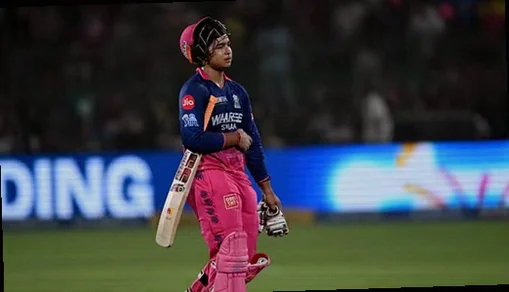
Vaibhav Sooryavanshi has been drawing a wave of praise lately—people calling him a demigod, comparing his promise to Lamine Yamal’s level, and surrounding him with one compliment after another. But it’s worth pausing before the excitement turns into drowning in the noise. At just 15, he has only featured in eight first-class matches so far and, across those outings, he has averaged 17.25. He has just one half-century to his name as well.
Also, the question keeps getting asked: when did T20 cricket become the main measure of everything? Time and again, players—ranging from Sachin Tendulkar to MS Dhoni and Virat Kohli—have stressed that Test cricket is the highest benchmark, the ultimate peak. Doing well in the longer format is presented as what truly matters. White-ball cricket may be exciting, offered as something you enjoy in bursts, but the red-ball game is treated as the staple that builds a cricketer day after day.
There’s no denying that Sooryavanshi looks like a genuine prodigy. He can clear the boundary with ease, finding gaps and launching to all parts of the ground even at such a young age. Still, branding him as a cure-all won’t do him—or the sport—any favours. The real danger is that unrealistic expectations can distort development, pushing a teenager to chase headlines instead of building a complete game.
Surya and Abhishek: lessons to absorb
There are two cases that Sooryavanshi would be wise to study. The first is Suryakumar Yadav, whose T20 rise initially came with extraordinary momentum and then, over time, began to shift as his international opportunities evolved. Suryakumar did play Test cricket and also featured in multiple ODI matches, yet he failed to consistently make an impact in those formats.
Now picture the outcome if a player is over-celebrated in T20s—constantly described as a rare “360-degree” talent—yet struggles when the challenge changes to Tests or even the 50-over game. In that scenario, the long-term damage can be severe, because the reputation built in one arena may not translate when the sport demands different skills and temperament.
Then there is another uncomfortable question: what kind of standing does a star actually hold in Indian cricket once the initial buzz fades? For instance, even after leading India to the 2026 T20 World Cup title, Suryakumar’s status is not portrayed as extraordinary in the same breath as the nation’s long-format icons. When his playing days eventually end, it’s unlikely his name will be mentioned alongside the Test greats—largely because he couldn’t leave a lasting mark as a Test cricketer, or even as an ODI performer.
Abhishek Sharma is facing a similar crossroads. Not long ago, during the T20 World Cup period when he was struggling, he lost the backing of fans. Former Pakistan fast bowler Mohammad Amir even referred to him as a slogger—an assessment that drew attention for all the wrong reasons.
At the moment, Abhishek can remain relatively protected as long as he continues scoring in T20 cricket. But that safety doesn’t last forever. The format is brutally fast, and opponents eventually adjust—by studying patterns, tightening bowling plans, and targeting weaknesses that were previously masked by early success.
That adjustment has already started to happen to some extent. Without sound technique—something that is usually shaped and tested through red-ball cricket—it becomes difficult to predict whether Abhishek can sustain a long career at the top level. And with a packed T20 calendar leaving little room for the longer format, the pathway to improvement can shrink. More than a year has already passed since he last played a Ranji Trophy game.
To be a true star, cross-format excellence matters
If someone is going to enjoy the kind of enduring stardom associated with Jasprit Bumrah, Virat Kohli, or Sachin Tendulkar, they need to be effective across formats. The central worry with Sooryavanshi is that the spotlight might become so T20-focused that he doesn’t give Test cricket the seriousness it requires. His management and support system also carry a heavy responsibility—because keeping him grounded isn’t only about coaching and strategy, but about protecting him from the wider hype machine as well.
He must understand that cricket is far bigger than a single innings measured in 120 balls. If that perspective slips, the development of a young talent can be pushed off course. That is why the message is clear: saving him from the glare of over-expectation is essential.
The BCCI, along with current and former Indian cricketers, now have substantial work ahead. They will need to keep holding a realistic mirror to him—consistently. What they cannot do is continue feeding the public and media frenzy that has been building for some time, because a teenager’s long-term career cannot be built on noise alone.
