
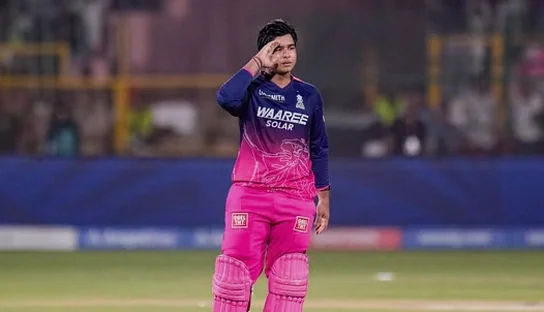
Rajasthan Royals left Jaipur on the wrong end of the result, yet their squad’s most exciting young holding only grew heavier in value. Vaibhav Sooryavanshi couldn’t prevent Sunrisers Hyderabad from winning, but he altered the way the game—and his season—reads, by turning a defeat into a statement innings. With SRH chasing 229 and finishing with nine balls to spare, the 15-year-old left-hander’s 103 off 37 balls became the defining piece of RR’s story.
Quick facts
- Match situation: Sunrisers Hyderabad chased 229 successfully with nine balls remaining.
- Vaibhav Sooryavanshi’s innings: 103 off 37 balls.
- Boundaries in the century: 12 sixes and five fours.
- Rajasthan’s total: 228/6.
- Sooryavanshi’s season match worth before this game: ₹6.13 crore.
- Rolling match cost after eight matches: ₹62.88 lakh (₹7.86 lakh per match).
- Sooryavanshi’s updated season match worth after the hundred: ₹7.98 crore.
- Current rolling cost after the update: ₹62.86 lakh.
- Calculated profit (season): ₹11.70 crore on an assumed ₹1 crore investment (return multiple: 12.70x).
Sooryavanshi’s century came with force, reshaping Rajasthan’s first innings into a total that should have carried more weight on most nights. He reached his hundred in 36 deliveries, then powered the middle overs with 12 maximums and five boundaries to help RR post 228/6. Hyderabad’s chase delivered the loud answer, but it didn’t erase what Sooryavanshi had already put on the board.
A “stock” that keeps climbing
The unusual part is how neatly his rise continues even while the team falls short. Rajasthan lost the contest, yet their most valuable young asset looked even more valuable after it. It’s the kind of split that has started to define his season: personal output climbs, while conversion into points depends on the rest of the match plan.
Before SRH arrived, the numbers suggested Sooryavanshi was already outperforming his “price.” His season balance sheet showed ₹6.13 crore in match worth against a rolling cost of ₹55 lakh, leaving him with a profit of ₹5.59 crore leading into this game. After the latest century, his total match worth rose to ₹7.98 crore, while his rolling cost moved to ₹62.88 lakh.
Now the headline figure becomes difficult to ignore. If Sooryavanshi is treated like an investment whose on-field value grows with each match, a ₹1 crore stake is generating ₹12.70 crore in generated value. That translates to a profit of ₹11.70 crore on a ₹1 crore investment, or a return of 1,169.6%—a jump that reads like breakout territory rather than steady development.
For Rajasthan Royals, this has shifted the narrative away from “promising teenager” into something closer to a franchise economics case study. Expensive signings have to justify their price match after match, often under pressure to be consistently decisive. Sooryavanshi, by contrast, sits on a low cost base with a high-impact role, and his ceiling already appears big enough to influence an entire innings.
The SRH match itself added ₹1.84 crore to his season match worth. After accounting for his rolling match cost of ₹7.86 lakh, the single-game profit comes out to ₹1.76 crore. In simple terms, one innings delivered more than 1.76 times the value of a hypothetical ₹1 crore investment.
Just as important, this doesn’t look like a random spike. Sooryavanshi has moved into the rarer bracket where valuation is increasingly driven by output, not potential. He has already produced multiple high-impact contributions on RR’s season ledger, and this hundred nudges his return into the kind of territory typically associated with elite auction bargains.
The team-level warning inside the glow
Yet there is a reminder hidden in the glitter: Rajasthan had a 228-run total and still lost. That matters because while Sooryavanshi’s “stock” rose, the points didn’t follow. The gap between individual value and team conversion is now the central issue they have to solve—players can create a premium asset spike, but the side still has to protect that value through bowling discipline, tighter fielding control, and better match management.
This game functions as a sharp case study for that exact problem. Sooryavanshi did his job with violent efficiency, enough to make the season balance sheet look excellent. Rajasthan, however, didn’t finish the job collectively, and the points table punished the team for it.
From a valuation lens, though, RR’s books still show something striking: a ₹1 crore investment turning into ₹12.70 crore isn’t normal cricket accounting. It suggests Rajasthan have unearthed a player whose current production is accelerating well beyond his cost, while his age still leaves plenty of room for the curve to rise further.
Sooryavanshi isn’t only delivering value for money—he is making the original price look almost unfair. And that’s why this innings, even in a losing cause, has become one of the clearest “value creation” markers of the season for Rajasthan.
How the player worth and season worth are calculated
The valuation model starts from the player’s auction price and converts it into a rolling match cost. For Sooryavanshi, the current rolling cost after eight matches is ₹62.88 lakh, which is equivalent to ₹7.86 lakh per game. From there, each match is assigned a monetary value based on normalised impact.
Batting contribution, strike-rate pressure, match situation, role value, manual performance rating, and innings influence are all translated into match worth. Bowling value is included where relevant, but for Sooryavanshi in this phase, the balance sheet is being driven primarily by batting output. His season worth is then calculated as the total sum of all match values.
After Match 36, the updated total match worth is ₹7.98 crore. Profit or loss is computed as: total match worth minus total rolling cost. Using the figures given for the current equation, Sooryavanshi’s calculation reads ₹7.98 crore minus ₹62.86 lakh, which equals a ₹7.35 crore profit (as per the model’s working).
The investment return multiple is shown as ₹798.11 lakh divided by ₹62.86 lakh, which equals 12.696x. That arithmetic is why a ₹1 crore investment in Vaibhav Sooryavanshi “stock” is now framed as worth ₹12.70 crore, carrying a profit of ₹11.70 crore.
