
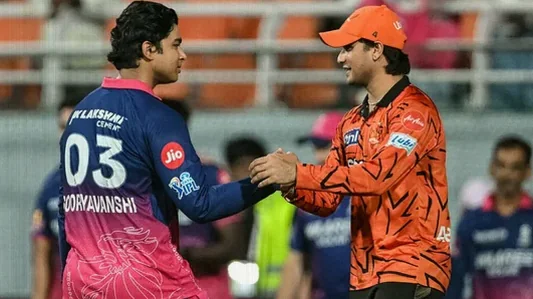
At only 15, Vaibhav Sooryavanshi has moved beyond being labelled an IPL breakout curiosity or a fresh Rajasthan Royals buzzword. The wonder began last year, when his 35-ball century hinted he wasn’t a one-season novelty. Now, IPL 2026 has positioned him as a genuine India option—possibly one the selectors can’t keep waiting on. After his display in the Eliminator against Sunrisers Hyderabad on Wednesday, the BCCI’s stance toward him is unlikely to remain “development first”.
Key takeaways
- Sooryavanshi has amassed 680 runs in 15 IPL innings in IPL 2026, striking at nearly 243.
- He smashed a record haul of 65 sixes in a single IPL season.
- In the Eliminator versus Sunrisers Hyderabad, he struck 97 off 29 balls, including 12 maximums.
- His innings against top-class pace—Jasprit Bumrah, Josh Hazlewood, Pat Cummins and Bhuvneshwar Kumar—has shown no visible nerves.
- Ajit Agarkar indicated discussions were already held on him, with the plan to keep monitoring him through India A.
Eliminator masterclass: taking apart every plan
The impact of the Mullanpur performance stood out for a simple reason: it didn’t read like a teenager riding pure instinct. Sunrisers Hyderabad had clearly worked on him before the game, with Cummins admitting they had multiple contingency plans—Plan B and Plan C—to counter his strengths. Yet Sooryavanshi, playing his first IPL playoff match amid rising chatter about a potential India debut, refused to buckle.
He disregarded the adjustments made by the bowling side—field reshapes, the slower deliveries, and the tactical “mind games” that typically disrupt batters at the crease. Everything collapsed under his timing and control, as he ripped through the entire approach in just 29 balls. His 97 came with five boundaries as well, meaning a staggering 92 of those runs were generated through boundaries alone.
Why IPL 2026 has changed the narrative around him
While the six-hitting and the record numbers dominate headlines, the bigger shift has been the maturity. Before IPL 2026 began, there were doubts and warnings about a possible “second-season syndrome”—the question being whether he could handle the pressure once opponents learned his patterns. Instead, Sooryavanshi has raised his level to a degree that makes him look almost untouchable in the format.
Even the conversation around him has transformed. Every innings now draws national attention, and every six seems to swing momentum and trend instantly. Earlier in the tournament, his fielding was questioned by voices such as Sanjay Manjrekar and Mohammed Kaif, and those doubts also spilled into whether he fit the wider India narrative. Yet he has remained remarkably composed throughout—whether that was sitting alone near the pitch before the Eliminator with his eyes shut, mentally mapping his plan, or speaking calmly after missing out on a century in a knock of 97.
That steadiness at such a young age has underlined why the next chapter should be different. The selectors have already placed him in the India A setup for an upcoming one-day tri-series in Sri Lanka that includes Afghanistan. For a player of his age, that step signals that he is no longer being treated as a distant prospect—he has firmly entered the senior-team conversation.
Ajit Agarkar later acknowledged that there had been discussions around him before the decision was made to keep him under observation for a little longer at the India A level. That caution makes sense, but IPL 2026 has also made one thing increasingly hard to ignore: this is not a talent India can afford to delay indefinitely in developmental pathways.
What comes next for India: timing and the England window
The immediate Ireland T20Is could arrive too soon, given scheduling and travel constraints connected to his India A assignment. However, the five-match T20I series in England in July feels like a stronger opening point. If India want to keep building around their highly aggressive T20 blueprint, Sooryavanshi appears to fit it naturally.
It’s easy to visualise the top-order shape: Abhishek Sharma and Sooryavanshi as openers, with Ishan Kishan at No. 3. That trio is built for fearless tempo and attacking intent—exactly the direction modern T20 cricket continues to move toward.
Earlier in the season, many expected Sooryavanshi might still have to wait behind Yashasvi Jaiswal and Sanju Samson in India’s T20I queue. Samson, after all, had been India’s Player of the Tournament in the T20 World Cup after stepping in from the bench. But the Mullanpur innings is likely to shift that hierarchy quickly. It signalled to selectors that the existing pecking order may need recalibration, and that Sooryavanshi’s place could come sooner than anyone initially expected.
Because his profile is unlike anything India has seen at 15. He isn’t only gifted—he already understands pressure, expectation, and tactical adaptation at a level that feels far beyond his age. Some players are meant to move slowly through the system. Others force the system to accelerate for them. Vaibhav Sooryavanshi belongs firmly to that second category.
