
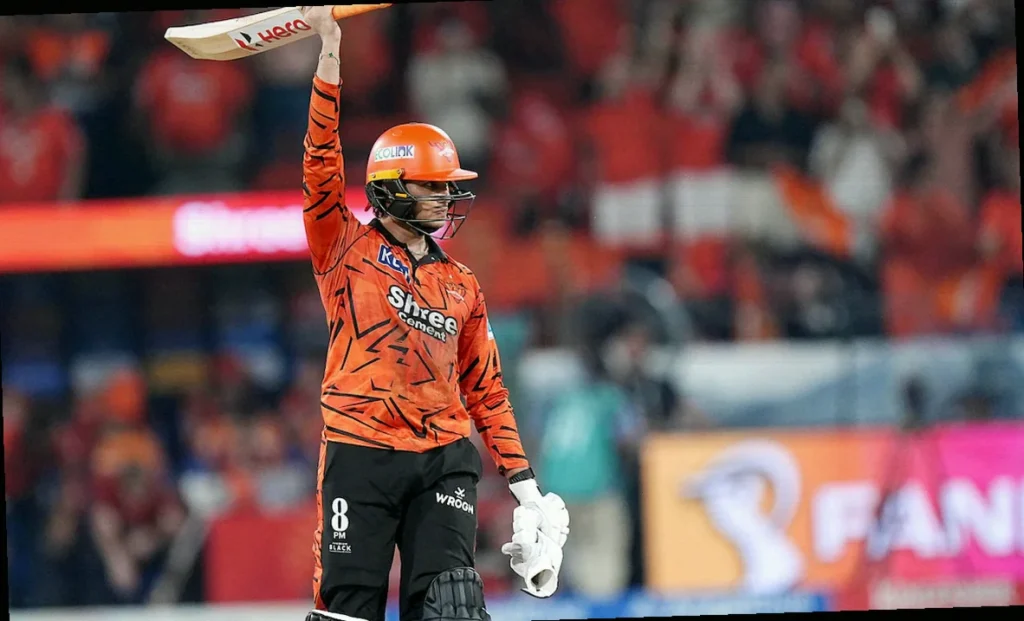
Sunrisers Hyderabad bowling coach Varun Aaron dismissed the idea that Abhishek Sharma’s recent struggles reflected any lack of temperament, insisting the young batter has shown the kind of maturity required to succeed at the top level. Aaron highlighted Abhishek’s performance in Hyderabad, where the opener delivered an unbeaten 135 off 68 balls to steer SRH to a commanding 47-run win over Delhi Capitals on Tuesday. Batting from the first ball to the last, Abhishek powered through a full range of shots, giving the side a fourth victory in seven matches this season.
Aaron’s praise carried extra weight given Abhishek’s difficult opening phase earlier this year at the T20 World Cup, which was co-hosted by India and Sri Lanka. After a disastrous start, the batter found form at the business end and played his part as India went on to lift the trophy. Aaron said that development has not been a one-off, and that the same mindset has continued into the IPL.
“I think he’s always had that maturity and that’s been there over the last couple of years. You can’t be the number one T20 batsman in the world without being mature. Obviously, he’s somebody who sees the opposition, sees the surface and decides to play a certain way,” Aaron said during the post-match interaction.
Aaron added that Abhishek’s approach in the match demonstrated a sharp understanding of the game. He pointed to how the left-hander managed risk carefully in the early phase before accelerating decisively, taking control once the bowling began to settle. “Today (Tuesday), it wasn’t the surface where you could just go hell for leather every single ball. So you have to respect the opponent, you have to respect the surface and he (Abhishek) did exactly that,” Aaron explained.
He further noted that the nature of T20 cricket means high-risk, high-reward methods don’t always come off, and players must be allowed room to find their rhythm. “And I think he’s shown glimpses of this in the past but obviously when you play a high risk, high reward kind of a game, sometimes it doesn’t work out and you have to give a player like Abhishek that leeway,” Aaron added.
While SRH’s batting set up the contest—targeting Delhi Capitals with a total of 243—the chase was disrupted by Eshan Malinga. The Sri Lankan right-arm fast bowler struck at the right moments, finishing with remarkable figures of 4 for 32. Another important contribution came from young pacer Sakib Hussain, who kept the batters under pressure and also managed to claim a wicket.
Aaron said the impact of both bowlers came from their variations and their ability to stay incisive. He singled out Malinga’s skill in reversing the ball, noting that the reverse swing was visible from around the 11th or 12th over, which becomes particularly difficult for batters because the white ball makes it hard to judge the shininess. Aaron also credited Malinga with executing yorkers effectively, mixing in a sharp slow-ball option, and delivering pace in the 140-plus range—sometimes approaching 145. “And with Sakib, that slow ball is just brilliant. He’s almost getting as much turn as an off spin on the slow ball, same arm speed, executes his yorkers, can ball 140 plus as well,” Aaron said.
Looking beyond the match, Aaron said SRH had planned ahead of the IPL season to build bowling options that can challenge batters regardless of what surface is presented. “So with the way the game is headed and with the way IPL is going, you have to have that pace variance where you can go from 140-145 down to almost 107 because Sakib’s one of his slow balls, 107,” he remarked.
He explained that such adaptability helps captains make decisions based on the game situation rather than relying heavily on pitch conditions. “Going into this year, one of our plans were to have bowlers who can offer something to the captain irrespective of the surface. So, if you talk about Sakib and Malinga, they almost remove the surface from the equation with their skills. That stood out for me and for everybody,” Aaron added.
Aaron also spoke highly about Sakib Hussain, describing what stands out as the pace and the variety he brings. He stressed that in the IPL, even a bowler who clocks around 140 kmph can be punished if the attack lacks different looks, but Sakib’s mix has provided the edge. “It’s again that variance. I’ve seen Shakib for almost two years. He always had the pace, very quick arm action, very awkward. So as a batsman, especially at the Rajeev Gandhi Stadium, on our wicket, if you have a beautiful action and you bowl 140 plus, you’re just going to get lined up,” Aaron said.
He pointed again to the slow ball as a key weapon, explaining that Sakib’s work has helped sharpen the skillset even without a long-term coaching pipeline. Aaron said the teenager had put in effort over the previous months, with camps arranged specifically for him. “He didn’t have the access to getting coached long term and he’s put in a lot of work over the last couple of months. We’ve had camps for him specifically. He’s flown down to Bombay for five days, then we’ve called him to Chennai,” Aaron said.
Aaron added that since Sakib was picked up following the IPL 2026 auction, the young pacer has responded well to the training demands. “There has been a lot of work which has gone behind the scenes immediately after the auction and he’s responded really well and he has that will, he has that hunger,” he stated.
Wrapping up his assessment, Aaron emphasised that talent alone is not enough in T20 cricket, and the crucial ingredient is drive. “That’s the most important thing and obviously you might have the best skills in the world but if you don’t have the will and don’t have the hunger, it’s not going to work out,” he concluded.
