
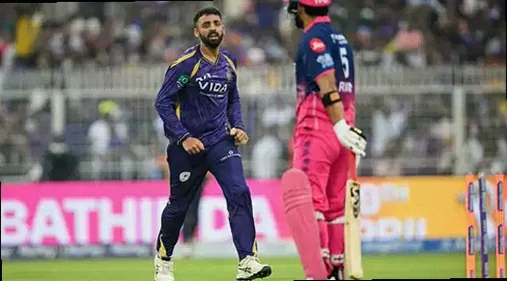
KKR spinner Varun Chakaravarthy said the emotions inside the dressing room after the franchise finally got their first victory of IPL 2026 came through clearly, describing “a lot of tears” that were absent when they lifted the title in 2024. The four-wicket triumph—something he labelled “very very significant”—arrived after a long wait and reflected how, at Eden Gardens, key pieces began to click for Kolkata.
First IPL win of the season brings relief for KKR
Chakaravarthy, who has had to work through a tough stretch that started around the T20 World Cup, credited the result to a rare alignment of conditions and execution. He also pointed out that the Eden Gardens surface offered a different look towards the back end of a long campaign, with the square showing signs of slowing down.
- KKR earned their opening win of the season in their seventh attempt.
- Chakaravarthy described the victory as “very very significant.”
- He said the team’s dressing room reactions included “a lot of tears,” unlike the year they won the IPL in 2024.
- He linked the improved match feel to the pitch beginning to slow down late in the season.
Injury setbacks and recovery shaping Chakaravarthy’s spell
The performance also came after Chakaravarthy overcame physical issues in the run-up to the match. He revealed that he had sufficiently recovered from two finger fractures on his non-bowling hand, but admitted the timeline of injuries affected his ability to field earlier.
“Unfortunately, before the first match itself, I fractured one of my fingers and in another match, I fractured another finger,” Chakaravarthy said. “Yeah, left hand, two fractures. So, I couldn’t use my left hand itself. So, fielding, it was totally out of the question. I am trying to manage but it is still a little painful.”
He added that the Kolkata track generally becomes slower as matches progress. “Generally, it starts getting a bit slower,” he said, explaining why he felt the wicket played like a 180–190 surface on the day. “I am not saying it slows down so much but today, I felt it was a 180-190 wicket.”
- Chakaravarthy had two fractures on his left (non-bowling) hand—one before the first match and another in a subsequent game.
- The injuries prevented him from fielding earlier, though he said he was still managing pain.
- He suggested the Eden Gardens wicket was playing in the 180–190 range, and both sides struggled with batting.
Player of the Match impact: 3/14 and the turning phase
Chakaravarthy returned figures of 3 for 14 in his four overs and was named Player of the Match for the impact he made when the game needed it most. He also cautioned against reading too much into one outing, pointing to how T20 matches swing depending on what the pitch offers.
“Look, just because I have taken three wickets today, I don’t want to make a sweeping statement and all,” he said. “That’s the nature of the game. Next match, if the wicket has nothing in it, that’s going to happen to every spinner. As you can see, initially, every spinner was travelling. So, that’s how it is. Once the pitches start slowing down, that’s how we start coming into the game and we start being more effective. So, it’s the nature of the game and we can’t change it. So, I don’t think much about that.”
Chakaravarthy’s spell began to change the complexion of the contest when he came on in the ninth over. At that stage, Rajasthan were cruising at 79 for 0. He struck quickly—using just four deliveries to make the breakthrough—first removing Vaibhav Sooryavanshi to register his 200th T20 wicket. He then forced Dhruv Jurel into a stumping and followed up by bowling captain Riyan Parag in an uninterrupted four-over stint that he said ultimately shifted the momentum.
- Player of the Match for 3/14 in four overs.
- He entered in the ninth over with Rajasthan at 79 for 0.
- He took three wickets within a short spell: Vaibhav Sooryavanshi (fourth ball), Dhruv Jurel (stumped), and Riyan Parag (bowled).
- The wickets included his 200th T20 dismissal.
Adjusting lines, not changing pace or length
When asked what changed in his bowling, Chakaravarthy insisted he did not alter his pace or length. Instead, he said he adjusted the line of attack to create more pressure.
“I didn’t change my length or my speed,” he said. “I am just changing the line of attack a little. So, more cramping lines, as in, not in the fourth stump line, wide of off, legside wide. I am working on all the lines right now, I am not just sticking to stumps.”
Still, he maintained that he would lean into his core strengths when the pitch supported it. “Once there is something in the pitch, I go back to my strength. My strength is to keep attacking the stumps,” he said. “But if there is nothing in the pitch, that’s when bowlers start searching, they start getting confused, they are clueless, which happens to everyone. It has happened to the best of the best. So, no one can be judged with just one match of good performance and bad performance also.”
He added that he is especially demanding on himself after games. “I am very tough on myself. If I don’t do well, I go and pinpoint what is not there and all those things,” Chakaravarthy said. “But because the pitches were such that there was nothing for the spinners. If you see other spinners also, it was the same condition for everyone. So, yeah, it’s nice that there is something for the spinners now and hopefully there is more for the spinners.”
KKR’s season context: injuries, scrutiny, and building back
Chakaravarthy also addressed KKR’s difficult start to the tournament, highlighting how early injuries disrupted their planning. He felt the noise outside the bubble affected players, and he acknowledged that the support staff and management have faced pressure not only over results but also over their auction approach.
“We have not been winning and there are many outside noise which comes and which affects the players. But finally, we turned out in the better side today. We won the match,” he said.
He then pointed to the injury toll that hit before the tournament even fully began. “Yes, there are many places to improve, for sure. Because we started this tournament with many, as in many injuries and it actually crippled us before even the tournament started,” Chakaravarthy said. He singled out the coaching setup, including head coach Abhishek Nayar.
“So, I would like to give credit to the coaches, the head coach also, Abhishek Nayar,” Chakaravarthy added. “If you’re taking up a team in such a condition, you have a lot of work to do and you need a lot of courage for that. So, he has taken up the team from a very tough situation. So, it’s going to take some time for build up. And I think slowly, slowly, step by step, baby step, one win here, one win there, we will be back on track.”
- He cited early injuries as a major reason KKR struggled even before the tournament fully got underway.
- He said external criticism and “outside noise” can affect players while results are not coming.
- He credited the coaching group and specifically head coach Abhishek Nayar for taking charge in a difficult situation.
- He framed the season recovery as gradual: “slowly, slowly… baby step,” building from one win to the next.
