
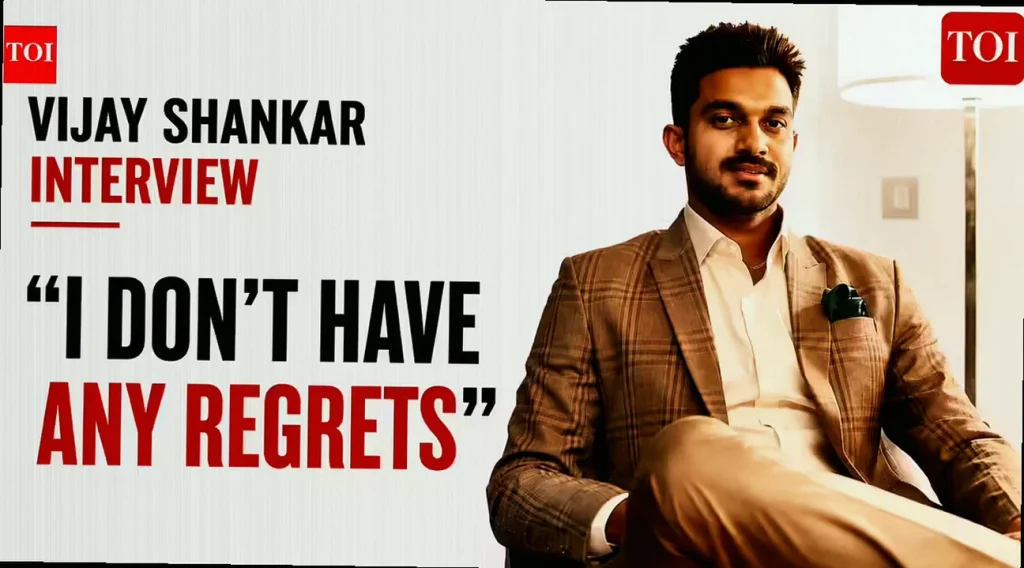
For years, Vijay Shankar has been a name that drew plenty of conversation in Indian cricket—often for the wrong reasons. During the 2019 World Cup, he was branded a “3D player,” a label that quickly became a talking point rather than a fair assessment of a developing all-rounder. Injuries only added to the noise, with criticism and close scrutiny following him through major parts of his career. Yet as the Tamil Nadu all-rounder steps away from Indian domestic cricket and the IPL, the tone in his voice is notably calm. There is no bitterness—only acceptance, gratitude, and a quiet pride in a journey that carried him to the India jersey, delivered tournament successes with Tamil Nadu, and kept him in the IPL spotlight for a long stretch across multiple franchises.
In an exclusive conversation with TimesofIndia.com after announcing his retirement, Shankar looked back at the emotional weight of his decision, the physical setbacks that shaped his path, the reality of handling public criticism, and why he still wants to keep playing in overseas leagues. He also spoke about the role of all-rounders in modern cricket, the impact of evolving tournament rules, and shared his views on younger talent making waves.
Emotions behind the retirement call
Asked what his first feeling was when he posted his retirement note, Shankar said the moment was strange in its own way. The decision, he explained, was something that had been building for a long time, and then suddenly realizing it was reaching an end felt “odd.” While he described it as emotional, he also emphasized that at some stage in a career, you simply have to make the call.
He traced the decision to the last stretch of his Ranji Trophy days. In those final years, he had still been producing good performances and putting together solid seasons, but he felt his motivation was tightly linked to reaching the highest level. Across his career, he admitted he never got the chance to play in the Duleep Trophy, even once. The IPL also remained a major motivation, but when he wasn’t picked this year, it sharpened the sense that the domestic dream he had chased was already giving him what it could. He added that he had delivered a good Ranji season too, which made the choice feel both logical and personal.
Shankar also reflected on how he batted and how that experience helped him stay effective. Throughout his career, he said he played across the batting order—moving up and down and adjusting to different roles—yet still managed to post meaningful numbers. His mindset, he stressed, was always centered on contributing his best to the team rather than chasing a specific personal lane.
Domestic cricket, leadership, and the all-rounder’s rhythm
On how domestic cricket, particularly his long stint with Tamil Nadu, shaped him, Shankar was emphatic about its value. For him, it offered repeated exposure to quality bowling and the chance to compete against high-calibre players, which he believes is the best environment for developing talent for the Indian team.
As captain, he won three trophies for Tamil Nadu—the Vijay Hazare Trophy, the Syed Mushtaq Ali Trophy, and the Deodhar Trophy. When asked whether his leadership style changed across those different formats, he returned to a simple principle: he had to do his job first. He said he aimed to stay ready to meet whatever the team required at that particular moment, regardless of individual targets. In his view, he had always prioritized what the side needed over personal milestones, adding that focusing purely on individual numbers might have produced a different kind of career record. Instead, he wanted to do well for the team.
He also felt captaincy brought out the best version of him. Shankar described it as a responsibility that forces you to step forward when situations become difficult, support players through conversations, and offer comfort and confidence when it matters. That, he said, was special.
With his all-round role and captaincy responsibilities overlapping, he was asked how hard it was to bat, bowl, field, and lead. His answer was that he enjoyed it. As an all-rounder, he said, you remain connected to the game throughout—unlike a specialist who bats and then waits in the field. That constant involvement, he added, suited him and he genuinely liked it.
When captaincy came into play, the key for him was understanding when to use his skills. Sometimes, he explained, you can’t overdo it; other times, you might bowl too much or end up adjusting your batting placement too late. Knowing how to read those moments was essential, and he believed it helped him perform to his best.
He entered the Indian team as an all-rounder, and the discussion then moved to the challenges of early international cricket—particularly with Hardik Pandya also in the setup. Shankar’s response was grounded: wherever he played and whatever role he received, he had to be prepared. Even in the national side, he said he batted in different positions, bowled when needed, and delivered when the team required it. He made it clear that his preparation always included being ready for matches where he might not bowl every time.
Shankar was also asked whether he ever wondered how his career might have looked without injuries, especially during the years from around 25 to 31 or 32. He said he had dealt with several injuries, particularly in that period. While he has thought about what could have been different, he believes it is extremely hard to change the past. For him, every setback is part of a bigger journey, and he feels he learned from each phase of his career. He insisted he has no regrets and is proud of the way he played his cricket, adding that the game taught him about leadership in life as well—something he remains thankful for.
Turning to the IPL itself, Shankar said he played for four franchises—DC, SRH, CSK, and GT—and under different captains. When asked which environment allowed him to play his most natural cricket, he said it was a difficult question because each phase and each team differed, and the experiences were not identical. Still, he acknowledged the importance of learning in every setup.
He won two IPL titles with Sunrisers Hyderabad and one with Gujarat Titans, and he didn’t want to rank one triumph above the others. Instead, he said he learned from all three franchises. He noted that even within those title-winning sides, his batting position kept shifting, but he found ways to succeed in whatever role came his way. He pointed out that if people looked at his overall IPL numbers, his average might sit around the mid-20s with a strike rate roughly near 130. However, he said what many don’t always recognize is how many distinct batting positions he covered across his career.
He offered a specific example from his final season with CSK: in five matches, he batted at No. 4, 5, 6, and 7—meaning he experienced four different spots in just five games. A similar pattern existed with Gujarat too. Whatever the match context—condition, situation, or required tempo—his job was to come in and do the best he could.
When asked for a standout moment from his IPL journey, Shankar again returned to winning silverware. For him, lifting the trophy was “very, very special,” both with Gujarat and with Sunrisers Hyderabad. He added that even though he didn’t play a single match for SRH initially, he remembers fielding as a substitute in roughly 13 or 14 of the 17 matches he was involved in. He described those early opportunities as a chance to make an impact through catching and fielding, and he believes that helped him earn an earlier chance, ultimately leading to his debut for the franchise.
Shankar was also asked about the “3D player” tag from the 2019 World Cup period and whether it still sticks. He said the world is small, so it will follow him. He admitted he isn’t sure whether it will be interpreted positively or negatively. Early on, he tried to protect himself by avoiding social media and learning to ignore certain commentary, but he later learned that you simply have to live with it. People, he said, have opinions, and cricketers must keep fighting across a long 10- to 15-year career span. The next day always comes, so the answer is to train hard and prepare for the next phase—moving past whatever happens in between.
He then addressed the shifting demand for all-rounders. With the Impact Player rule in the IPL, teams often lean toward specialist batters and bowlers, and Shankar was asked whether that has reduced the need for all-rounders. He disagreed, saying the situation can be viewed in two ways. One argument is that the rule changes how roles are used. But from another perspective—especially if a player wants to represent the country and reach the top—an individual must keep finding ways to become the best batter and the best bowler possible. In his view, that is the right way to look at it.
Shankar emphasized that the IPL remains a major platform: if you perform, you get noticed and can move to the next level, and even one or two good games can bring confidence. But the work doesn’t stop there; you return to domestic cricket and keep grinding. He stressed continuous development with both bat and ball and warned against settling for excuses—either you keep improving in both disciplines, or you fall behind.
Asked about Vaibhav Sooryavanshi, the young batter who is already drawing attention at the age of 15, Shankar sounded impressed. He called the talent unbelievable, praising the way Sooryavanshi bats as phenomenal and inspiring because it challenges the idea that age is a barrier. Shankar noted that in India, people often assume careers are nearing the end once players hit 30, 31, or 32, while in other countries experience is treated as a bigger asset at that stage. He believes India’s talent depth creates tough competition, which makes consistent output even more remarkable.
He said Sooryavanshi is not just producing occasional flashes—he has been consistently performing in a substantial share of matches, which is exceptional for someone so young. Shankar also highlighted the quality of opposition, pointing out that Sooryavanshi is doing it against top bowlers. He even mentioned the kind of damage a batter can create when they can clear the ropes early, citing names such as Jasprit Bumrah, Bhuvneshwar Kumar, and Josh Hazlewood. Shankar finished by wishing the youngster well and hoping the momentum continues.
What comes next and a message to fans
In his retirement note, Shankar said he wanted new opportunities and to continue playing cricket. He explained that if he gets chances to participate in overseas leagues, he would like to explore them. He believes those opportunities would be valuable because he is still playing good cricket in Chennai and had a solid domestic season last year. For him, the goal remains to become a better cricketer—learning, improving, and continuing that process day by day. Even after he eventually stops playing completely, he said he would still want to keep learning, whether in coaching or another role.
When asked about the possibility of coaching, commentary, mentoring, or franchise management, he was clear that coaching appeals most. He said he loves it and expects to move into it a few years down the line.
Before closing, he offered a direct message to his supporters. Shankar thanked his fans for staying with him throughout his career. He reiterated that he has faced plenty of hate and criticism, but he also credited the wonderful fans who supported him genuinely. He ended by saying he will keep playing cricket because it is his life.
