
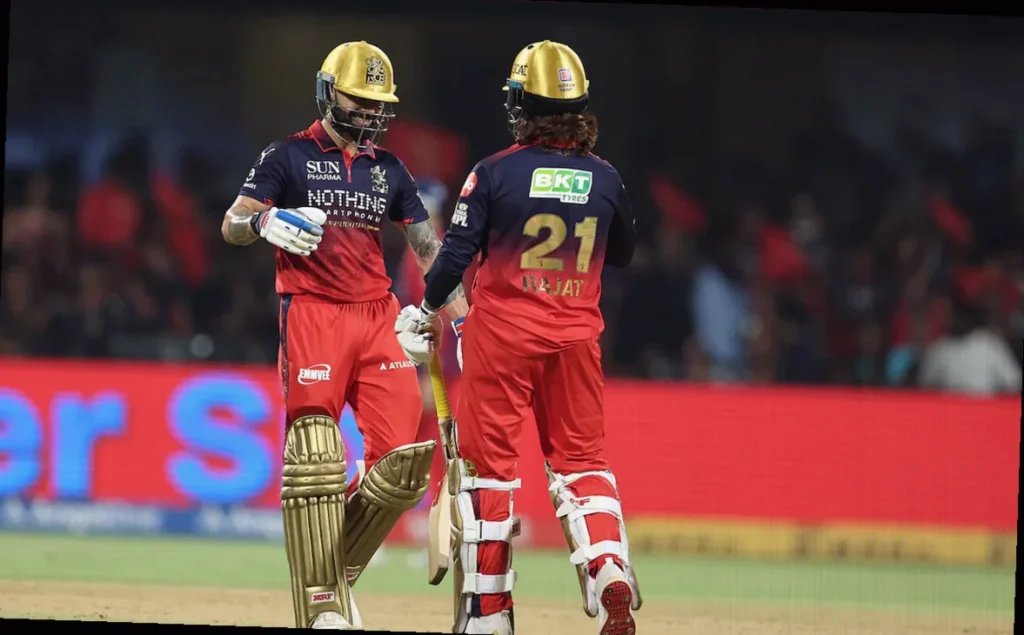
Royal Challengers Bengaluru’s batting order looks built to overwhelm opponents from the very first ball. At the top, Virat Kohli leads the charge alongside Phil Salt and Devdutt Padikkal, while the middle overs are loaded with big-hitting firepower through Rajat Patidar, Jitesh Sharma, Tim David and Romario Shepherd. The way RCB have structured their lineup means the pressure rarely stays in one place for long—once one phase ends, another one begins immediately, often with hitters entering at the exact moment a bowling unit thinks it has gained control.
Among the group, Patidar’s transformation has stood out this season. The RCB captain currently sits third on the run-scoring chart for IPL 2026. In his first five appearances, he has amassed 222 runs at a staggering strike rate of 213.46, a return that reflects both his intent and his ability to accelerate precisely when the match situation calls for it. That form was in the spotlight after RCB secured a five-wicket victory over Lucknow Super Giants while chasing a target of 147 at Bengaluru on Wednesday, and Kohli was asked to assess what makes Patidar’s approach so effective.
Kohli’s praise went beyond raw numbers. He described Patidar’s role as a key part of the team’s internal targets—explaining that the batter’s job is to read the moment and respond accordingly. “We have our KPIs as a batting unit, and it says Rajat has to go in and assess the situation,” Kohli said. He then added that the assessment isn’t only about the score or the conditions, but also about understanding the bowler’s rhythms—going as far as suggesting Patidar is effectively looking at the bowler’s heart rate rather than just the scoreboard. Kohli called the clarity behind that mindset “incredible.”
The captain also credited RCB’s planning at a broader level, arguing that the management’s team balance allows them to play a specific brand of cricket. In his view, the batting plan is designed so that different players can take responsibility in sequence rather than trying to force the same role from everyone. “Also, the way our management has stacked up our team allows us to play in a certain way,” Kohli said. “I have to adapt my role accordingly. It allows me to play a certain way up front with Salty.” He noted that the baton gets passed smoothly within the squad, which helps keep the momentum even when innings conditions change.
Kohli further highlighted the advantage of depth and freedom—pointing out the presence of hitters like Romario and Tim, and stressing that Romario and Tim can come in with the game already trending toward a chase-or-defend scenario. He mentioned that Jitesh Sharma—referred to as “KP” in the conversation—hasn’t even batted in any of the team’s matches yet, emphasizing how much batting impact RCB are still carrying as an option. Kohli’s message was that this isn’t merely a lineup with talent; it’s a batting group that is explosive by design. “It looks pretty intimidating if I were in the opposition as well,” he said, explaining how the threat remains even when the team loses wickets. He added that even when RCB are five down, Romario and Tim can still walk in and potentially swing the game quickly—capable, in Kohli’s words, of producing around 50 runs in four overs—giving everyone else more room to play their shots without overthinking the situation.
RCB’s mindset: not every match will be a 230-plus chase
While RCB’s batting strength is obvious, Kohli cautioned that the team’s approach can’t be one-size-fits-all. He acknowledged that not every contest will produce a 230 or 240 kind of scoreboard, and emphasized that adaptability is the real challenge as the tournament moves forward. “Well, it depends on the situation and the conditions as well. Not all games are going to be 230 or 240,” Kohli said. He added that the league has evolved, with modern cricket demanding different decisions and execution, but he insisted that teams must still keep a close watch on match conditions and how players respond under pressure.
Kohli also suggested that the pressure will rise as the tournament progresses. With RCB still in the first half of IPL 2026, he said the dynamics will change from the second half onwards, when matches become tighter and every mistake is punished more quickly. In that phase, he argued, it’s not just about having power in the batting order—it’s about applying cricketing intelligence when momentum shifts and when the freedom to attack disappears. “Teams that can apply that and adapt according to the conditions and the situation are the ones that will go a long way,” Kohli said.
As for his own development within the team’s evolving roles, Kohli suggested he is still refining his adaptation. He said the early stretch has not always looked like his best cricket—pointing to the last two games in particular—but maintained that his focus remains on raising his standard. “But yeah, the game has certainly changed,” he said. “As I said, I’m trying my best. I think I’ve done okay so far in adapting. Early on—the last two games—I haven’t been at my best, but I’m always looking to push the bar.”
