
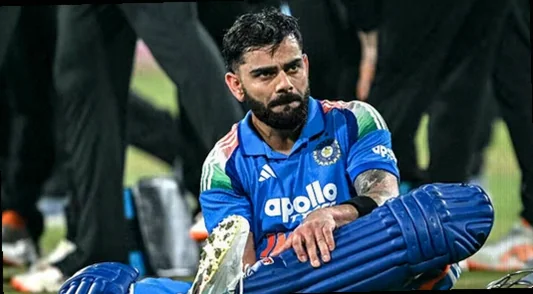
Just over a year after Virat Kohli stepped away from Test cricket, he has become a one-format international—an era shift that feels even sharper given how frequently the traditional 50-over game is played today compared to the years before the 20-over revolution took over. Yet the 50-over World Cup still sits at the top of cricket’s prize list, edging past the World Test Championship trophy and even the T20 World Cup in terms of sheer prestige and pull. For Kohli, that tournament remains the clearest north star.
In modern ODI cricket, Kohli has long been treated as the central figure, particularly in the way he hunts down totals with composure and precision. While he still has fewer runs than Sachin Tendulkar—the benchmark of the one-day era—Kohli’s numbers tell their own story in the format. During India’s home World Cup in 2023, he moved beyond Tendulkar’s long-held mark of 49 ODI centuries, finishing with 54 hundreds from 14,797 runs. His ODI average stands at 58.71, and his strike rate is 93.82, underlining both consistency and impact. Put simply, he has developed a reputation as the sport’s most dependable chase specialist, repeatedly turning pressure into momentum.
As IPL 2026 unfolds, it is easy to wonder why Kohli moved to conclude his T20I career so quickly, right after winning the Player of the Final award in the 2024 T20 World Cup. This season, he has already produced 542 runs in 13 innings, striking at 164.74. Among the leading five run-scorers, only KL Rahul has gone past him in strike rate—Rahul’s tally reads 533 runs at 171.93. And on Sunday, Kohli reached a major milestone as Royal Challengers Bengaluru beat Punjab Kings comfortably, becoming the first team to lock in a playoff spot this campaign. The win also marked Kohli’s record-extending ninth time reaching 500-plus runs in an IPL season.
Even as time passes and the sheer volume of elite cricket keeps rising, Kohli’s intensity has not dulled. He keeps moving with urgency, chasing every ball as if it still carries life-or-death weight, and running between the wickets with the same commitment that made him so feared in the early years. His passion is visible, and his competitive instincts remain sharp despite the grind. For younger players and anyone studying what it takes to stay elite, Kohli’s example is hard to ignore: professionalism as a habit, discipline as a default setting, and an unshakable desire to deliver the best version of himself each time he steps on the field.
At the age of 37, it is hard to miss what fuels him. The next 50-over World Cup in the Africas is still roughly 17 months away, but it is clearly in his mind. In a no-holds-barred conversation inside an RCB podcast, Kohli also offered a pointed, almost indirect answer to the question of why he continues to play instead of stepping back—especially when he could enjoy deserved family time and the comfort that comes with recognition. His message was that he plays only when he feels he can add value to the environment around him, and that he will not adjust his mindset to suit demands that ask him to prove something he believes should speak for itself.
Speaking with clarity and conviction, Kohli laid out his approach in plain terms. “My perspective is very clear. If I can add value to the environment that I am a part of and the environment feels like I can add value, I will be seen. If I am made to feel like I need to prove my worth and my value, I'm not in that space. Because I am being honest to my preparation.”
He continued: “I am being honest to how I approach the game. I put my head down. I work hard. I am very thankful to God for giving me everything that I have been given in my cricketing career. And I feel very blessed and grateful for the opportunity. And when I arrive to play, I put my head down.”
Kohli’s edge: preparation, proof, and the World Cup frame
It is not often that Kohli feels the need to spell out his mindset—his record is visible, and his commitment has been treated as a benchmark for years. Still, the comments carried a distinct undertone, suggesting there is something that continues to rankle him. Whether it is the ongoing questions about his World Cup involvement, or the outside insistence that he must keep showing that he still “has it,” Kohli did not hide his frustration.
He directly addressed the kind of workload he is willing to accept. “I work as hard, if not harder than anyone else. And I play the game in the right way. You want me to run boundary to boundary for 40 overs in an ODI game? I will do that without a complaint. Because I prepare accordingly.”
Then he explained how he shapes his preparation around the full match demands. “I prepare for the fact that I will field 50 overs, every ball like it's the last ball I'm going to play in my career. And I will bat that way. And I will run between the wickets that way. And I will do everything possible for the team.”
He added the sharp conclusion that made the tone of the message harder to miss: “After operating like this, if I have to be in a place where I have to prove my worth and value, that place is not meant to be for me.”
Depending on how one reads those remarks, they can come across as anger, hurt, defiance, or even a challenge thrown in plain sight. Many in the cricket world suspect Kohli would describe them as “honest,” because integrity has been a constant theme throughout his career. It also did not take long for speculation to begin about whether the comments were aimed at anyone connected to selection decisions or leadership groups. In the days since the podcast was released, discussion has circled around figures such as Gautam Gambhir (head coach), Ajit Agarkar (chief selector), and Shubman Gill (ODI captain)—though the comments themselves left room for interpretation.
Why the Test debate still lingers
Even Kohli’s strongest supporters have acknowledged that his last few years in Test cricket did not meet the standard he once set. Between 21 February 2020 and 5 January 2025—the span that covers his final 123 Tests—Kohli averaged 30.72 across 39 matches. Those numbers dragged his career average down from 54.97 at the end of 2019 to 46.85 at the point he announced his retirement, a drop of nearly eight runs per innings that reflected the struggles he faced. For some observers, there would have been logic—however uncomfortable—to an earlier retirement decision, particularly when the England tour was approaching. Even so, the conversation now is clearly not focused on what might have been.
Instead, Kohli appears unwilling to entertain the “will he, should he” storyline surrounding the next World Cup, which is still more than a year and a half away. He framed his mindset as settled and active, as if he has somehow found a way to keep time from affecting him. “I work out, we eat well at home. It is because I like living that way. It is not only to play cricket. So that is where I am. We are at like mid-‘26. But I’ve been asked so many times, do you want to play ’27 (World Cup)’?” he said.
He answered with the same direct logic: “I know the answer. Like, why would I leave my home, you know, get my stuff over…? Of course, if I'm playing, I want to play cricket. I want to carry on. Playing a World Cup for India is amazing. But as I said, the value has to be two sides.”
For now, the message is straightforward: Kohli’s motivation is not just about continuing to play, but about doing so with purpose—only when the environment and the expectations match the value he believes he brings. And for the team and selectors who hope to build around proven champions, the “other side” will need to recognize that a player who has been there, done it, and is still delivering can be a rare kind of asset.
