
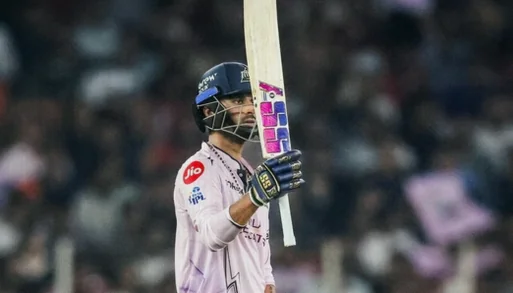
Washington Sundar didn’t walk into the middle of Gujarat Titans’ innings with the side cruising ahead—he arrived when the chase of a stable platform was still uncertain. Against Sunrisers Hyderabad, GT were 68/3 around the halfway point, having lost early momentum inside the opening overs while SRH’s powerplay control remained intact. Sai Sudharsan had steadied the innings, but Sundar was the one who truly released the pressure and reshaped the innings. His knock of 50 off 33 balls lifted Gujarat to 168, and that score looked far more imposing once Kagiso Rabada, Mohammed Siraj and Jason Holder struck in sequence to dismantle SRH’s pursuit.
Sundar’s innings mattered most because of the situation he inherited. GT had already lost Shubman Gill and Jos Buttler within the first six overs, and Nishant Sindhu also fell before the batting unit could properly settle. At that stage, the requirement wasn’t simply to score—it was to withstand the pressure long enough for the innings to keep room for acceleration, rather than letting SRH squeeze the batting into the 140–150 band. Sundar entered precisely that phase and provided the bridge GT needed.
His fifty arrived at a strike rate of 151.51, supported by seven boundaries and one six. The key wasn’t only the pace of scoring, but how he distributed his work. He didn’t consume deliveries and then leave the late surge for someone else; instead, he carried the innings forward himself. In the middle overs, Sundar struck at a steady rhythm, making 24 off 21 balls, a contribution that prevented further collapse. Then, in the final phase, he accelerated with 26 off 12 balls to push the total into defendable territory.
The impact of that innings showed up clearly in the monetary framework used for the analysis. Sundar’s match performance was valued at INR 2.72 crore, while his charged match cost was only INR 0.23 crore. That gap produced a profit of INR 2.49 crore, the largest figure recorded by any player in the game. It was a rare kind of dominance—big return against a comparatively small cost.
Kagiso Rabada delivered the strongest overall impact score in the model, helped by a three-wicket spell that swung the match’s momentum in the chase. Shubman Gill, meanwhile, topped the total match worth at INR 3.65 crore, with a large portion of that figure coming through captaincy value. Even so, Sundar finished as the biggest profit generator because his value-to-cost difference was the most pronounced. Sai Sudharsan produced a higher player-performance worth than Sundar in pure performance terms—INR 3.07 crore against a match cost of INR 0.61 crore—yet his profit came to INR 2.47 crore. Sundar’s cost base was lower, and that subtle structural advantage placed him marginally ahead of Sudharsan. The amount separating them was small, but the meaning was substantial: Sundar turned his contribution into the sharpest return for the price.
In simple arithmetic, Sundar generated INR 2.49 crore profit from an INR 0.23 crore match cost, which the model translates into an estimated 10.8x profit multiple on the charged cost for this game. His total return of INR 2.72 crore came to nearly 11.8 times his match cost. That ratio—more than the raw value alone—is what made the financial story of the match stand out.
The innings also changed GT’s cricketing value, not just their scoreboard. At the halfway point of the game, 168 didn’t look like a crushing total. The chase only became severely uncomfortable after SRH collapsed to 86. Still, Sundar’s contribution gave GT the extra cushion they needed to attack without chasing the scoreboard every ball. A target in the mid-140s would have forced a different chase structure; 168 asked SRH to take risks on a surface where clean strokeplay was already uncertain. Rabada and Holder then converted the pressure created by that required intent into wickets, tightening the noose after SRH’s early rhythm broke.
Sundar’s value sits exactly in that pre-collapse window. He didn’t just add runs to the innings; he altered the minimum total GT could defend. By pushing strongly late, he ensured SRH weren’t chasing a number that allowed calm, measured play—they were chasing a figure that required purpose from the outset. Once early wickets fell, the required rate and the scoreboard pressure grew together, making the chase increasingly difficult.
The model essentially rewarded the same blend that made the innings successful in match terms: recovery when the innings needed repair, acceleration when the platform could be converted, and a finish that delivered a defendable final score. It also avoided a common T20 pattern where a stabilising innings turns into a drag. Sundar repaired GT’s innings first, then paid it off at the death.
When it came to the best financial returns across the match, the middle order and the key finishing contributions stood out. Gill’s total worth was highest overall at INR 3.65 crore, but INR 3.60 crore of that was driven by captaincy value. Rabada produced INR 2.52 crore in match value and INR 1.75 crore in profit. Jason Holder delivered INR 2.50 crore in value and INR 1.62 crore in profit. Sudharsan generated INR 3.07 crore in revenue and INR 2.47 crore in profit. Sundar, however, topped the profit table because he combined a high-impact batting performance with an exceptionally low match cost, making him the cleanest financial winner from GT’s 82-run triumph.
Different players owned different columns—Rabada had the impact side, Gill had the total-worth column through leadership contribution, and Sundar had the return-on-cost angle. Yet Sundar’s lead was the sharpest because his story is built on one clear equation: INR 0.23 crore cost, INR 2.72 crore value, and INR 2.49 crore profit.
Method note
The monetary value is based on the match-specific rating-adjusted model output for GT vs SRH, Match 56. Player match worth includes the model’s converted performance value. Profit is calculated as the rating-adjusted total match worth minus the charged match cost. For Washington Sundar, the computation is INR 2.72 crore match worth minus INR 0.23 crore match cost, equalling INR 2.49 crore profit. Captaincy value is treated separately where applicable: Gill’s total worth includes captaincy contribution, while Sundar’s value is drawn from player performance. The model is exclusively designed by the author and is not an official IPL metric or a salary calculation.
