
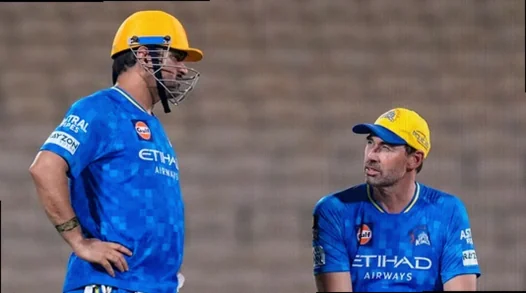
Chennai Super Kings, one of the inaugural franchises of the Indian Premier League, have built a reputation for winning, with five title triumphs to their name. Yet the opening stretch of the 2026 campaign has been a stark contrast to their usual standards. CSK have lost three games in a row and sit at the very bottom of the points table, a situation that has quickly turned into a wider conversation about what is and isn’t working inside the team.
As the defeats pile up, scrutiny has moved beyond the playing group and onto the coaching set-up. Stephen Fleming, the head coach who has been part of the CSK system since 2009, is now being questioned as the franchise looks for answers and tries to find a route back to competitiveness.
Fleming’s tenure has been decorated in the past. Since taking charge in 2009, he helped shape a strong working relationship with former captain MS Dhoni, and that coach-captain combination became a defining feature of CSK’s rise. Together, they guided the side to all five of their IPL titles, arriving between 2010 and 2023, with CSK often operating like a well-oiled unit.
However, the current season’s struggles have prompted former India opener Sadagoppan Ramesh to challenge the broader narrative around CSK’s success. In his view, Fleming’s achievements have been closely tied to Dhoni’s leadership, and the shift to a more recent leadership group featuring Ruturaj Gaikwad has not produced the same rhythm—at least so far in 2026.
Ramesh argued that Fleming’s impact cannot be separated from Dhoni’s captaincy, adding that the coach should be assessed in the same way the fitness and adaptability of players are. He also suggested that Fleming may not be adjusting quickly enough to the modern, more aggressive style of T20 cricket. Ramesh’s comments, shared on Instagram, were blunt: he claimed Fleming has not found success elsewhere without Dhoni running the side, and that the coach appears to be “five steps behind” in terms of mindset and adaptation.
There is, nonetheless, a measurable element to the criticism. Under Fleming’s guidance, Gaikwad’s captaincy record includes eight wins in more than 22 matches. Even so, CSK have struggled to regain their trademark consistency since 2024, finishing fifth in 2024 and dropping further to 10th in 2025.
Ramesh also placed the emphasis squarely on Gaikwad’s personal output. Despite holding the captain’s role, he has not delivered strongly as a senior batter, managing only 41 runs across three matches in 2026. The former opener urged Gaikwad to get runs on the board, lead from the front, and help guide CSK’s younger batting group while focusing on controllables and working to rediscover his form.
In his assessment, experience matters in more than one way. While he said it takes no particular background to hit boundaries in T20 cricket, he argued that the ability to prevent them is where experience becomes crucial—and he pointed to CSK’s bowling as an area lacking in that regard. For Gaikwad to strengthen his position as captain, Ramesh insisted he must start scoring regularly and, ideally, win matches through his own batting impact.
With the season still in its early phase, CSK still have time to reverse their fortunes if they can identify the right direction from their leaders. Their next assignment comes at home against Delhi Capitals, with the Men in Yellow aiming to register their first points of the campaign and arrest the slide before it becomes harder to recover from.
