
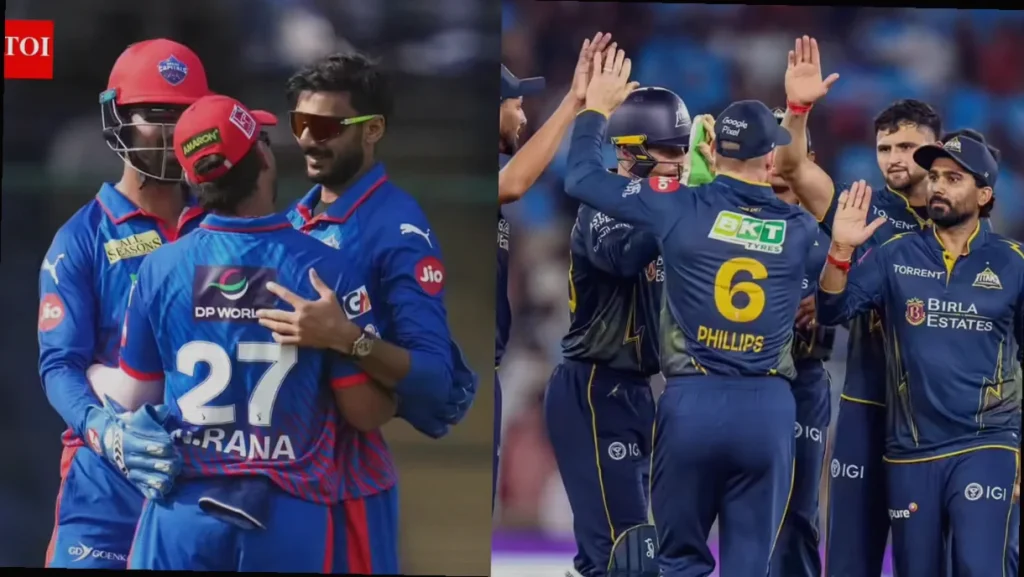
Gujarat Titans’ IPL 2026 campaign has begun with familiar frustrations: the top of the batting order is providing a platform, but the middle overs are refusing to convert promise into totals that win consistently. At the same time, Delhi Capitals have found a different kind of momentum through Sameer Rizvi, whose ability to take control in pressure moments has started turning tight chases into successful ones. When GT and DC meet, the match could effectively be decided in the overs where both teams have shown the most contrasting form.
Gujarat Titans: Middle-order woes keep resurfacing
Despite encouraging starts, Gujarat’s innings story has followed the same pattern in the early stage of the tournament. In both of their matches so far, the team has looked set during the first half of the innings, but once the middle overs arrive, the momentum stalls. Batters struggle to rotate the strike efficiently and also fail to find the required acceleration at key times, which has resulted in totals that don’t consistently challenge opponents—or chases that don’t get over the line.
This isn’t being treated as a one-off slump. Since IPL 2025, Gujarat’s middle-order average has been the lowest across all teams, suggesting a deeper, structural issue rather than a temporary loss of form. The inconsistency from those batters has also increased the workload on the top order, forcing them to deliver at near-perfect levels every match just to keep the innings alive.
If Gujarat are going to reverse their fortunes, more dependable contributions will be needed from the players expected to anchor and accelerate in the middle—Glenn Phillips, Rahul Tewatia, and Shahrukh Khan among them. Without that support, even strong starts are likely to keep ending with the team chasing results instead of dictating terms.
Delhi Capitals: Sameer Rizvi’s rise sets the tone
For Delhi, the early narrative has been far more encouraging, largely thanks to Sameer Rizvi. He has become the breakthrough performer who turns difficult phases into match-winning opportunities. His value extends beyond raw runs; it is also about how he manages the game—timing his shots, controlling the tempo, and maintaining composure when wickets tumble.
Delhi’s first match of the season illustrated the impact clearly. They were struggling at 26 for 4 in a modest chase when Rizvi took charge. He remained unbeaten on 70, stabilising the innings and building a platform from the brink. In the following game, he came in early again and produced an even more influential knock—an unbeaten 90—guiding the team through another challenging chase.
Rizvi’s standout trait is adaptability. When pressure mounts and wickets fall, he can absorb the situation without losing shape. When the match opens up, he can also shift gears and accelerate. A key part of that success has been the partnerships he has formed, particularly with Tristan Stubbs, which have helped Delhi rebuild methodically rather than panic.
As the tournament develops, opponents are expected to plan specifically for Rizvi. Still, if he keeps finding this form, Delhi won’t just benefit from a reliable middle-order option—they’ll have a genuine match-winner who can influence the direction of their season.
GT vs DC: The middle overs may decide everything
The clash between Delhi Capitals and Gujarat Titans carries a simple early-season lesson: matches are increasingly being shaped in the middle overs. While both teams have relied on their top orders to set the stage, the overs between 7 and 15 have emerged as the key battleground so far for both sides.
Delhi’s path has been defined by resilience. Twice, they faced collapse scenarios, only for Sameer Rizvi and Tristan Stubbs to steer the innings back with calm, measured batting. Their ability to take in pressure, slow the damage, and rebuild has given Delhi an edge—especially in tight chases.
Gujarat’s story, in contrast, has been about failing to convert advantage. Strong starts from their top three have repeatedly evaporated because the middle order hasn’t managed to accelerate or even stabilise when it matters. That inability to capitalise has cost them winning positions in both matches so far.
With a high-scoring surface expected for this encounter, the importance of the middle phase only increases. This is the stretch where intent must translate into execution. If Gujarat’s middle order finds the spark, they can quickly flip the momentum. If it doesn’t, Delhi’s composure during pressure situations could again become the deciding factor.
- Both teams’ outcomes so far have been strongly influenced by the overs between 7 and 15.
- Delhi have recovered from collapses through Rizvi and Stubbs’ controlled rebuilding.
- Gujarat have wasted top-order starts due to middle-overs underperformance.
- On a likely high-scoring wicket, middle-overs execution becomes even more critical.
