
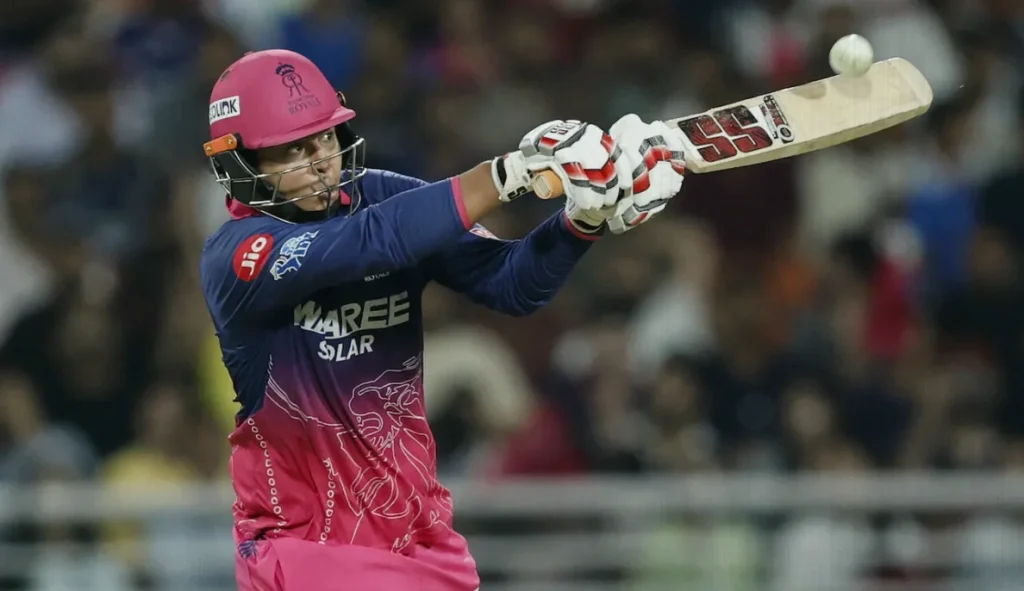
Selection debates rarely get this straightforward in the IPL: Vaibhav Sooryavanshi finished a sensational campaign with a cushion over the rest—44 more runs than the next-best batter across the season, a strike rate that was 23 points higher, and 29 extra sixes. The numbers were backed by timing as well, with a 78 off 26 to overhaul 202 against the defending champions, a 36-ball century, a 93 off 38 in a chase of 221 that felt like a must-win, and a 97 off 29 in his first-ever playoff appearance. He then followed it up with 96 off 47 in Qualifier 2, as wickets continued to tumble around him. No matter the age or the stage, his production stayed enormous.
Vaibhav Sooryavanshi
Inns 16 | Runs 776 | Strike Rate 237.30 | Avg 48.50 | 1×100/5×50
- He struck 78 off 26 to chase down 202 against the holders.
- He fired a 36-ball hundred as his scoring kept accelerating.
- In another high-pressure chase, he made 93 off 38 to reach 221 in an effective must-win.
- In his first playoff outing, he delivered 97 off 29.
- In Qualifier 2, with wickets falling, he still managed 96 off 47.
Virat Kohli
Inns 16 | Runs 675 | Strike Rate 165.84 | Avg 56.25 | 1×100/5×50
On the other end of the age spectrum, Virat Kohli showed two versions of himself. The first was familiar—he topped 600 runs for the fourth straight season. The second was a twist on how he went about it: instead of relying on volume alone, he leaned into pace, looking to hit boundaries on a near-continuous basis and maintaining control through the powerplay. With the season placing a premium on early momentum, Kohli’s strike rate of 175 in the first six overs was only bettered by five of the other 15 batters who finished with 200-plus runs in that phase. He also ended the year with his quickest IPL fifty ever, and he has now reached fifty-plus scores in IPL matches 77 times—at the age of 37.
Ishan Kishan (wicketkeeper)
Inns 15 | Runs 602 | Strike Rate 182.42 | Avg 40.13 | 6×50 | Catches/Stumpings 9/1
Ishan Kishan’s most productive IPL season is best understood through the influence of his big innings. He made 80 off 38 in the opening game, when the rest of SRH’s top six managed just 59 off 51. Then he turned a contest into a statement with 91 off 44 in the match that ignited their campaign. Later, he struck 74 off 31 to help chase 229 successfully. Against RCB, he produced 79 off 46 as SRH posted 255. Yet the most telling of his six fifties may have been his slowest at the time: 70 off 47 in a tight chase during a four-point encounter at Chepauk. In the end, he ranked as the third-most impactful batter of the season.
Rajat Patidar (captain)
Inns (not provided) | Runs (not provided)
In a season where only MS Dhoni and Rohit Sharma have managed to lift the IPL trophy in back-to-back years, Rajat Patidar put forward a strong case for being the standout batter. Only Vaibhav Sooryavanshi and Abhishek Sharma struck more sixes. Among players who scored 500-plus runs, only those two had superior strike rates. And among non-openers who still reached 150-plus runs, he was the quickest to the mark. Patidar began the season with aggressive statement knocks—31 off 12 against SRH in the opener, 48 not out off 19 versus CSK, and 53 off 20 at the Wankhede. He then delivered one of the tournament’s signature innings in Qualifier 1 against Gujarat Titans, with RCB lifting the tempo and their captain leading the charge.
Heinrich Klaasen
Inns (not provided) | Runs 600+ | Avg/strike (not provided)
Heinrich Klaasen went where middle-order batters rarely venture in T20s: he amassed 600-plus runs while batting outside the top three. He crossed the 30-run mark in 11 of his 15 innings, often choosing to stay in a responsible gear to manage an inexperienced Sunrisers middle order. That restraint didn’t remove his destructive edge—witness the damage he caused to Delhi Capitals and Mumbai Indians, including a 65 not out off 30 while chasing 244. In a crucial Chepauk contest, Klaasen’s spell of hitting—especially his impact against Akeal Hosein and Noor Ahmad—shifted the contest’s momentum at just the right time.
Nitish Kumar Reddy
Inns (not provided) | Runs/strike (not provided)
Among the strongest options for a finishing role, two were overseas—Donovan Ferreira and Tim David—while more international talent was expected to feature later. Still, Nitish Kumar Reddy could make the argument for selection on his own. His strike rate trailed those two by only a handful of points, and he delivered meaningful cameos in close to half of the innings in which he batted. His bowling figures didn’t instantly grab attention, but the list of batters he dismissed stood out. Rinku Singh, Sanju Samson, Ayush Mhatre, Dhruv Jurel, Will Jacks, and Prabhsimran Singh were among the names on that record, underlining the effect he had for SRH beyond his batting.
Krunal Pandya
Inns (not provided) | Overs (not provided)
Krunal Pandya batted only nine times and, on average, bowled three overs per match, yet he still ended up 13th in the team’s MVP standings for the season. His batting came most often as support in a No. 5 role, meant to provide stability. Even then, he crossed 40 in three of those appearances, including a 46-ball 73 that helped swing momentum against MI at Raipur. As a bowler, his economy was exceptional and his wicket-taking was elite: his dismissals included Vaibhav Sooryavanshi, Heinrich Klaasen, KL Rahul, Mitchell Marsh, Suryakumar Yadav, and—when it mattered most in the final—Jos Buttler.
Sunil Narine
Inns/spells (not provided)
Sunil Narine’s season reads like a blueprint for taking control when scoring is supposed to surge: he averaged 6.64 runs per over in a campaign where the overall scoring rate nearly reached the double-digit zone. In five of his 13 spells, he conceded at under a run a ball, including two separate runs of 1 for 13—first against LSG and then versus MI. Narine was a key reason Kolkata Knight Riders stayed in playoff contention deep into the season. It was also a reminder that spin hadn’t disappeared entirely from the IPL, even if it felt like it had been widely overlooked.
Jofra Archer
Inns/spells/wickets (not provided)
With qualification hanging in the balance, Jofra Archer delivered his best all-round showing of the season—both with bat and ball. His 15-ball 32 helped RR reach a total above 200, and he then played the role of match-ender in the defence by removing Rohit Sharma, Naman Dhir, and Hardik Pandya. Across the campaign, he was a consistent force with the ball, finishing 11 wickets clear of his next most prolific teammate. Importantly, 14 of his 25 wickets arrived in powerplay overs, the fourth-highest such tally by any bowler in the competition.
Bhuvneshwar Kumar
Inns/spells/wickets (not provided)
A decade earlier, Bhuvneshwar Kumar began a stretch of consecutive Purple Cap-winning seasons, with the first of those years delivering him his maiden IPL title—and denying RCB theirs. Years later, he arrived again as a decisive figure, this time helping RCB secure back-to-back crowns and nearly adding a third record Purple Cap. He took 17 powerplay wickets while conceding under seven runs an over, and at the death he claimed nine wickets while working at around eight runs per over. His key scalps included Gill in Qualifier 1 and Sai Sudharsan in the final. It wasn’t only his bowling that carried weight either—he also managed to win a game with the bat.
Kagiso Rabada
Inns/spells/wickets (not provided)
Bhuvneshwar’s powerplay haul of 17 would have been enough to match the best figures for a single IPL edition, but Kagiso Rabada went further. He finished with 20 wickets in the first six overs. Rabada, alongside Mohammed Siraj, was central to breaking teams early and sustaining GT’s momentum on the route to the final. Rabada outperformed every other new-ball bowler in terms of wicket frequency, taking a wicket every 13 balls. He also recorded five three-wicket hauls—only Bhuvneshwar had more—and he joins Bhuvneshwar, Dwayne Bravo, and Harshal Patel as the only bowlers to have collected multiple Purple Caps.
Sakib Hussain
Inns/spells (not provided)
The final spot in the side had plenty of domestic competition, but it went to a 21-year-old trusted with the demanding job of being a back-half specialist in his rookie IPL season. Sakib Hussain bowled 42 overs in total, with 19 of them delivered from the 15th over onward. The economy rate begins to look even better once that context is taken into account. After a dream debut against RR, he produced two understated but decisive spells in wins over CSK: 1 for 32 in Hyderabad while defending 194, and 2 for 34 at Chepauk.
