
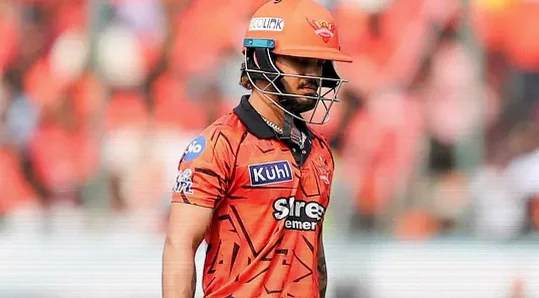
Sunrisers Hyderabad’s loss to Punjab Kings was not only about failing to defend a 220-plus total. It also revolved around a selection narrative that appeared to drift between the toss and the second innings—suggesting SRH’s plan was still being adjusted once the chase got underway.
At the toss, Ishan Kishan delivered a message that sounded decisive. He said, “We have 2 changes. Salil comes in place of Livingstone, and Praful is making his debut today. He comes in place of Jaydev Unadkat.” The wording carried the feel of a clean, last-moment revision: Praful Hinge was drafted in, Jaydev Unadkat was left out, and the team appeared to be rolling with a fresh-looking option.
Yet during Punjab Kings’ chase, Unadkat ended up bowling for SRH. That detail turned what could have been dismissed as a simple communication slip into something more significant. It indicated that SRH might not have fully committed to the new route, and once the match pressure rose, they reverted to the familiar choice.
SRH’s “change” that didn’t hold
This is where the controversy of the decision becomes clearer. Praful Hinge is a 24-year-old fast-bowling prospect from Vidarbha—still early in his T20 development. In a match where SRH named him as a debutant at the toss, he represented the unknown factor: a bowler Punjab Kings would have to process without the comfort of prior exposure in the format.
When Kishan announced Hinge’s inclusion to replace Unadkat, it implied SRH had spotted a need for variation. Perhaps it was about adding fresh pace, altering the seam-bowling angle, or bringing in a skill set Punjab Kings hadn’t fully prepared for. However, once Unadkat still entered the attack, the whole idea began to look like the worst outcome—an approach that wasn’t sustained long enough to become a real strategy.
The underlying issue seemed to be trust. SRH did not fully back the debutant option. And by returning to Unadkat, they also revealed uncertainty about the alternative path they had initially presented.
Unadkat’s spell and the scoreboard impact
The consequences arrived quickly. Punjab Kings chased down SRH’s 219 for 6 with six wickets to spare. Unadkat’s bowling figures read 3 overs for 40 runs. In a chase of that scale, those overs are not just routine. They can be the kind of spell that either injects doubt into the batting chase—or, as happened here, allows the opposition to settle.
Punjab Kings did not merely stay in the hunt; the chase began to feel controlled and smooth. Once that momentum shifted, SRH’s task stopped resembling a steep mountain and started looking like a run-chase that Punjab had already paced properly.
That is why the spell felt costly. Defending 219 is not only about avoiding disaster. It is about keeping the target “alive,” forcing hesitation at least once, and creating a moment where the batting side has to think twice. SRH never truly managed that pressure. Unadkat’s contribution was part of the reason the chase kept flowing.
What SRH might have gained from Hinge
This does not automatically mean Praful Hinge would have bowled better had SRH stuck with him. Debutants carry risk, nerves, and unpredictability—there is no guarantee that a new name will instantly deliver. Still, SRH could have taken value from making the switch more decisive in three broad ways.
-
Unfamiliarity: Punjab Kings already knew the general Jaydev Unadkat profile—his left-arm angle, pace range, and the way he varies tempo. Hinge would have arrived with more uncertainty around him. Even a single over that batters cannot read clearly can change the mood of a defence in T20 cricket.
-
Tactical clarity: If SRH’s decision was truly to move away from Unadkat for that match, then backing Hinge would have shown conviction. Instead, SRH signalled one thing and then did another. Middle-ground decision-making can make a side look as though it is trying to avoid both failure and responsibility.
-
A real gamble: On a day like this, committing to a gamble could have been more productive than falling back into a familiar option. High-scoring games often punish half-choices and reward full commitment.
Why the late-call angle mattered
The easiest way to describe the sequence might be to call it confusing. But for SRH, the deeper problem was indecision. Kishan’s words at the toss suggested SRH had made a bold late switch—Hinge in, Unadkat out. Yet the chase told a different story. As the game tightened and the match situation demanded execution, SRH reached for Unadkat again.
Once that fallback option went for 40 runs in 18 balls, the entire pattern began to look like a decision that had lost confidence before the match had properly settled. The cost was not only runs or overs. It was clarity—something that often decides outcomes in T20 cricket, especially in the early phases when teams need certainty more than anything else.
In the end, SRH did not secure the upside of fully trusting their debutant, and they also did not gain the comfort of sticking with their established experience. They ended up caught between the two, and in a chase that moved quickly and struck hard, that gap became Punjab Kings’ opening.
SRH’s last-minute call did not just look untidy—it ultimately hurt them in the moments where T20 games are most often decided: those early overs when confidence and control matter most.
