
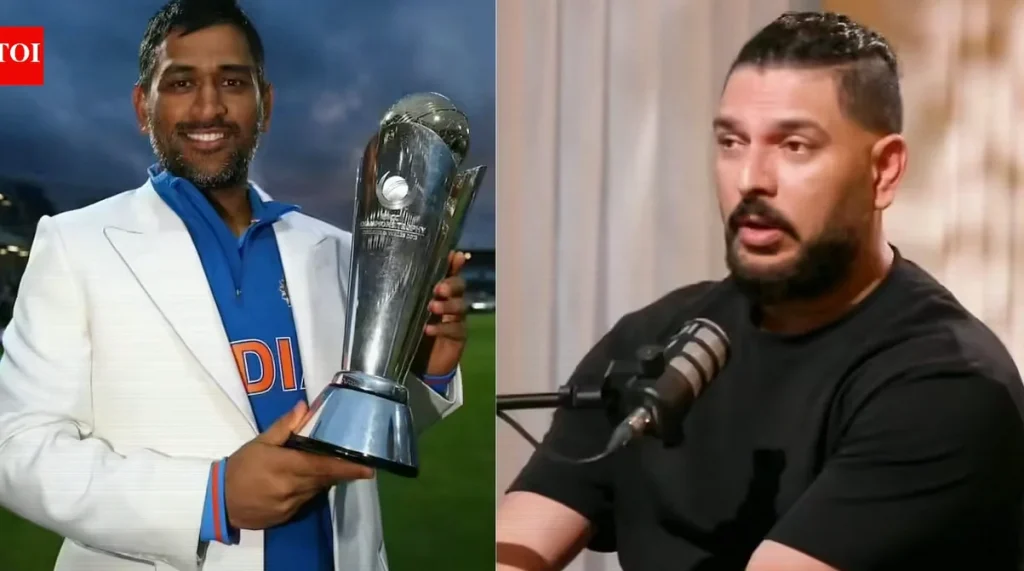
Yuvraj Singh has reflected on the way captaincy appointments in cricket can sometimes come as a surprise, even when expectations point in a different direction. In a candid discussion, the former India star recalled the moment MS Dhoni was named India captain “from nowhere,” despite the presence of multiple senior figures in the squad. Yuvraj, who at the time was the vice-captain and widely seen as one of the next in line for leadership, said that such calls may not always land well with the players who feel they have earned the role through long-term performances.
Speaking on a podcast with Sports Tak, Yuvraj linked his own memory to current captaincy debates, including the discussion around Abhishek Sharma and leadership duties when Pat Cummins is absent. In that context, Ishan Kishan was given the captain’s responsibility, and Yuvraj admitted that decisions like these can be emotionally tough for players—particularly those who have been steady contributors over the years.
Yuvraj was blunt about the feeling such moments can create. “It is disappointing. I love Ishan Kishan. I have seen his growth as well in Indian cricket, his comeback as well,” he said. He then explained the contrast he sees between players who are quickly thrust into leadership and those who have built their place within a franchise over time.
To illustrate his point, Yuvraj described a hypothetical scenario involving Abhishek Sharma before the World Cup: if a player arrives into the setup, delivers standout performances for his domestic team—scoring a hundred in the final—then carries that form into the World Cup and subsequently earns the captaincy of a franchise, the message can look different from the outside. In Yuvraj’s view, the emotional impact is sharper when a player like Ishan Kishan, who has spent seven years playing for a single franchise and has also captained at the state level, is still made vice-captain rather than being handed the top role.
“Now what frame of mind he plays franchise cricket with—there’s a bit of disappointment,” Yuvraj said, underscoring how leadership choices can influence motivation and mindset even when relationships remain strong. He added that the wider picture matters, but from a player’s perspective, the timing and reasoning behind captaincy calls can still feel unfair.
Drawing from his own journey, Yuvraj suggested that unexpected leadership appointments have long been part of Indian cricket’s story. He pointed back to the period when he was in the ODI team setup, with Harbhajan Singh and Virender Sehwag as senior members. Even with Yuvraj positioned as vice-captain, he said Dhoni arrived into the conversation and was named captain “from nowhere,” despite the established order.
“Whatever the reasons—franchise cricket will not determine if you will captain India,” Yuvraj noted. Still, he emphasized that personal disappointment can be hard to ignore when someone has given so much for you across many years.
Yuvraj also revisited the leadership shift from 2007, when India had several experienced options that could have been considered for the captaincy role. Instead, Dhoni was entrusted with the responsibility, a decision that surprised many within the team, including Yuvraj himself—then vice-captain in the ODI setup and seen by many as a likely future leader. In spite of the initial shock, the choice went on to transform Indian cricket.
Dhoni went on to guide a young Indian side to triumph in the inaugural T20 World Cup in 2007, kicking off what would become one of the most successful captaincy periods in the country’s history. During that era, Yuvraj remained an important presence, playing a key role in India’s 2007 T20 World Cup win and later delivering a standout run as Player of the Tournament in the 2011 ODI World Cup, reinforcing how bold leadership decisions can pay off on the biggest stages.
