
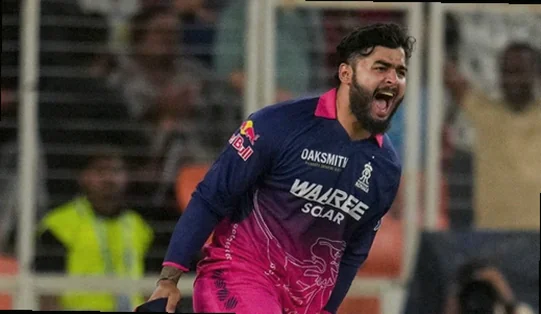
In November last year, the idea of “one franchise’s gain” turning into “another team’s loss” became a storyline after Sanju Samson’s big switch. For Rajasthan Royals, the departure was more than a personnel change—it was the end of an era built around their homegrown star, who later captained the side for five consecutive seasons from 2021 through 2025. That stretch included a run to the 2022 final, their first appearance in the title match since the triumphant 2008 campaign, and Samson had grown into the face of the franchise.
Replacing him was never going to be simple, especially with limited obvious options. Ravindra Jadeja, brought into Rajasthan through the Samson trade arrangement, looked like the most direct fit: a hardened campaigner with captaincy experience, even if his time leading Chennai had been brief and not defined by long consistency. Still, Rajasthan chose a longer runway, leaning instead on another homegrown talent—Riyan Parag.
Quick facts on Rajasthan’s new captain
- Riyan Parag is 24 years old and from Assam.
- He has been part of the RR setup since 2019.
- His breakthrough came in IPL 2024 with 573 runs in 14 innings (strike rate 149.21).
- In 2025, he added 393 runs at a strike rate of 166.52.
- After two IPL 2026 matches, Rajasthan are top of the table with four points and a net run rate of +2.23.
Parag’s association with Rajasthan dates back to 2019, when the franchise backed him through the early stages of his development. The payoff arrived later than fans might have expected—2024 is where his impact truly surfaced. He struck 573 runs in 14 innings at a strike rate of 149.21, and then followed it with 393 runs the next year at an even sharper 166.52.
With that kind of form, the captaincy looked like a logical next step, and Parag has responded with the same intensity. The early proof came quickly: after two matches in IPL 2026, Rajasthan sit first on the table, holding four points and a net run rate of +2.23. The clearest sign of leadership arrived in their second game, when they defended 211 against Gujarat Titans in Ahmedabad.
Why Parag’s “bat first” call mattered
The decision to bat first raised eyebrows, especially because the IPL 2026 pattern has leaned heavily toward teams chasing. In the first eight matches, only a single successful defence had been recorded, making Rajasthan’s choice feel like a potential gamble. Yet Parag’s reasoning wasn’t presented as instinct—it was framed as a calculation built around match conditions.
Ahmedabad, unlike many other venues, has historically leaned toward sides that bat first. Last season, seven of nine games at the Narendra Modi Stadium were won by teams setting a target. Gujarat understand their home conditions well, but Parag’s approach effectively gave Rajasthan the best route to victory at the venue, and it worked—though not without a couple of crucial tactical adjustments.
The two moves that swung the match
The first turning point came with Dhruv Jurel’s promotion. Jurel has typically been used as a middle-order batter, but in IPL 2026 he has been pushed up to number three. Before this season, he had batted in the top three only twice in T20s, producing 23 and 0 in two Syed Mushtaq Ali Trophy appearances—an indicator that the role was a deliberate stretch, not a default selection.
Against Chennai Super Kings, Jurel made 18 off nine balls, showing signs of tempo but not a full statement. Against Gujarat, however, the promotion delivered in a big way: Jurel struck 75 off 42 balls with five fours and five sixes, providing the innings base after a 56-run partnership with Yashasvi Jaiswal. Later, Parag confirmed the promotion was his call and emphasized that he had wanted Jurel to seize the opportunity at number three.
“I think we’ve not done a lot of justice to the talent that he possesses. He’s done the hard job… But now that we had an opportunity at number three, I was the first one to say he has got to bat there, and he showed us why,” Parag said.
The second defining moment arrived at the death overs, where Parag showed the kind of captain’s instinct that doesn’t wait for a single plan to play out. With Gujarat needing 15 off 12, he initially went with Tushar Deshpande, then changed direction and handed the ball to Jofra Archer. Archer produced a clinical over, conceding just four runs and shifting the chase to 11 needed off the remaining six.
For the last over, Parag had safer-looking options available, including Sandeep Sharma and Nandre Burger, both with overs remaining. Instead, he backed Deshpande again. The result was decisive: yorkers came in sequence, Rashid Khan was dismissed on the penultimate ball, and Deshpande conceded only four runs to close the match with a six-run win for Rajasthan.
Parag later described the mindset behind the final-over decision. “It was just incredible… I took a chance thinking let’s go full and fast. The way my boys executed, it was insane,” he said.
There was also a subtle hint that the captain’s thinking evolved through input from his players. Parag revealed that he had planned to alter the batting order and that Jurel played a part in the final arrangement. “I was actually going to switch up the order. So, credit to Dhruv Jurel. He asked me to go with Jofra in the 19th,” Parag added.
It’s still early, but Parag’s authority is already coming through in the way Rajasthan are operating—no frantic reactions, just control and conviction. As the season begins to settle, Rajasthan remain on top, while Chennai—where Samson is still searching for rhythm—sit at the bottom.
