
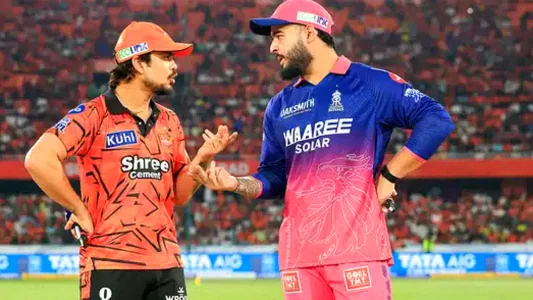
SRH’s batting “revolution” since 2024 has been powered less by random bursts and more by a repeatable pattern: ruthless Powerplay starts from the top. Their openers consistently seize the first phase, lay down a platform, and then push the chase or the innings into territory where recovery becomes extremely difficult. The numbers underline how often it works—no team has crossed the 200-run mark more frequently in this period, and most of those totals have followed the same blueprint.
Quick facts
- In SRH’s 15 innings of 200-plus since 2024, Travis Head has scored 650 runs at a strike rate of 187.86.
- In those same games, Abhishek Sharma has struck even faster, with a strike rate of 227.24.
- SRH average 77 for 1 at the end of the Powerplay in their 200-plus innings.
- Only the second time this season SRH have reached 200 without a meaningful contribution from their openers.
- Earlier at Chinnaswamy, Head and Abhishek combined for 18 off 17, yet SRH still made 201.
- Against an unbeaten RR side, SRH managed 216 while the Powerplay contribution from the openers was similarly light (18 off 19).
- In that match, RR’s Powerplay returns were 49 for 3 and 51 for 1 (modest by SRH’s standards), while SRH’s middle overs surge came from 78 runs between overs 9 and 13.
Abhishek Sharma is usually the spark that turns a good start into a game-changing one, with Travis Head providing the acceleration that follows. Even when Head is framed as a “second fiddle,” it’s only in relative terms—he remains central to how SRH stretch totals past the point of comfort. In the 15 innings where SRH have reached 200-plus, Head’s 650 runs have come at a strike rate of 187.86, while Abhishek’s 227.24 reflects a slightly more aggressive conversion from the same early opportunities.
The typical SRH script in those big totals is also clear from the Powerplay snapshot. On average, they are 77 for 1 after the first six overs in those 200-plus matches, which is why the outcome at Chinnaswamy—and again in the game versus an unbeaten RR—felt like an exception rather than the rule. For only the second time this season, and rarely in this stretch since 2024, SRH breached 200 without their openers delivering meaningful damage.
That deviation started at Chinnaswamy, where Head and Abhishek managed just 18 runs off 17 deliveries between them, yet SRH still finished on 201. The pattern repeated against RR: the openers combined for 18 off 19, but SRH posted 216, showing they could still outpace the scoreboard even when the usual first-phase impact didn’t arrive.
The odd part wasn’t the end result—it was the middle of the innings, where SRH found a new rhythm. Their Powerplays in these matches were modest by their own standards, with totals of 49 for 3 and 51 for 1 in the relevant games. In 2024 and 2025 combined, SRH have reached 200 with a Powerplay below 65 only once, making these performances stand out as unusual even by their own high bar.
RR’s plan and SRH’s counter
RR, in this contest, leaned into a weakness they believed they could exploit. Their right-arm seamers—Jofra Archer, Tushar Deshpande, and Sandeep Sharma—targeted Ishan Kishan’s body, a line that had caused him problems last season, when he was dismissed three times in 19 balls. This time, Kishan turned the strategy into something he could score off, particularly by moving the ball onto his preferred areas—square on the leg side—where he collected 27 off 12 when targeted there.
Then Heinrich Klaasen took over in the way he often does: by reading the spin matchups and breaking them decisively. Ravi Bishnoi, the tournament’s leading wicket-taker, was brought into the equation and was struck for 21 off 10. That over-by-over disruption mattered because it forced RR to hold an extra over, throwing off their control during the middle phase.
As RR’s rhythm slipped, SRH piled up quickly. They added 78 runs in five overs between overs 9 and 13, which effectively turned a chase-or-innings scenario that might have felt tight into one that became increasingly out of reach. Even at 216, SRH weren’t fully comfortable, but the damage in those middle overs gave them enough margin to finish strongly.
One reason the innings felt precarious was the profile of SRH’s bowling. Their attack, light on experience, was set against the tournament’s most explosive Powerplay unit. RR arrived with momentum—averaging 14 an over in the first six overs across four innings, and losing just one wicket in that span. In three of those games, the contest had already felt decided inside the Powerplay, which is exactly what made the match so sensitive to early breakthroughs.
RR also benefited from the fact that both SRH openers were back in the pavilion inside the second over, pulling RR into a phase they have largely managed to avoid this season. Dhruv Jurel and Riyan Parag haven’t been the quickest starters against spin, and Shimron Hetmyer’s recent T20 returns have typically come higher up the order. In this game, though, he was pushed to number five—a role he struggled with last season—while Donovon Ferreira had a lot riding on him.
RR’s batting order also carried unusual pressure points: Ravindra Jadeja misfired at number seven, and the only follow-up after Archer to come was Jofra Archer. In contrast, SRH’s middle order had recalibrated after an atypical beginning, which is why the scoreboard still moved away from RR even when the early cushion SRH usually enjoy didn’t fully show up.
Once RR’s top-order advantage disappeared, their middle overs couldn’t bridge the gap. This is the sort of off day they will want to put behind them soon—especially in a tournament where sharper edges appear as the season progresses and small slips tend to decide bigger things.
