
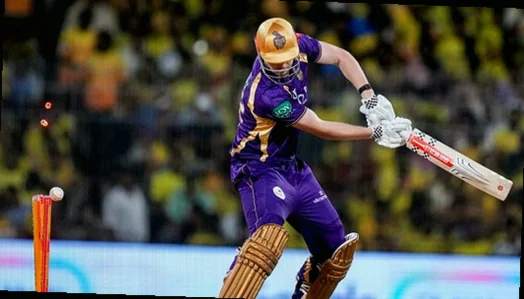
Cameron Green’s matchup against CSK wasn’t merely subpar—it was the sort of night that makes a franchise start asking tougher questions about what a high-priced buy is supposed to deliver. He went out early in the chase of impact, registering 0 runs and 0 wickets while conceding 30 runs, and in the model-based “match worth” framework he returned ₹0. By the time KKR absorbed a 32-run defeat, the gap around his performances had widened into numbers that feel uncomfortably familiar in IPL spending terms.
This is no longer only about Green’s initial ₹25.20 crore auction price. After five games, the cumulative loss KKR are carrying on him in this model stands at ₹8.01 crore. That figure sits in a bracket where teams typically expect a genuine, role-stable first-choice IPL player—money that can otherwise secure proven value. In fact, it is in the same cost neighbourhood as Tilak Varma’s ₹8 crore contract, and it also resembles what teams have committed to players such as Mukesh Kumar or Harshal Patel.
A game that pushed the deficit into a new bracket
- KKR’s defeat vs CSK: 32-run loss
- Green vs CSK: 0 (runs), 0 wickets, 30 runs conceded, match worth returned ₹0
- Model per-match cost for Green: ₹180 lakh
- KKR loss on Green after five matches: ₹8.0086 crore (shown as ₹8.01 crore)
- Green’s best single-match return this season (vs LSG): ₹64.87 lakh
- Total match worth from five games: ₹99.14 lakh
Against CSK, Green’s output triggered another full negative hit within the model. With his per-appearance charge fixed at ₹180 lakh, a return of ₹0 means the entire match cost is treated as loss. The CSK game sharpened the story because it removed even the possibility of partial compensation—there was no meaningful batting value and no wicket-taking impact to soften the hit.
Before the CSK outing, Green had at least one evening that pointed to upside. In the match against LSG, he produced his best single-game return of ₹64.87 lakh. Yet in the larger picture, that stands out as the exception, not the emerging pattern. Over five matches, his total match worth is still only ₹99.14 lakh, which against a cumulative investment of ₹9 crore leaves KKR with the net deficit of ₹8.0086 crore.
That ₹8.01 crore number is where the discussion starts to change tone. It is not just a theoretical red-ink line—it matches the auction value of Tilak Varma, and it also sits alongside what franchises have paid for Mukesh Kumar and Harshal Patel. In other words, KKR’s Green ledger has drifted into the same financial neighbourhood as an entire frontline player, making the gap feel larger than a routine patch of poor form.
The Tilak Varma comparison
Tilak Varma is not simply a random name from a past auction list in this comparison. He represents a premium tier of player spending—figures teams usually back with clear expectations about role certainty, repeatable contributions, and usefulness across a season. At ₹8 crore, that is the range where a franchise expects a dependable player to consistently justify the outlay.
That is what makes the Green comparison sting. KKR’s loss on one player has already moved beyond what another team spent to acquire Tilak Varma outright. Put simply, the downside attached to Green is now large enough to resemble the full price of a separate high-value acquisition rather than just a temporary mismatch between fee and output.
There is also a risk profile inside the model. Green carries a per-match charge of ₹1.8 crore, so each appearance comes with immediate pressure. A modest outing does not make much of a dent; a poor showing hurts badly. When a game produces a zero-return outcome—like the one against CSK—the financial impact becomes a full-blown crater.
What the season sheet reflects is harsh, but it is straightforward. In five matches, Cameron Green has generated total match worth of ₹99.14 lakh, while his average normalised impact sits at 14.12 in the model. His best game remains the LSG match, and everything else has either underwhelmed or actively damaged the balance sheet.
The individual match returns spell it out: ₹32.41 lakh in one game, ₹1.86 lakh in another, ₹0 in a third, ₹64.87 lakh against LSG, and then again ₹0 against CSK. The pattern does not resemble a player stabilising his investment. Instead, it looks like a volatile asset—one modest spike, followed by too many flat lines that fail to protect the fee.
The CSK match worsened the problem because it removed any excuse of partial compensation. There was no clear batting return, no notable bowling impact to add value, and in the model’s terms there was no match worth at all. KKR paid the full appearance cost and, in monetary terms within this system, received nothing back.
Why this matters beyond one bad game
A player bought at Green’s price does not need to justify the entire fee every single night. But he cannot keep slipping into games where downside overwhelms upside. This model is built to penalise low-return appearances when the player’s auction burden is heavy. For Green, that burden is beginning to define the season more than the occasional flashes of impact.
That is why the Tilak Varma angle is more than a headline comparison—it gives scale to the damage. For fans, ₹8 crore is a clear figure; for teams, that bracket is tied to what money can buy in real squad planning. Once the loss on Green reaches that level, the conversation moves beyond simple patience. It becomes about opportunity cost, squad value, and whether the investment is delivering enough to justify the drag on the overall unit.
Right now, the numbers offer a brutally simple answer. KKR have invested ₹9 crore worth of match-share into Cameron Green so far, while the returns stand at ₹99.14 lakh. The hole is ₹8.01 crore—meaning this is not just a bad run of form, but a gap that effectively equals the price of Tilak Varma sitting on the wrong side of the ledger.
How Cameron Green’s tournament worth is calculated
The method starts with a player’s auction or retention value and converts it into a per-match cost. For Green, the base price used is ₹25.20 crore. The model spreads this across an expected 14 league matches, which results in a fixed per-match cost of ₹180 lakh. Each appearance is then measured against that charge.
From there, each match contribution is translated into a normalised monetary impact. That score is built using batting, bowling, and fielding inputs, and can be adjusted with manual rating factors, captaincy bonus, or synergy bonus where applicable. After the final normalised impact is produced, it is converted into a rupee figure referred to as match worth. This number is meant to show what the player returned in that specific game within the system.
The key balance-sheet figure follows next. Rolling profit or loss is calculated as match worth minus the per-match cost for that appearance. So if Green returns ₹64.87 lakh in a match but his cost for that game is ₹180 lakh, the model records a negative result for that appearance. If he returns ₹0—exactly what happened against CSK—the model treats the full ₹180 lakh as a loss for that match.
When those match-by-match outcomes are added together, they form the tournament balance sheet so far. That is how Green’s season ends up at ₹99.14 lakh in total returns against ₹9 crore invested, leaving KKR with an overall deficit of ₹8.01 crore after five matches.
