
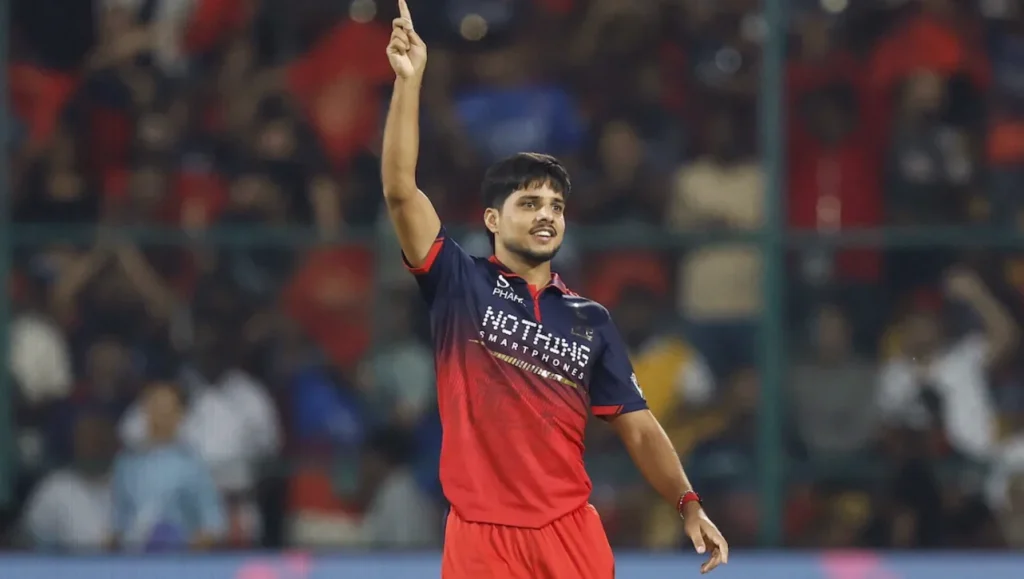
Royal Challengers Bengaluru’s decision to bring in Rasikh Salam for INR 6 crore ahead of IPL 2025 looked like a bet on upside. The early signs suggested a player with talent, but the real question was whether he could be shaped into a consistent match-winner in the franchise system.
During RCB’s title-winning run, Rasikh managed only two appearances and claimed a single wicket with Josh Hazlewood, Bhuvneshwar Kumar and Yash Dayal already established as the main pace options. Yet the contract wasn’t built for instant returns. The franchise view was that he belonged in the long-term plan, provided he received the right structure to turn raw potential into reliable output.
Looking back at Rasikh’s career up to 2025, the team management saw patterns that offered clues about what might unlock him. One clear theme was a familiar “in one place, out the next” cycle that had shown up fairly regularly for him in Jammu & Kashmir. On the advice of Krunal Pandya, he made a change of state and shifted to Baroda.
The intent was straightforward: open the door to more playing time and help him build a more complete skill set. In other words, he would develop as a professional without getting stuck dealing with selection uncertainties or having to constantly prove himself across different formats.
That stability also changed the way he approached his role within a group. With more space to grow, Rasikh began thinking like a leader—guiding younger bowlers and sharpening his understanding of tactics rather than just executing deliveries. Jitesh Sharma, RCB’s vice-captain, recognised that shift too, since he moved to Baroda alongside Rasikh with the same goal of improving his cricketing craft.
“The abilities you’ve seen have always been there,” Jitesh said after Rasikh’s 4 for 24 helped drive RCB to their fourth victory in five matches. “He has simply learned how to apply them more effectively. That comes when you have a strong coach, a mentor, and the right environment. You start understanding when a plan is required and when it’s not.
“He worked extensively on yorkers and slower balls. He knew the IPL was close, so you have to be spot-on and play with the right intensity. Mistakes will happen, but you rehearse so much that it becomes second nature. That’s what allows you to perform when the pressure is on.”
Jitesh’s read proved accurate. The “muscle memory” wasn’t born on Wednesday night—it had been forming for a while. Earlier in the week at the Wankhede, there were moments hinting at it, while the Chinnaswamy offered confirmation that RCB were watching a bowler with far sharper tactical clarity than before.
How Rasikh’s spell swung the match
- RCB’s pacer didn’t start perfectly: his third ball in the powerplay was clubbed over mid-on for six by Aiden Markram.
- Instead of backing away from the plan, Rasikh responded with intent—bowling two back-to-back slower deliveries to Markram and Mitchell Marsh.
- The adjustment came quickly because he was reading the surface: while RCB had previously scored 250 against Chennai Super Kings at the same venue, Wednesday’s pitch was drier and offered less grass, meaning the ball didn’t skid as much. Pace-off, therefore, mattered.
- Rasikh’s evolution had been underway for years. When he first broke through in 2018-19, he was mainly known for swing. Over time, he recognised the need to reinvent himself.
- Watching Harshal Patel’s 2021 campaign—especially the way he landed slower balls that dipped and cutters with precision—left an impression and helped Rasikh identify what could broaden his threat.
- From around 2022-23, he began adding those variations more earnestly, including during match simulations against Rishabh Pant at the NCA, where he trained during Pant’s comeback after a career-threatening accident.
- Those efforts turned into something bigger in the league pathway. Pant took notice and recommended Rasikh to Delhi Capitals, and Rasikh flashed promise in IPL 2024.
- After he wasn’t retained for the mega-auction, RCB moved for him, seeing how effective he could be as a third seamer—someone who could bring options rather than just pace.
- At the Chinnaswamy, Rasikh’s first-over fortunes swung as the last ball brought a slice of luck: Markram edged a full toss onto the leg-stump line, handing RCB a wicket from a 10-run over and, more importantly, boosting Rasikh’s confidence.
- With belief established, his second over underlined the off-season work. He kept landing the right balls without being concerned about the reputation of the hitters he was facing—Mitchell Marsh and Nicholas Pooran.
- Josh Hazlewood then sustained the pressure at a probing Test-match length, forcing risk without offering batters a free hit. Pooran tried to break out but chopped onto his stumps for 1 off 7.
- Hazlewood and Rasikh combined to dominate the powerplay, restricting LSG to their lowest total in that phase across the season. Rasikh had already stamped his authority with figures of 1 for 12 after two overs.
- The real measure came later at the death. When Rasikh returned for his third spell in the 16th over, he had to manage two established batters—Mukul Choudhary and Ayush Badoni.
- Even when he was steered away behind square off a slower ball, Rasikh stayed true to his strengths and removed Badoni off the final delivery. The key difference was in length: the wicket ball was fuller and the boundary ball shorter, forcing a slashing attempt that Jitesh took cleanly.
- In the final over, he nailed a yorker to break up Choudhary’s middle and leg stumps after a slower ball had already been dispatched.
- Avesh Khan’s innings ended in similar fashion as his stumps were knocked over by another yorker, sealing the close of LSG’s chase.
Rasikh completed the night with his best IPL figures—4 for 24. Of his 24 runs conceded, 10 came from slower deliveries and 14 from pace-on. The distribution mattered, but the bigger story was his intelligence: recognising exactly when to deploy each option and how to keep batters guessing on a surface that played into his strengths.
RCB didn’t hand him a full opening straight away; it took three matches for the opportunity to arrive, after they began with Abhinandan Singh. But after consecutive performances that forced attention, it now looks unlikely he’ll be sitting out for long—especially in a season that could end up defining his IPL career.
