
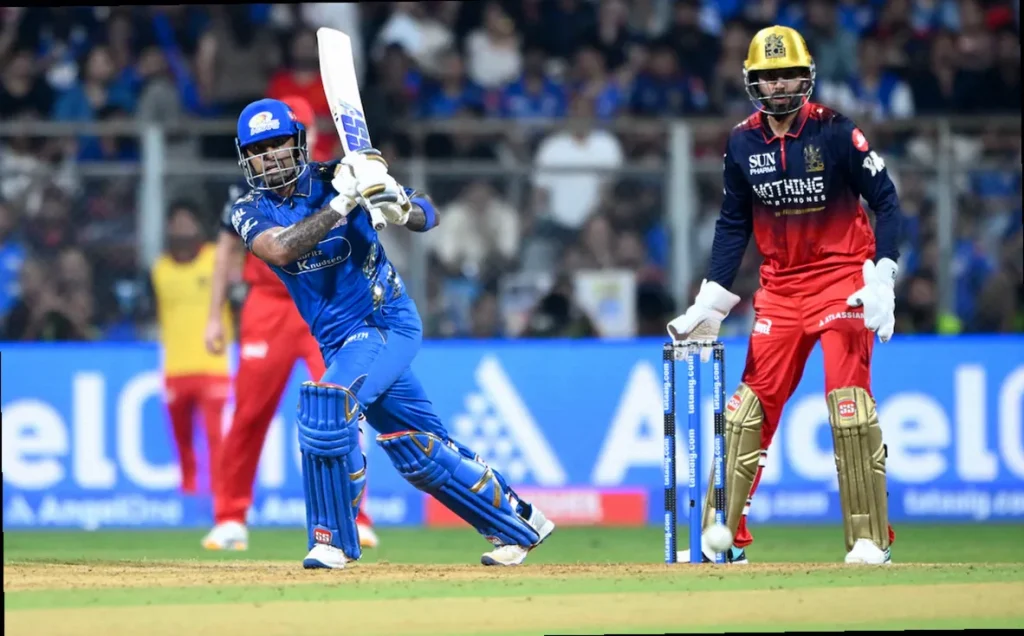
Defending champions Royal Challengers Bengaluru locked horns with five-time title winners Mumbai Indians in an IPL 2026 encounter at Mumbai’s Wankhede Stadium on Sunday, but the contest was anything other than a smooth sprint. The match finally finished in four hours and 22 minutes—considerably longer than the typical timeline for a T20 game—after a series of stoppages that kept disrupting the flow. The delay sparked renewed debate about over-rate discipline and match pacing across the league, with an MCC official in attendance adding a fresh set of ideas for the game’s governing body.
IPL 2026 clash goes long as stoppages pile up
While captains can face penalties when their side fails to complete the allotted 20 overs within the required time, the wider problem of slow games continues to linger in the tournament. This particular fixture stood out due to how often play was interrupted, stretching the overall duration well beyond what fans generally expect from a T20 format.
- The Bengaluru vs Mumbai Indians match at Wankhede Stadium concluded in 4 hours and 22 minutes.
- The extended time was attributed to multiple breaks and interruptions during the game.
- Despite existing over-rate penalties for captains, games in the IPL can still run over the four-hour mark.
MCC’s Fraser Stewart calls for faster tempo and firmer action
Fraser Stewart, head of cricket at the Marylebone Cricket Club (MCC), was present at the match and later discussed what he observed. Speaking at an event in Mumbai, he described the pace of the game as unusually slow and pointed to the number of times players cycled on and off the field without any sense of urgency.
Stewart’s central argument was that the sport needs a stronger mechanism to keep teams moving quickly between deliveries. He drew a direct comparison with The Hundred, where the fall of a wicket triggers a countdown and the next batter must be set promptly.
- Stewart said the key issue was the “pace”—the game moved slowly with frequent stoppages.
- He compared it with The Hundred, where a wicket triggers a 60-second clock and delays can lead to five penalty runs.
- He acknowledged the need for hydration and conditions in India, but said the volume of people entering and leaving the pitch repeatedly lacked urgency.
- He argued that umpires should do more to maintain momentum when breaks become frequent.
Stewart backs a tougher stance for officials
Stewart also placed responsibility on the match officials, saying delays were being allowed to drag on. He suggested that if umpires do not enforce the available tools under the laws, consequences should follow.
He further noted that the rules already permit warnings and five-run penalties, but he believes they are not consistently applied. One of his proposals was to impose financial penalties on umpires when over-rates are poor, aiming to ensure games move along at a faster pace.
- Stewart said it is an umpire’s duty to help keep the game flowing.
- He added that slow enforcement matters more when every interruption can become valuable for broadcasters and viewers.
- He suggested umpires should be fined in cases where games are consistently delayed.
- He pointed out that the laws allow warnings and five-run penalties, but umpires are reluctant to use them.
- His specific idea: fine umpires if over-rates fall short, to encourage better tempo.
Result: RCB beat MI by 18 runs; third straight loss for Mumbai
On the field, Royal Challengers Bengaluru secured an 18-run win over Mumbai Indians. It also marked a worrying moment for the MI camp, with the result becoming the third consecutive defeat for the side led by Hardik Pandya.
- RCB defeated MI by 18 runs.
- The loss was Mumbai Indians’ third straight setback.
- Hardik Pandya led Mumbai Indians in the match.
