
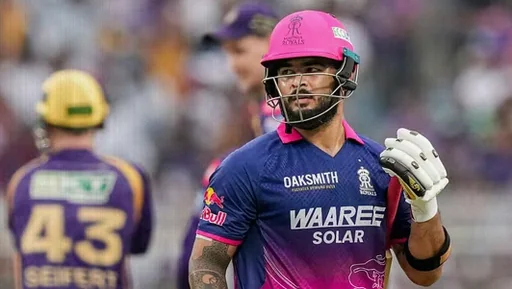
Rajasthan Royals have started the IPL season with a swagger that looks difficult to ignore, driven by the explosive batting at the top from Vaibhav Sooryavanshi and Yashasvi Jaiswal. Their bowling attack is also anchored by Jofra Archer, giving the franchise a clear identity in both departments. Yet, despite the team’s strong overall momentum, the spotlight has turned to captaincy and batting form—especially Riyan Parag, whose returns with the bat have been minimal and who has struggled to deliver when it matters.
Key takeaways
- Rajasthan Royals are positioned third in the points table with four wins from their first five matches.
- Riyan Parag has managed only 61 runs in six innings so far, including a score of 12 against KKR.
- Rajasthan’s bowling leadership is provided by Jofra Archer, while the batting thrust comes from Vaibhav Sooryavanshi and Yashasvi Jaiswal.
- Parag has produced very limited impact in this season’s run-chases and innings, raising questions about his role as captain and batter.
- With a score of 155 against Kolkata Knight Riders, Rajasthan’s chance at a fifth win has looked uncertain if they fail to defend or chase effectively.
Strong Royals start, but Parag’s batting returns are under scrutiny
Rajasthan’s early-season form has been eye-catching, but the narrative around their campaign is being shaped by one glaring batting concern. In the matches played so far, Parag’s contribution has been close to negligible, with just 61 runs across six innings. That includes his innings of 12 against Kolkata Knight Riders, a knock that did little to ease the pressure building around his form.
Even before this season began, there were signs that Parag may not have been the ideal choice for leadership. Last year, when regular captain Sanju Samson was forced out due to injury, Parag stepped in to fill the captaincy role. However, he could not deliver meaningful results in that stretch—Rajasthan lost six of the matches he captained across eight appearances.
From a 2024 high to a difficult dip
In 2024, Parag looked like a genuine long-term prospect in the top-order. He struck 573 runs at an average of 52.09, riding a wave of batting momentum and confidence. During that period, he also earned opportunities with India. However, his returns in the international setup did not match the promise he showed domestically, and the slump carried back into IPL too.
Last season, his batting numbers dipped. This year, with him operating as the permanent captain, the situation has worsened rather than improved. The article’s underlying point is that the current form isn’t something that can easily be dismissed as a temporary rough patch—because Parag doesn’t appear to be batting with the same impact and freedom that made his 2024 performances stand out.
There are times when even established stars experience barren phases, and fans can sometimes accept it if the player still provides enough with effort and consistency. The comparison drawn is that big names such as Virat Kohli and MS Dhoni have had seasons where runs were harder to come by, but their overall body of work and ability to grind through tough spells helped them remain valuable. In Parag’s case, the current slump has not been accompanied by that kind of accumulated output, leaving his form difficult to rationalise.
Knocks of frustration and a changing batting profile
Another factor being highlighted is that Parag does not look like the same batter who impressed in 2024. Back then, he was widely viewed as a potential successor in the mould of Kohli, playing with fitness, timing, and the ability to clear the ropes to all parts of the ground. In the current IPL run, he has struggled to play big shots, and that inability has reportedly led to dismissals driven by frustration—an issue that compounds the pressure with every passing innings.
Even so, the Royals at the moment have a strong opening combination, and the logic is simple: if Sooryavanshi and Jaiswal keep delivering consistently, Parag’s impact might not be as critical in every match. But the article stresses that run-scoring won’t be guaranteed every time, and when the top order falters, an out-of-form Parag becomes a direct problem for the team.
Pressure of finals history and the need for support
The pressure is also framed through Rajasthan’s tournament history. Since winning the inaugural IPL in 2008, they have only reached one more final. That limited final experience is described as something that can intensify expectations and stress around the captain—particularly when the skipper’s personal batting form is not helping.
There is also a concern about lack of on-field support. The argument presented is that Parag does not seem to have a teammate he can rely on during crisis moments. The article points out that Rajat Patidar—who was made captain of Royal Challengers Bengaluru in a similar context—had Virat Kohli as a dependable presence in high-pressure situations. When RCB eventually won their first-ever trophy under Patidar last year, Kohli’s role was highlighted as a major asset during crucial phases.
For Rajasthan supporters, the hope is that Parag turns things around quickly. The IPL is described as a competition where outcomes can swing rapidly—two quick losses can shift a team’s season trajectory dramatically, and the league does not offer much recovery time once momentum slips.
Rajasthan have enjoyed a strong start, with their only defeat so far coming against Sunrisers Hyderabad. However, the article notes that the situation could change in the immediate future. Their score of 155 against Kolkata Knight Riders is presented as a total that may not be enough to secure a fifth win, meaning Parag’s struggles could remain central to how the match ultimately unfolds. If Rajasthan manage to win from this position, Parag’s form would still remain a concern, with questions likely to persist until his batting starts delivering again.
