
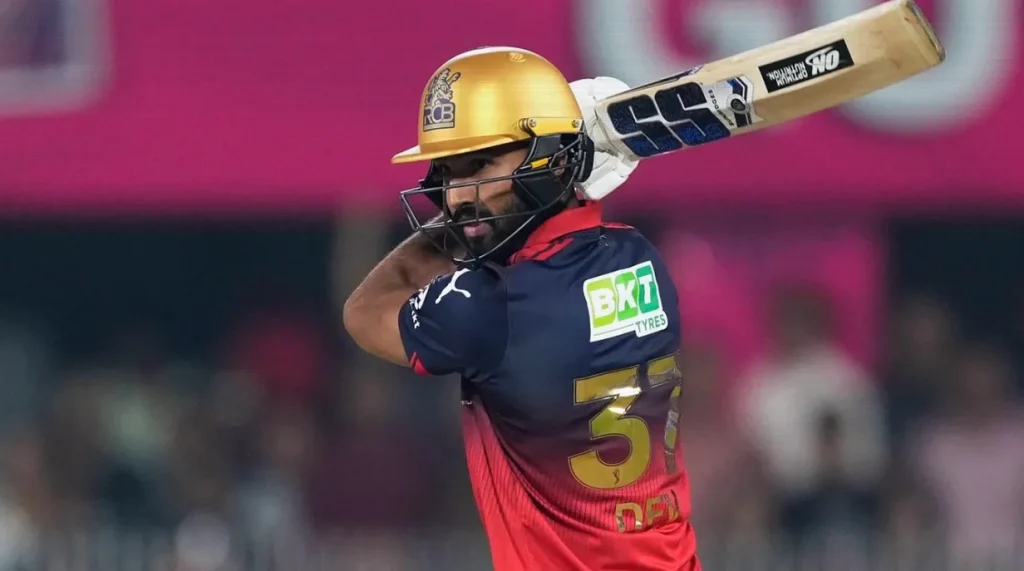
IPL 2026 has started with Devdutt Padikkal announcing a new, more aggressive version of himself. In Friday’s clash against Gujarat Titans (GT), the Royal Challengers Bengaluru (RCB) top-order batter delivered his second tournament-defining knock of the season—smashing a flawless 55 off 27 balls while steering a chase of 206, taking the game into RCB’s control and pushing Padikkal into a brand-new rhythm.
There’s a sense of reinvention at play, and it starts with Padikkal’s own evolution. Once viewed as a talented but comparatively restrained T20 batter, he has now fully embraced the modern, high-tempo approach. The contrast between the older and current Padikkal is what makes his early-season form so intriguing.
One of the clearest indicators of that transformation is his power-hitting efficiency in the first ten balls he faces this season. His strike rate of 170.18 is the highest mark he has produced in an IPL campaign. Last year, that figure was 126.51, and the year before it stood at 74.42. This IPL also began with Padikkal failing to clear the boundary off the first three balls he saw in T20s where ball-by-ball tracking is available. However, by the sixth match of the season, he has already struck a six on the very first ball faced on two different occasions—first against Sunrisers Hyderabad (SRH), when he flicked a Jaydev Unadkat delivery aimed at his pads over square leg, and then versus GT, where he launched Kagiso Rabada long over fine leg.
Changing instincts is never easy for athletes, especially when a player’s natural style has been shaped by years of routine. Yet Padikkal has made the adjustment successfully. In 99 T20 innings up to 2024, his overall strike rate sat at 131.98. Since then, across 22 innings, it has jumped to 165.36. For this IPL specifically, his strike rate rises further to 184.07.
Speaking after RCB’s win over GT, Padikkal explained that the shift is not only mental. “It’s not just about self-belief that the management has given me. There are also a few technical adjustments I’ve made over the last couple of years, and you have to commit to them. At the start, it was tough because it’s a big change from my usual process and routine, but the results are coming now,” he said.
Padikkal struck six sixes in his innings on Friday. It was the fifth time he has hit that many in a T20 knock, but the striking detail is the speed at which he built them. In each of the previous four occasions, he had faced at least 46 balls. Against GT, he reached those sixes in just 27 deliveries—making every boundary feel more forceful and commanding than the one before.
Two of the sixes stood out in particular. The first came from just outside leg, where the left-hander opened his body and lifted a lofted effort with a high right elbow, sending it over covers off Mohammed Siraj. Padikkal later described it as his favourite shot of the day. The other highlight was a swivel-pull: he turned his hips to create space against a short-of-a-length delivery from Prasidh Krishna and then launched it over fine leg.
The boundaries didn’t come from one single area of the ground. They were spread across the park, with the final one—an aggressive slog-sweep off Rashid Khan in the tenth over—taking him to a 20-ball half-century. By then, Padikkal had already set the chase in motion, and RCB’s required run rate had dropped to 8.80 at the halfway point of the chase. It was clean, almost effortless hitting, the kind that hasn’t really been associated with Padikkal in the same way during earlier IPL seasons.
At the post-match press conference, Padikkal also addressed the narrative around his changing role. “It’s time we forget the previous version. The conversations about me being different have gone on for far too long. This is who I am now. That’s how a cricketing career progresses—you identify what you need to work on, and you work on it. I’m still young, and I’m very happy with the progress I’ve made. I’m looking forward to what’s ahead,” he said.
He added that the environment at RCB has supported the transition. “When I joined RCB, the set-up here and the management have been excellent in giving me the direction and the pathway I wanted. And DK [Dinesh Karthik], Andy [Flower], Mo [Bobat]—I can name every single one of them. The environment they’ve created in this group is special, and that has really helped me.”
The most dramatic shift this season has been Padikkal’s willingness to attack balls on a length. Up to this IPL, his balls-to-sixes ratio against length deliveries was 29.31—meaning 19 sixes came from 557 balls. Now, that has improved sharply to 5.11, with nine sixes arriving from just 46 balls. The change is equally visible in strike-rate terms: earlier in his T20 career, his strike rate versus length balls was 111.31, but this IPL it has nearly doubled to 221.73. Against GT, three of his sixes also came off length deliveries, including the cover drive over Siraj.
By the time of this match, Padikkal had already amassed 208 runs in six innings in the tournament. That total leaves him only 39 runs short of his entire run output from ten innings last season. Yet it is still the boundary numbers that have made the loudest impression: he has hit 13 sixes already this season, compared to 14 in the corresponding point last year.
With India scheduled to play ten T20 internationals across June and July, Padikkal will be hoping to return to the national side for his first T20I since 2021. For now, though, the focus remains on this season’s momentum—because the form he is showing is already delivering results for RCB.
