
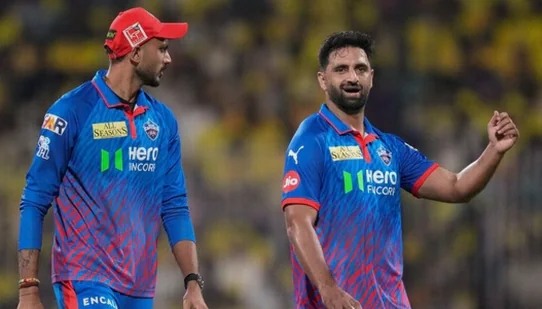
Early returns from Auqib Nabi’s IPL stint haven’t been reassuring. After just a handful of appearances, the 29-year-old fast bowler has struggled to make an impact in the shortest format—no wickets yet, and plenty of punishment in return. While it is still early in his campaign, the bigger issue is that the performances have looked below the standard expected from a T20 strike option. The onus is now on Nabi to prove the doubters wrong.
A slow start that raises questions
Nabi has played three matches so far. In that time, he has failed to take a wicket and has often been hit for runs rather than allowing batters to find rhythm. The raw numbers are one thing, but the manner of his spells has been the concern—he hasn’t looked like a bowler suited to modern T20 demands.
One of the biggest problems has been pace. With his deliveries sitting around the 120–130 kmph range on pitches that tend to assist batting, it becomes difficult to trouble top-order batters who are geared to attack from ball one. And with T20 cricket continuing to evolve, a bowler who cannot ramp up pace and vary his approach risks being neutralised quickly.
There is also the question of tactical variety. Nabi appears to be sticking to a single style—four-day length, repeated ball after ball. In IPL conditions, especially on flat surfaces, that kind of predictability is dangerous. Batters can simply line up, wait for the right release, and then hit through the line. When the lengths are too consistent, the opposition doesn’t need to take risks; it can punish the bowler on routine.
Those concerns were echoed in the way Punjab Kings dismantled Delhi Capitals in their latest meeting, a chase that ended up becoming the highest successful target in IPL history. Prabhsimran Singh and Priyansh Arya were among the batters who made the most of the situation, underlining how punishing the wrong bowling lengths can be in the T20 format.
Placement, captaincy calls and an expensive over
There is also a sense that Nabi may not have been brought into the right setup. Sympathy for the learning curve is fair, but the overall environment matters too. Axar Patel, the captain, has appeared uncertain in his decision-making at times, and the criticism is that Nabi could have been introduced differently—rather than being thrust into the spotlight immediately.
The argument is that more experienced options such as Mukesh Kumar, T Natarajan, or even Lungi Ngidi might have been better suited to begin with, giving the team a steadier bowling plan while the young pacer found his feet.
That said, the captaincy isn’t the only factor. Nabi himself compounded the pressure in an early moment of his spell: he bowled a no-ball in his second over, and the over then worsened further when he was struck for a six. The result was an expensive phase, with 27 runs conceded in that particular over.
What must change after this season
Looking beyond the current campaign, the call is for a major transformation. Nabi is described as being too heavy for the role of a fast bowler, and the claim is that his frame limits his flexibility. Without the ability to shift, he cannot consistently add extra pace — a crucial ingredient if he is to survive the pace and power demands of IPL batting.
Performing in domestic cricket is one challenge; matching the intensity of the IPL is another. The comparison isn’t even being made with international cricket at this stage. The point being made is simpler: the conditions and opposition in the IPL are a different universe—less margin for error, faster scoring rates, and batters who are ready to attack on flat wickets.
There have been suggestions by prominent voices, including Sourav Ganguly and Irfan Pathan, that Nabi could be fast-tracked to Test cricket. The counterpoint is that if this is the best version of his bowling in T20, then that route may not solve the immediate limitations he is showing.
Support for Nabi, but accountability too
Delhi Capitals director of cricket and former India batter Venugopal Rao has backed Nabi after the team’s defeat on Saturday. Rao said Nabi had done well in red-ball cricket and that this is his first IPL, adding that he would gain experience. He also emphasised how difficult it is to find fast bowlers in India and suggested Nabi would learn as the season progresses.
However, the backing also comes with a demand for stronger follow-through. The criticism is that while Rao’s intent may be positive, the impact hasn’t matched the backing so far. The team’s bowling results and overall form have worsened under his watch, and the view is that he should be held to account for the direction being taken.
The immediate requirement is straightforward: Nabi must not vanish into the background after a rough start. With 60 wickets in 10 games during Jammu and Kashmir’s historic title-winning Ranji Trophy campaign, his domestic record shows he is capable of taking wickets. That is the benchmark fans and the franchise will want him to start translating into IPL performances.
Reassessment and the path to IPL “material”
Ultimately, the argument returns to fundamentals. A good bowler is a good bowler, regardless of the format—but the evidence from Nabi’s early IPL outing suggests he is not yet performing at the level he has been made out to be in recent months. What is needed now is a reassessment of his potential and a clear plan to equip him with the tools required to become genuine IPL material, and eventually the kind of international-ready fast bowling that his domestic numbers hinted at.
