
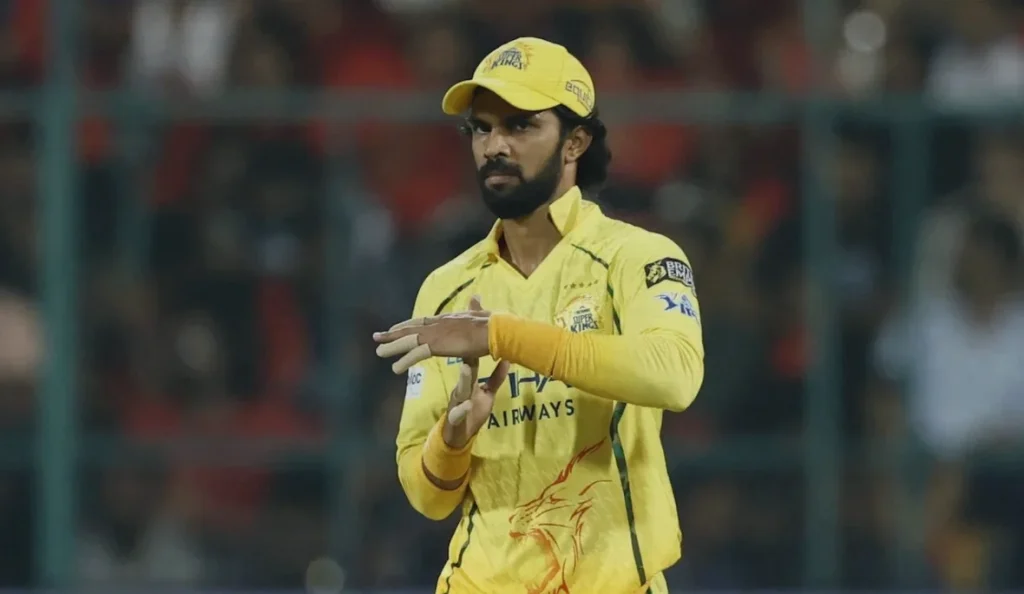
Before Sunday, Chennai Super Kings had managed something that felt almost routine in the IPL: they had never surrendered 250 runs in an innings, they had never bled 78 runs or more in the final overs, and they had not suffered a four-match losing streak against Royal Challengers Bengaluru. In Bengaluru, though, CSK’s death-overs bowling looked stripped of its usual answers, and the numbers only underline how sharply that trend was broken.
Even with IPL 2025 already in the rear-view mirror, where CSK scraped only four wins from 14 matches and finished last in the standings, their economy in the death overs stood at 11—good enough to be the fourth-best across all franchises that season. Now, with IPL 2026 still early, the picture has changed dramatically: CSK have already conceded 111 runs in 40 balls in the death, translating to an economy rate of 16.65, the worst among the ten teams.
It’s not as if the problems began only in the most recent clash. In CSK’s tournament opener, Rajasthan Royals never allowed the contest to reach the death overs, completing a chase of 128 in 12.1 overs. Then, at Chepauk in the previous game, Punjab Kings burst for 33 runs in just 2.4 overs at the end to chase down 210 with more than an over to spare.
Sunday brought the same theme—only louder. Led by Tim David and Rajat Patidar, CSK were charged for 78 in the last four overs, which ranks as the fifth-highest total in IPL history for that phase. The match swung into RCB’s favour as CSK’s control slipped, turning a manageable situation into a late-innings onslaught.
There was, however, a better start against RCB after Ruturaj Gaikwad chose to field first. CSK struck early by removing Virat Kohli in the fifth over, and on a surface that offered little grip with the outfield helping the batters, they kept RCB to 51 in the powerplay. After 11 overs, the score sat at 98 for 2—under nine an over—suggesting CSK were building a platform that could be defended.
That’s when the dynamic reversed. As the pitch played a bit more cleanly and Patidar along with Devdutt Padikkal started pressing the accelerator, the bowling lost its shape. The following five overs were taken for 74 runs, and while that alone was damaging, the real blow was still coming. Patidar fell, Tim David walked in, and from there the death overs turned into a showcase of hitting. CSK wilted under the pressure, and the execution crumbled when it mattered most.
It wasn’t simply a question of effort—it was the execution that went wrong. Ball-by-ball data points to deliveries that offered easy scoring opportunities: more than half of CSK’s death overs balls were either full tosses or full-length balls, and CSK managed just one yorker across the phase. There weren’t many meaningful changes in length or pace, and RCB cashed in with nine sixes in the last four overs, eight of them off Tim David alone.
CSK are not short on death-overs experience, either. Ahead of the RCB match, Noor Ahmad had already bowled over 14 overs in the death in the IPL with an economy rate of 8.02. Yet on Sunday evening, he leaked 21 runs in the 17th over. Jamie Overton, too, arrived with a death-overs economy of 9.26 in T20s since the start of 2025, but David punished him for 30 in the 19th. Anshul Kamboj did remove David with a yorker, but the delivery came with an overstep, costing CSK more than 40 runs in total. At the time of that no-ball, David was on 29; he eventually finished with 70.
Consistency was the biggest issue. Noor conceded 28 runs in his first three overs, and then tried too hard in his final over—bowling quicker than the match required. With limited turn available, David had a clear read on the length. Overton, in the penultimate over, kept firing it in the same slot, allowing David to keep going deep into the over. Even when CSK tried to hit the hard length, David found a top-edge that sailed over the wicketkeeper. Kamboj bowled decently, but the no-ball was a costly lapse.
Head coach Stephen Fleming addressed the pattern directly after the match. “Today we just didn’t execute,” he said. “It’s been different [in the two games]. I thought we were a bit passive in the last game throughout the innings. The fast bowlers, in particular, just searching a little bit. It was much better for the first half today but then just the execution under pressure [went wrong].”
Fleming added that CSK were punished for small margins. “Against a hitter like Tim David, who is very destructive, you’ve got to be absolutely spot on once we fell behind and he got his rhythm, and there’s a no-ball in there as well. Let’s not forget that. There’s probably 40 runs in there. There’s really small margins and with a good hitter like David, we’ve got to be more exact than that. So, we missed where we needed to be and we got hurt in the hardest of fashions.”
Such death-bowling worries were already on the radar when Nathan Ellis withdrew from IPL 2026 with a hamstring injury. The impact has been evident across two matches. While Fleming sounded cautious in his assessment—suggesting teams across the league have struggled to find answers—he still acknowledged that CSK need to settle into a more controlled rhythm. “We’ve got a young group trying to create a core moving forward,” he said. “We’ve got players who aren’t quite at their best and you talk about trying too hard; sometimes, the effort is a little bit too desperate.”
He continued: “We’ve got to work our way into a better game rhythm and for the bowlers in particular, it is tough. It’s incredibly tough. The margins for error are very small. We started our way to, what, 210. That has been winning scores in the past. So the bar has been lifted with the aggression of the batting, and the bowlers are scrambling. It’s not just us. Bowling teams are scrambling to find a little bit of assistance in the pitch but also find methods to shut these hitters down. So it’s a tough contest for bowlers. Batters are certainly dominating with the rules we’ve got.”
For CSK, the concern deepens because this is now a historic first in IPL history: they have conceded more than 10 runs per over in three consecutive games. Spencer Johnson remains on the bench, and even his return is still tied to recovery from injury, while Gurjapneet Singh is not typically viewed as a death specialist. With three defeats in three, CSK now face a pressing challenge—solve the death-overs problem quickly, or risk another long campaign, despite being the five-time champions.
