
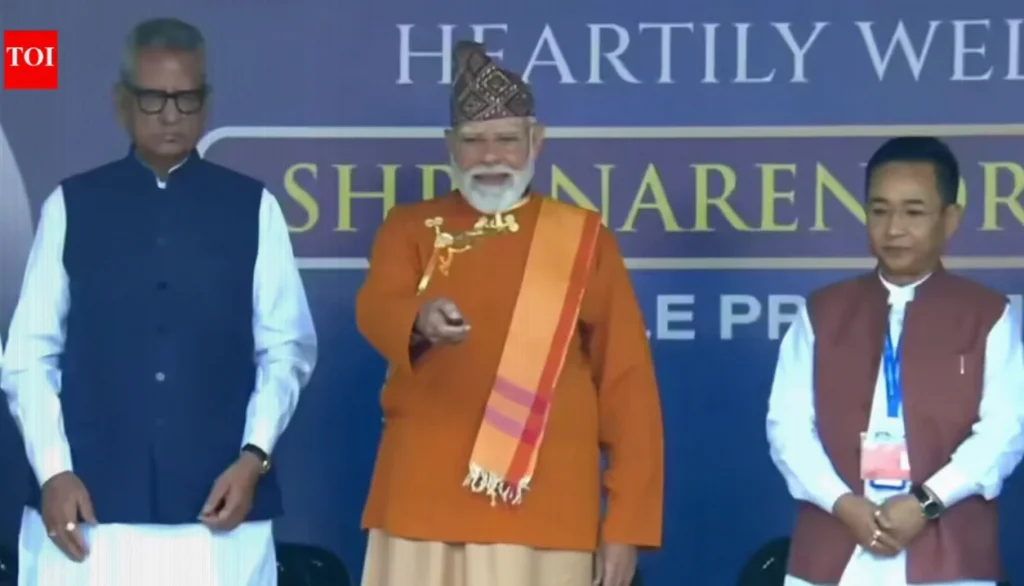
Prime Minister Narendra Modi on Tuesday virtually inaugurated an indoor cricket academy network spanning six Northeastern states, underscoring a renewed focus on sports infrastructure and grassroots development in the region. The launch was carried out from Gangtok, with new indoor facilities rolled out in Manipur, Arunachal Pradesh, Sikkim, Meghalaya, Mizoram and Nagaland. The initiative is supported by the Board of Control for Cricket in India (BCCI) and is intended to ensure uninterrupted practice even during the area’s long monsoon season.
Indoor academies unveiled across six Northeastern states
From Gangtok, Modi formally introduced state-of-the-art indoor academies across the six states—Manipur, Arunachal Pradesh, Sikkim, Meghalaya, Mizoram and Nagaland. The projects are designed to keep training schedules on track throughout the year, particularly when heavy rainfall disrupts outdoor activity for extended stretches.
Manipur’s flagship academy in Imphal
At the Luwangpokpa Cricket Stadium in Imphal, the Manipur Cricket Association’s indoor academy was highlighted as a flagship venue for year-round development. The academy is equipped with three dedicated practice strips, a gymnasium, administrative spaces and a swimming pool, creating a complete training environment aimed at supporting high-performance preparation.
“Historic moment” and impact on local players
Manipur Cricket Association secretary Lairenjam Geetranjan Singh described the opening as a “historic moment” for the state’s cricketing future, saying the facility will reshape the sporting landscape in Manipur. Singh said the academy will help players train continuously, with particular benefit during the rainy season, without needing to travel out of the region.
- Singh described the academy as a “historic moment” for Manipur cricket.
- The facility is expected to enable year-round training, especially during monsoon months.
- He said players will be able to practise without travelling outside the state.
BCCI support for maintenance and operations
Singh also stated that the BCCI will cover maintenance and operational expenses for the next two years. He pointed to recent achievements as evidence of the state’s growing strength, noting that Manipur reached five domestic finals in 2025 and claimed two Under-19 titles.
- Maintenance and operational costs for two years will be borne by the BCCI.
- Manipur reached five domestic finals in 2025.
- Manipur won two Under-19 titles.
- Singh added that the players are local talents developed through years of grooming.
Arunachal’s Doimukh academy and calls for consistent cricket
In Arunachal Pradesh, the indoor academy at Doimukh—developed in partnership with the Arunachal Cricket Association—was praised as a “landmark day” by president Nabam Vivek. Vivek said the project could serve as a turning point because monsoon conditions in the region typically last between six and seven months. He also stressed the importance of having stadiums that can host domestic competitions.
Senior player Techi Doria supported the sentiment, explaining that training during the rainy season had long been a challenge. With the new facility in place, he said such difficulties would be avoided, and it would encourage players to maintain consistent practice.
- Nabam Vivek called the Doimukh academy a “landmark day.”
- He noted Arunachal’s monsoon can run for six to seven months.
- Vivek urged the need for venues to host domestic events.
- Techi Doria said rainy-season training was previously difficult.
- Doria added that the facility will help players train consistently.
Modi on strengthening the Northeast sports ecosystem
Speaking at the event, Modi said investments in infrastructure like these will “nurture local talent, provide better training opportunities and strengthen the Northeast’s growing sports ecosystem.” He was in Gangtok on an official visit and, earlier in the day, also launched multiple development projects, highlighting the Centre’s commitment to expanding sporting and infrastructure capabilities across the region.
The inauguration reflects a broader push to build year-round training pathways for budding cricketers in the Northeast—an approach that can complement franchise-league pathways like the IPL by improving the pipeline of players trained in structured environments.
