
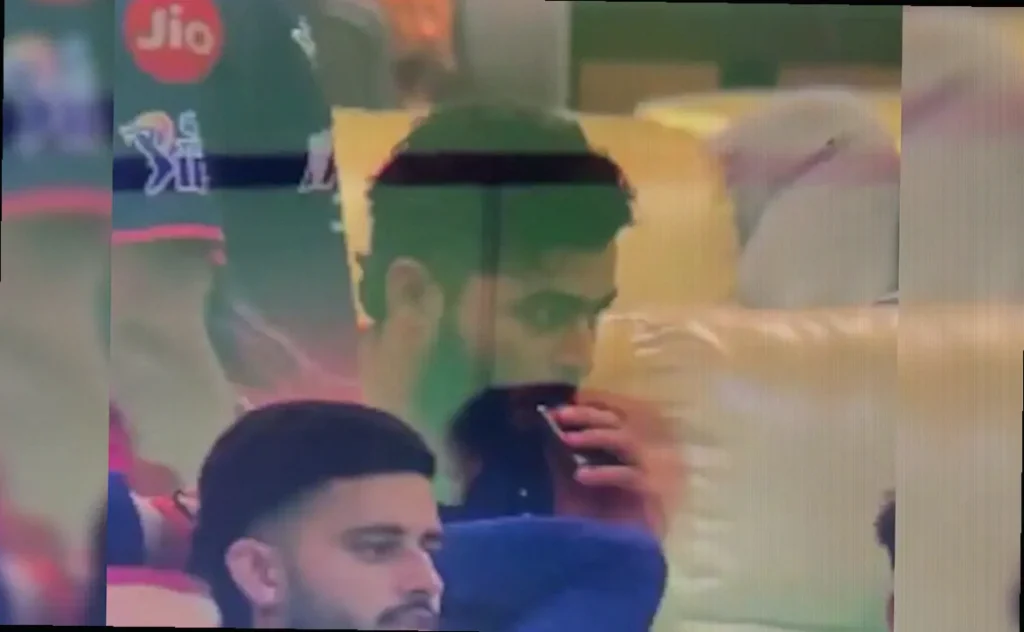
Rajasthan Royals captain Riyan Parag has been fined 25% of his match fee after being caught on camera vaping inside the team dressing room during an IPL 2026 fixture, triggering widespread controversy. The incident took place in Mullanpur during the match against Punjab Kings, and the league’s disciplinary process has now moved to sanction Parag under the IPL’s Code of Conduct.
The Board of Control for Cricket in India announced that Parag, leading RR, was penalised for breaching Level 1 of the Code of Conduct for Players and Team Officials. Alongside the monetary fine, he was also handed one demerit point for the offence, which was recorded during Match No. 40 of the TATA Indian Premier League 2026 against Punjab Kings.
In its statement, the board said Parag was found to have violated Article 2.21 of the IPL Code of Conduct, a clause that covers behaviour bringing the sport into disrepute. The matter came to light during the second innings, when Parag was seen using a vape inside the dressing room.
Parag admitted the offence and accepted the sanction decided by the match referee, Amit Sharma. The board also flagged that further action could be considered beyond the player alone, adding that RR, its officials, and other team members may also face consequences following the incident.
The statement further noted that the board is examining additional pathways to initiate proceedings for “stringent action” against the team and relevant personnel, with the aim of protecting the IPL’s reputation. When asked about the possibility of action against Rajasthan Royals, the BCCI secretary Devajit Saikia said that while the board is exploring steps against the franchise, the decision is not yet final.
Parag’s offence has also drawn attention to broader legal restrictions on e-cigarettes in India. The government banned e-cigarettes in 2019, covering the production, sale, and distribution of such products. Under the law, a first-time offender can face imprisonment of up to one year and/or a fine of Rs 1 lakh.
The IPL Code of Conduct describes Article 2.21 as a provision intended to address conduct that harms the standing of the game and is not specifically and sufficiently covered elsewhere in the code, including Article 2.20. It states that, depending on the seriousness and context, the article may prohibit—without limitation—public acts of misconduct, unruly public behaviour, and inappropriate remarks that are detrimental to the interests of the tournament.
In determining how serious the breach is, the code says the context of the situation and whether the conduct was deliberate, reckless, negligent, avoidable, and/or accidental will be assessed. It also explains that the person lodging the report places the incident on a severity scale, ranging from Level 1 for minor conduct up to Level 4 for extremely serious behaviour.
Because Parag’s case was classified as a Level 1 offence, the code indicates there was no need for a hearing, paving the way for the fine and the demerit point to be applied following his acceptance of the referee’s sanction.
