
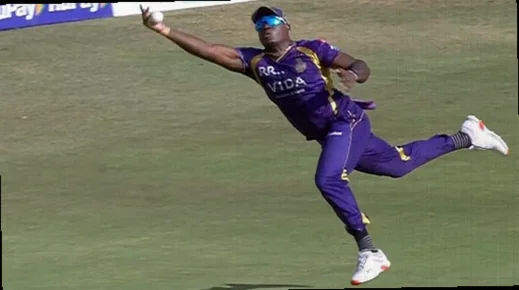
Kolkata Knight Riders’ win over Sunrisers Hyderabad hinged on a turning point in the 11th over, when Rovman Powell pulled off an extraordinary catch to send Heinrich Klaasen back after Cameron Green delivered the ball. At that stage, SRH were 117/2 with 10.3 overs gone, and the innings still looked set to race beyond the 200-run mark. On the surface it was “just” a wicket, but in the impact model used for this valuation, the catch carries a starting worth of ₹12.21 lakh and climbs to a projected figure close to ₹1.5 crore once Klaasen’s form, SRH’s match position, and the damage averted are factored in.
Powell’s catch caused the SRH collapse — and the timing was the entire difference. SRH were moving comfortably through the chase of momentum early on, already reaching 117 with only two wickets down. With 57 balls left, the run-rate sat above 11 an over, yet KKR hadn’t managed to break the innings open. Their task, in practical terms, was to stop SRH from turning a strong first phase into a brutal finish. That’s exactly what the wicket changed. Klaasen was on 11 off 7 at the moment of dismissal, which can look like a minor line item in isolation. The context, however, tells a different story: the two deliveries before the wicket went for six and four, and Klaasen had clearly shifted from settling in to launching. SRH had the platform, their most dangerous middle-order batter had found rhythm, and then the wicket arrived before the real damage could be done. That is why Powell’s fielding moment is valued higher than a routine catch would be.
In the model, the base credit for completing the dismissal is ₹12.21 lakh. This reflects the direct fielding impact of taking the wicket. But Klaasen wasn’t an ordinary batter in an ordinary situation. He was the key player most likely to convert SRH’s 117/2 into something in the neighbourhood of 200 or 210. The prevented continuation is where the valuation rises sharply. The projected total of around ₹1.5 crore isn’t based purely on reputation; it is built from Klaasen’s form, his role, and the match state at the time.
Heinrich Klaasen entered the KKR game among SRH’s most dependable high-impact performers of the season. He had already been one of the tournament’s leading run-scorers, and he had repeatedly steered SRH through difficult periods with calculated aggression. The key point about his value isn’t merely that he scores runs, but that he finds a way to score from the exact situations where SRH either need rescue or need acceleration. That dual role—insurance when things slow, and a launch mechanism when things are already in motion—was precisely what SRH had in front of them against KKR. They weren’t in trouble at 117/2; they were in the kind of position where one Klaasen burst could have rewritten the match.
With SRH already ahead of the curve at 117/2 after 10.3 overs, a standard finishing pattern could have brought them close to 190. A finish led by Klaasen, however, had the potential to nudge the total beyond 200. That difference is not just a number; it changes the chase entirely—altering the bowling plans, the risk tolerance, and even the mental shape of the second innings. KKR ultimately chased 166 with control. Had SRH posted a target above 200, the game would have been completely different.
Why the projected value reaches ₹1.5 crore comes down to how the model treats Powell’s catch in three layers. First is the base catch value of ₹12.21 lakh, the clean fielding credit for completing the dismissal. Second is the Klaasen continuation component, which forms the largest part of the projection. From SRH’s position before the wicket, Klaasen’s recent form and his role made it reasonable to anticipate a major extension had he survived. He had 57 balls of team time remaining, eight wickets still available, and he had just moved into attack mode after striking a six and a four. On that basis, the model estimates the prevented Klaasen continuation at around ₹1.20 crore. This figure does not claim that Klaasen had already generated that exact amount of impact. Rather, it reflects that Powell’s catch stopped the most likely high-damage scenario from unfolding.
Third is the collapse trigger. After Klaasen fell, SRH didn’t simply slow their run flow. They collapsed. What looked like a journey towards a 200-plus total ended at 165. This post-wicket fall adds additional value to the catch because it wasn’t only one wicket in a stable innings. It was the moment when the innings flipped from “launch” to “breakdown.” When these layers are combined, the final projected worth of the catch lands at around ₹1.5 crore.
The dismissal changed the entire value of SRH’s innings, and the clearest way to understand Powell’s catch is to see what it blocked. A scorecard only shows that Klaasen was dismissed for 11, but it doesn’t show that the wicket came immediately after he struck six and four. It also doesn’t show that SRH were already two wickets down with nearly half the innings still to go, or that Klaasen had already demonstrated across the tournament that he could take SRH from unstable or promising positions into meaningful totals. Impact analysis highlights those missing parts. Powell’s catch shut down the most dangerous route available to SRH: it removed the batter best positioned to influence the final 57 balls, converted a platform into pressure, and gave KKR a decisive foothold. Once Klaasen was gone, SRH lost control, lost wickets, and ended well below what their trajectory suggested.
On paper, it was Cameron Green’s wicket and Powell’s catch. In value terms, it was the point where KKR stopped SRH’s innings from becoming expensive. The base value sits at ₹12.21 lakh, and when Klaasen’s continuation threat along with SRH’s collapse is added, the projected value rises to around ₹1.5 crore. For KKR, the catch wasn’t only a fielding highlight—it was a high-value intervention in the match’s overall balance.
Method note: This valuation is based on a cricket impact model developed by the author. The model assesses batting, bowling, fielding, match situation, phase pressure, role difficulty, manual performance rating, and captaincy impact, then converts the contribution into a rupee value using the player’s auction or retention price and expected season usage. It is not an official IPL metric, salary calculation, or franchise accounting figure.
