
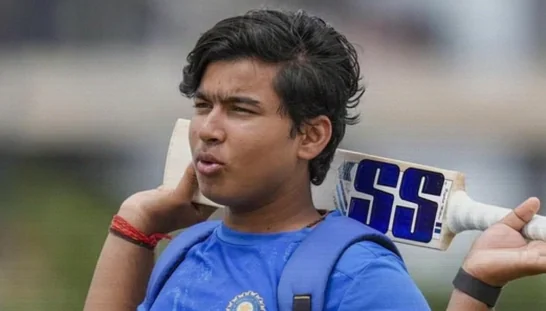
With momentum already building around Vaibhav Sooryavanshi’s chances of wearing India colours, the latest backing is even bolder: the teenager is being tipped to earn a place in the Test XI. At just 15 years old, Sooryavanshi has made enough progress over the past year to spark genuine excitement among former players, who are keen to see him step out in the Indian Test arena. Sooryavanshi’s experience so far has been dominated by T20 cricket, with occasional outings in the one-day format, while red-ball work has come far less frequently. He has played only eight First-Class matches, though he does have a few Youth Tests to his name. The long-term view is that he could become a serious Test prospect, but for now, his best fit appears to be the format where he has already shown his strongest returns.
That view is echoed by Zubin Bharucha, Sooryavanshi’s mentor and the figure credited with bringing him into the Rajasthan Royals setup. Bharucha believes the smartest move for the youngster—both for his development and for the bigger picture—is to take the plunge with an India debut sooner rather than later. In making that case, Bharucha reaches back to 1989, recalling how the BCCI backed a young Sachin Tendulkar and handed him his Test cap against Pakistan. Bharucha argues that the only way to properly judge a player’s composure is to throw him into the demanding environment and see how he handles it under pressure.
“That’s a difficult one because, honestly, if you look at it from any sort of metric—score, strike-rate, runs—he is already ahead of so many people waiting in the line. I actually feel they need to take that leap of faith, as they did with Sachin Tendulkar, and blood him straightaway,” Bharucha said to Wisden. “Only by throwing him into the deep end can one truly measure the level-headedness of a 15-year-old.”
While Bharucha is clear that Sooryavanshi should be tested in the Tests, he also believes the youngster’s ceiling is not limited to the role of an opener. Sooryavanshi has opened throughout his career, but according to his mentor, his most natural impact could arrive in the lower middle order—an area where India’s Test structure has recently relied on players such as Rishabh Pant and Ravindra Jadeja. Bharucha suggests that with a few adjustments to his technique and decision-making, Sooryavanshi could be set up for something special in that phase of an innings.
Is Sooryavanshi ready for Test cricket?
Bharucha’s starting point is technical. “My belief is that technically, he doesn’t commit himself enough. He is always on the back foot, and that to me is the holy grail of batting. So when the ball is moving, if you don’t commit your front foot—that is talking about the greats of the greats. The question is whether we can get him to follow the same sequence when the ball is moving. I also feel that opening isn’t his calling. He has so much more to offer, that we would be amiss to suggest he goes into the opening slot straightaway,” he added.
He then outlined a possible starting plan for the Test format. “I won’t put him at 4 at the moment. He is slightly behind that. Numbers 5-6 might be a better entry point, where he can potentially come in around the 60th or the 70th over, and then pile on a quickfire 40-50. After that, when the new ball arrives somewhere along the way, he can learn to manage it as well. My long-term thought is that if we can help him understand the nuances of the moving ball—how he deals with it in different combinations—then his range will expand. For example, if there is a Test in Bengaluru, he might still open and score runs, but if he’s playing at Leeds or somewhere else, where the ball isn’t as visible and the crowding of fielders around the batter changes the equation, it could be a challenge.”
Bharucha concluded by stressing that flexibility could be the final breakthrough. “Still, over time, if he figures it out, he would be equally devastating at the top as he would be lower down the order. That would be the final piece in the jigsaw.”
