
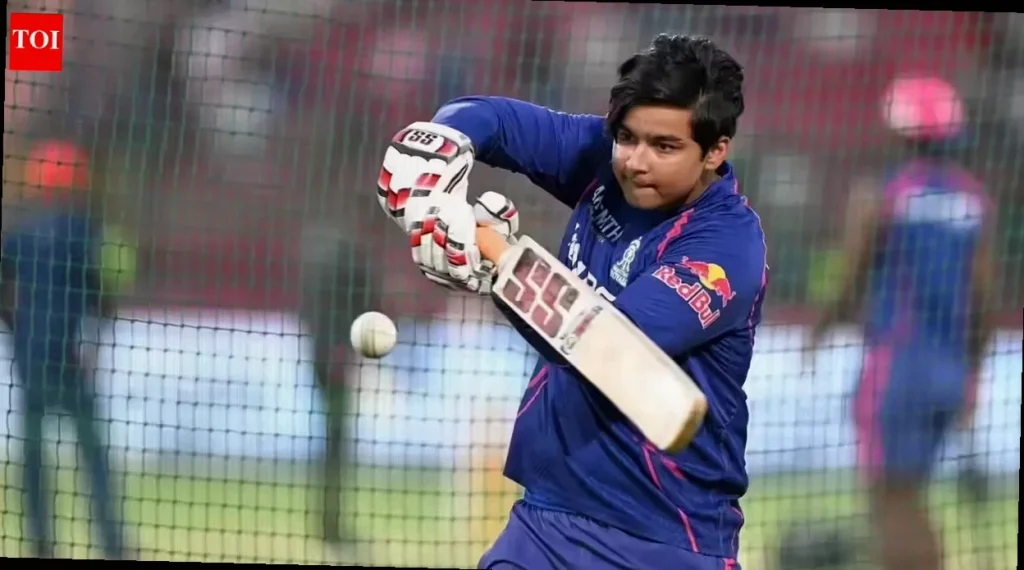
Vaibhav Sooryavanshi’s last outing in the 2025 IPL season still lingers in the minds of fans, not just for what he did with the bat, but for the message that came with it. During a conversation with Rahul Dravid, the youngster was told: “Next year will be crucial. It will be a real test for you because opposition bowlers would have figured you out.” By that stage, Sooryavanshi had already etched his name into IPL history as the youngest batter to record a hundred. Yet even a year on, bowlers have struggled to find consistent answers. In IPL 2026 so far, he has struck one century, added two more fifties, and has already crossed 400 runs, with the competition still underway.
After Dravid moved on from the Rajasthan Royals, the franchise did not slow down in its efforts to refine Sooryavanshi’s approach. The teenager even missed his Class 10 board exams to take part in the Royals’ training camp. While he had already produced centuries in England, Australia and South Africa, and also delivered a match-winning 175 in the Under-19 World Cup final, he continued to invest additional time in strengthening various aspects of his batting.
Speaking about the Royals’ preparation for a more difficult second IPL campaign, Sooryavanshi’s mentor and former Rajasthan Royals director of cricket, Zubin Bharucha, explained that the entire set-up was built around staying ahead of opponents who would have studied the youngster closely.
“Everybody predicted that he would not have a good second season in the IPL. And that became a major source of motivation for us to get him ready, because once teams know his game, the challenge is figuring out how to counter him. So what can we do to be one step ahead? He is intuitive and extremely intelligent. He is incredibly sharp. He remembers every tiny detail of every tiny ball that gets bowled to him. It’s all very specific, very well planned—he is always prepared for what could happen, and he’s good with scenarios. It’s a combination of things you don’t often see together,” Bharucha said.
Bharucha added that Rajasthan Royals began working on Sooryavanshi’s batting long before the pressure of a second-season spotlight arrived. From the time they first identified him, the franchise tracked a wide range of details—everything from bat speed and swing speed to key impact points.
In Bharucha’s account, Sooryavanshi’s bat-swing speed initially sat in the 90 to 95 kmph band. The Royals’ goal was to push that higher and enhance his ability to strike the ball cleanly.
“We worked on it very diligently. We used heavy bats, outfield sessions where he was encouraged to hit every ball for six, and multi-stage sequencing drills. Within three to four months, we saw his bat speed rise from the 92–95 kmph bracket to nearly 110–115 kmph. That’s a massive change. In bat-speed terms, it’s a huge jump—those were the kinds of improvements we focused on. Then came the next layer, which was helping him access different deliveries,” Bharucha said.
Bharucha also pointed out that Sooryavanshi had initially leaned more heavily toward shots on the off side. The Royals wanted to balance that tendency, improving his option set across the crease.
“At the start, he was a bit more tilted towards the off side, so his game had plenty of off-side shots, but not as many on the leg side. We had to work on that. Even now, when he faces fuller balls on middle stump through midwicket and square leg, he may not be as comfortable as he could be. But we have made him substantially better than he was before,” Bharucha added.
He further said that Sooryavanshi trained using the same structured methodology the Royals have used for players such as Yashasvi Jaiswal, Dhruv Jurel, Riyan Parag and Sanju Samson.
“From a systems perspective, we always track how many balls a player faces each day, each week and each month. Players like Yashasvi Jaiswal, Dhruv Jurel, Riyan Parag and Sanju Samson have gone through thousands and thousands of repetitions and faced thousands of balls in training. We simply put him through the same process,” Bharucha said.
