
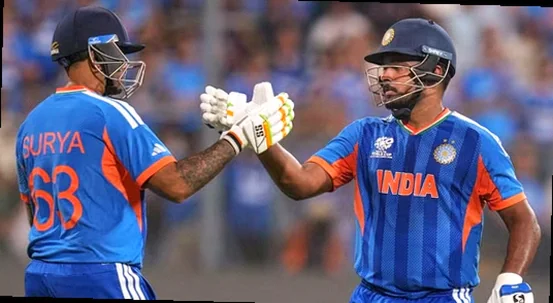
In recent weeks, reports in Indian cricket circles have suggested that Suryakumar Yadav’s spell as India’s captain in T20 internationals could be reassessed sooner than later. The discussion has centered on the idea that the BCCI may want to identify a longer-term option well before the next T20 World Cup, scheduled for 2028, with the aim of building leadership continuity beyond the current 2026-winning captain. Former India head coach Ravi Shastri, however, believes the federation should look in a specific direction rather than focusing only on the usual debate around immediate form.
Shastri points to Samson for India’s next leadership phase
Speaking on the ICC Review, Shastri said that India could indeed be looking for a fresh captain by the time the 2028 tournament arrives, depending on how Suryakumar performs over the next couple of years. He acknowledged that if India were to move on from Suryakumar, there would be more than one name for consideration, but he still felt one standout player should be elevated for a leadership role.
Shastri noted that Shreyas Iyer could be among the candidates, citing his IPL record, and he also mentioned Hardik Pandya as another option. Yet the former coach’s preference was clear when he highlighted Sanju Samson—currently not leading any IPL side as captain—despite that fact.
“But Sanju Samson has put himself there for a leadership role because he’s done that in the past for Rajasthan,” Shastri explained. “And he’s a certainty in the side, at the top of the order, extremely destructive. So I see him—this is just the start of something more you’ll see from Sanju over the next two or three years.”
Why Shastri calls Samson a leading prospect
Samson has previously led Rajasthan Royals in multiple seasons, including a run to the IPL final in 2022. He has since moved to Chennai Super Kings, where he operates under the captaincy leadership of Ruturaj Gaikwad. Even with that change in team and leadership structure, Shastri believes Samson’s value has remained consistent—both as a dependable figure in India’s shortest-format setup and as a batter with growing experience.
Shastri argued that Samson has answered doubts about his ability. “I think he has put a lid on all those question marks. There was always ability. People would, in fact, be disappointed because he wouldn’t do justice to that ability,” he said.
Impact in high-pressure matches
A major reason Shastri is backing Samson is the manner in which he has stepped up during crucial phases in recent months. In particular, he pointed to Samson’s run during the T20 World Cup, where he produced three major half-centuries across the three must-win games at the end of the tournament—a stretch that helped keep India’s campaign alive and demonstrated his ability to deliver when the stakes rise.
Shastri then added to the argument by emphasizing Samson’s performances beyond that tournament. He highlighted how Samson played after the T20 World Cup, describing how he nearly carried India in multiple important matches, including the quarter-final against West Indies, the Super 8 stage games, the semi-final, and the final.
CSK maturity and leadership responsibilities
Beyond raw match-winning bursts, Shastri said he is even more convinced by the maturity Samson has shown while batting at the top of the order for CSK. With the pressure of expectations and the absence of one of the team’s senior figures, MS Dhoni, Samson has been required to take on greater responsibility in the leadership group. Shastri believes Samson has responded well—leading from the front in yellow with a couple of centuries and another strong season to reinforce his growing stature.
Concluding his remarks, Shastri said that Samson’s approach in the IPL—especially the composure and maturity he brings to big situations—makes him a clear option for leadership in the future. He ended by throwing his full support behind Samson as the next India leadership candidate, framing it as the beginning of a longer upward arc over the coming years.
