
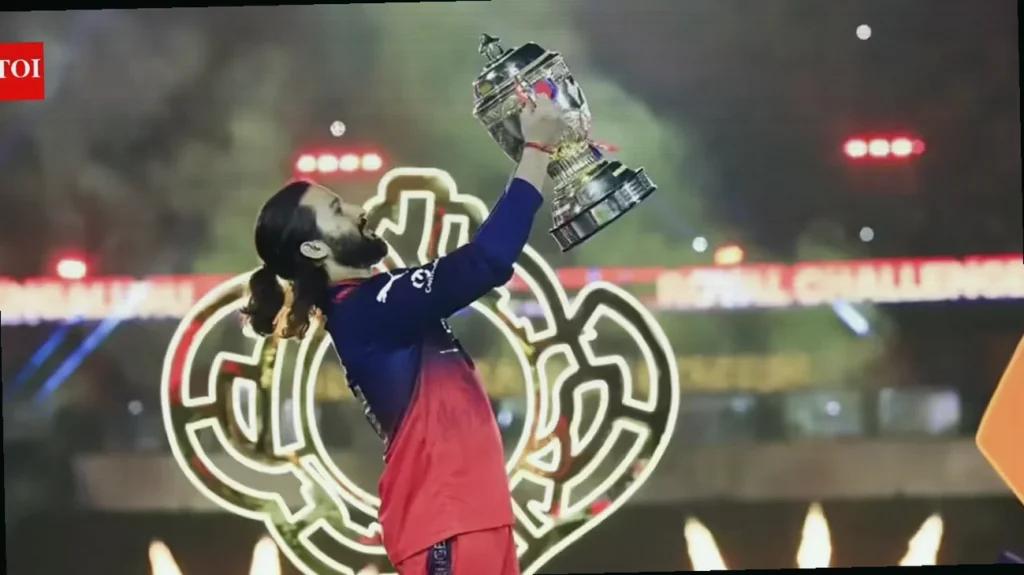
Fireworks lit up the Ahmedabad night as Royal Challengers Bengaluru marked yet another IPL title with celebrations that spilled into the streets. In the middle of the noise, one man stayed back, watching quietly from the stands and letting the moment settle in.
That spectator was Abhishek Pathrod, positioned close to the presentation area as he waited for his childhood friend, Rajat Patidar. After the trophy was lifted, Patidar walked straight over to him and the two shared a long embrace—eyes wet, emotions spilling over after years of shared ambition and hard graft on the field.
“Dekha, jeet gaye. Kar diya na maine,” Patidar told Abhishek before pulling him in for another hug. Abhishek, who had already spent a good amount of time playing junior cricket alongside him, couldn’t help adding a playful reminder of the journey that had brought them here.
“Yes bhai, welcome, injury replacement to two-time IPL-winning captain,” Abhishek said, prompting laughter between them. The line carried more than humour—it captured how quickly careers can pivot in T20 cricket, and how faith in a teammate can turn into belief at the highest stage.
From RCB understudy to back-to-back captain
- Rajat Patidar now became the only captain after MS Dhoni and Rohit Sharma to win consecutive IPL titles as captain.
- Abhishek Pathrod described Patidar’s captaincy as a shift from a relatively unknown RCB name to a leader who delivered the trophy.
- Pathrod recalled friends asking Patidar about pressure when he took over the role.
Two years ago, Patidar was just another face in the RCB dressing room. He shared the space with household names such as Virat Kohli and Faf du Plessis, along with other major stars, yet he hadn’t fully stamped his identity on the IPL stage.
Now, the picture has changed completely. Patidar stands out as the only captain after MS Dhoni and Rohit Sharma to guide his team to back-to-back IPL titles from the captain’s chair.
Pathrod looked back on what it meant when Patidar first took over. “No one knew, I mean, he didn’t know he was matching the kind of records Rohit and Dhoni have. His teammates told him,” he said. Pathrod also recalled the early days of the captaincy, when friends gathered and asked him, “Bhai, 17 saal se nahi jite, pressure ka kya?”
He remembered Patidar smiling and replying, “Kya pata iss baar jeet jayein.” And then, in the end, he led the team to an IPL title—turning early conversations into a reality.
The captaincy challenge—and the calm that came with it
Leading RCB is not the same kind of job as captaining a side like Mumbai Indians or Chennai Super Kings. The franchise has carried the weight of a long wait—17 years without a trophy—and the pressure that comes with that history is unlike anything else in the league.
But Patidar didn’t just accept the responsibility. He also raised his batting output alongside the captaincy, a combination that many elite captains have struggled to maintain consistently.
His childhood coach and mentor, Amay Khurasiya, said leadership qualities were visible in Patidar long before the armband. Khurasiya described how he used to assess him in youth camps, noting that Patidar often spoke less, but when he did, it was with clarity and sound thinking.
“I have seen him from a very young age… we do a lot of tactical assessment, a lot of strategical assessment of kids—asking them questions—and he was always there with a different thought process,” Khurasiya said. “He used to speak very less, but whenever he spoke, he spoke a lot of sense.”
Khurasia added that Patidar’s leadership showed up in how he took chances and owned decisions. “As a leader, if you see, he takes his chances, he takes his decisions… if they don’t come his way, he will accept them. If things don’t go his way, he will accept them,” he said.
Even when the franchise approached him about the captaincy in 2024, Patidar didn’t immediately say yes. Pathrod explained that he wanted to return to domestic cricket first—captain teams there and check whether he was truly ready to handle a responsibility of this scale.
Patidar had already captained in domestic setups before moving up the ladder. He later led Madhya Pradesh to the final of the Syed Mushtaq Ali Trophy. Madhya Pradesh lost that final by five wickets, but Patidar’s unbeaten 81 off 40 balls stood out as a defining innings.
When Patidar eventually took the RCB captaincy, many around him felt the decision leaned more on temperament and personality rather than only on captaincy experience. His calmness, in particular, became a talking point.
Khurasiya compared that steadiness to some of cricket’s most composed figures. “Look at the way he bats and captains. Think of Roger Federer—calm and composed. Rahul Dravid, calm and composed. Sachin Tendulkar, calm and composed. MS Dhoni. Patidar is very similar,” he said. “But that doesn’t mean he isn’t aggressive.”
Khurasiya explained that the aggression sat inside rather than on the surface. “He has always been one of those people who are aggressive from within but never feel the need to show it. Rajat is the same. He is a man of few words, but whenever he speaks, he speaks sense.”
He also pointed out the courage required to keep emotions controlled. “Not showing your emotions also takes a lot of courage and aggression. If you want to see his aggression, look at his batting and look into his eyes. He will never respond with words, but he will definitely respond with actions,” Khurasiya added.
Not just a spin basher: Patidar’s season numbers
Patidar’s overall return for the season was 501 runs at an average of 41.75, with a strike rate of 192.69. Beyond the steady partnerships and key contributions, one innings in Qualifier 1 against Gujarat Titans stood out as a clear marker of how much he had grown as both a batter and a captain.
Known previously for dominating spin, Patidar expanded his attacking range further this season. He went after pace and spin with similar confidence, and did so at a pace that made the innings hard to contain. This year, 283 of his 501 runs came against fast bowling, where his strike rate reached 177.9. Against spin, his strike rate climbed to 201.8.
Pathrod said the numbers were tied to the intense preparation Patidar had been putting into his batting ahead of recent IPL seasons. “Many call him ‘spin destroyer’ here. That’s his nickname. But it’s not just spin. He hits both spinners and fast bowlers equally well. He’s had success against quality pace attacks too,” he said.
He also described Patidar’s routine away from match day. “Rajat spends at least four hours batting every day at the Holkar Stadium (in Indore, Madhya Pradesh). Even now, he gives himself three to four hours of batting practice regularly. He plays spinners and fast bowlers, and there are throwdown specialists who bowl to him. In this IPL, he smashed pacers too. He did a lot of practice for this,” Pathrod said.
With RCB now carrying two titles in succession, Patidar’s place in the franchise’s history is firmly cemented. If Kohli was the pillar around which Bengaluru built their championship-winning teams, Patidar is being seen as the architect who turned those dreams into something tangible.
And after back-to-back celebrations, the future looks even louder. A historic hat-trick of IPL titles could still be on the horizon for Patidar and RCB in 2027.
