
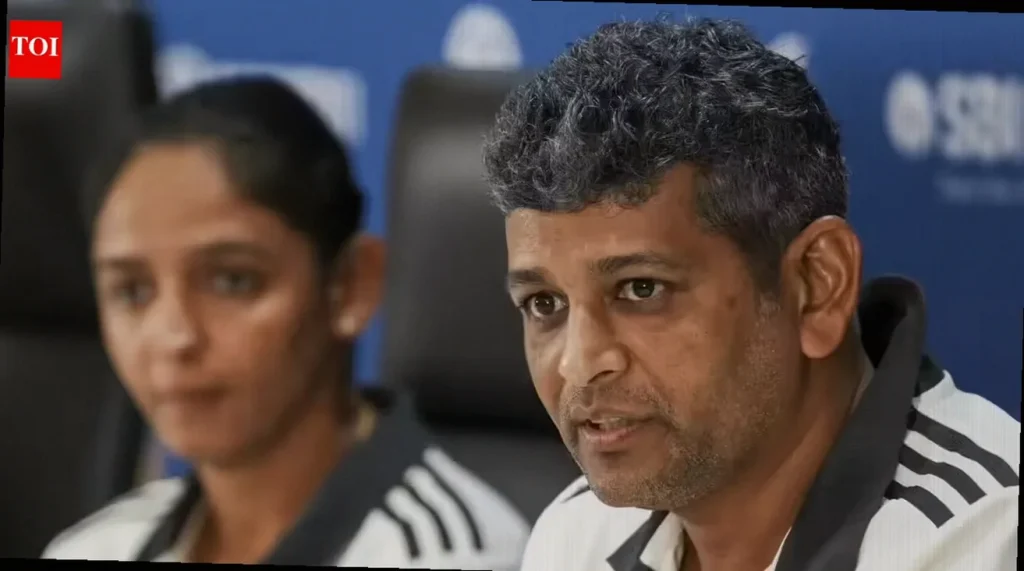
MUMBAI: India’s women may be reigning world champions in 50-over cricket, but their T20 preparations are showing clear gaps as they look to replicate similar heights in the shortest format. On Monday in Benoni, the Harmanpreet-led side were beaten by South Africa by 23 runs in the fifth and final T20I, after failing to overhaul a modest target of 156. India ended their chase on 132 for eight in their 20 overs, and the loss sealed a 4-1 series defeat. The setback arrives at an awkward time with the 2026 Women’s T20 World Cup in England due to begin on June 12, leaving the group with little room to ignore the issues exposed across the series.
The bigger concern is not just the result, but the road ahead. South Africa are drawn alongside India in Group A of the upcoming World Cup, with defending champions Australia and other teams including Bangladesh, the Netherlands and Pakistan completing the group. With that in mind, India’s head coach Amol Muzumdar said the team would rather focus on the lessons than dwell solely on the final scoreline. He admitted the side were “a little disappointed with the 4-1 result,” yet framed the series as valuable competition in tough conditions.
Speaking after the series ended, Muzumdar described the contest as one India had to earn through the process, adding that the tour had been a strong test despite the outcome. He pointed to two main problem areas: difficulties in taking wickets during the Powerplay and batting that did not consistently finish off games in the opening portion of the series. India lost the third T20I by nine wickets even after posting a competitive 192 for four, underlining that the ability to set a platform was not always translating into controlling the finish. Muzumdar said those specific concerns were addressed later as the tour progressed.
“Initially, in the powerplay, we weren’t able to pick up wickets, that was one area of concern for us,” Muzumdar said, while also highlighting finishing with the bat as another point that needed improvement. He added that India corrected both aspects during the final stretch of the series, suggesting the team learned quickly after early setbacks.
With the World Cup on the horizon, India also rotated personnel and used the series as an opportunity to trial combinations. Smriti Mandhana, the vice-captain and a major opening force, was rested for the last two matches. Meanwhile, Anushka Sharma, representing Madhya Pradesh and Gujarat Giants in the domestic setup, was handed three T20I appearances. In those games, she scored 72 runs at an average of 24.00, giving India a chance to assess her impact at the international level.
Another player given a look was Kashvee Gautam, a pacer from Punjab and Gujarat Giants. Having already made her Test and ODI debuts within the past year, Gautam also received her T20I initiation during the series, though it did not go to plan. Across three matches, she conceded 87 runs in eight overs and took only one wicket, leaving her with an average of 87.00 and an economy rate of 8.87.
While India’s struggles contributed to the defeat, South Africa’s quality—particularly from their captain Laura Wolvaardt—was a decisive factor. Wolvaardt looked in complete command throughout the series, amassing 330 runs in five matches at an average of 82.50 and a strike rate of 168.36. Her run haul included three half-centuries and a century, and she finished as the leading scorer on either side by a wide margin. Her sequence of scores read 51, 54, 115, 18 and 92 not out, a set of knocks that consistently lifted South Africa’s batting and made India’s task significantly harder.
Muzumdar praised Wolvaardt’s batting, saying South Africa deserved credit and adding that Wolvaardt played “beautifully” through the series. That form, he implied, was one of the principal reasons India were forced to chase from behind rather than build pressure from the start.
Despite the series loss, Muzumdar insisted there were positives for India to carry forward. He singled out Harmanpreet Kaur’s batting, noting that the 37-year-old finished as India’s top run-getter with 169 runs in five matches at 42.25, including one half-century. He also welcomed a return of touch for wicketkeeper-batter Richa Ghosh in the final two matches. Ghosh struck 34 not out off 18 balls, and then followed it with 25 not out off 15 balls, after earlier scores of 5, 3 and 18 not out in her first three outings. Another bright spot was Deepti Sharma, who had initially struggled during the series but delivered when it mattered most in the fourth T20I at the Wanderers in Johannesburg. She contributed 36 not out off 26 balls, then produced a match-turning spell by taking five wickets for 19 runs in four overs with her off-spin.
Reflecting on the overall picture, Muzumdar framed the series as a mix of hard moments and useful progress. He reiterated that Harmanpreet’s form was a standout, described her preparation and work ethic as “spot-on,” and stressed that Ghosh’s late recovery and Deepti’s impact in the fourth match were significant positives. He also pointed out that the camp leading into the tour and the work carried out during April provided the foundation for the improvements seen in the later games. Although the result did not swing India’s way, Muzumdar said the team would treat the defeat as a source of learning and takeaways ahead of the next major assignment.
