
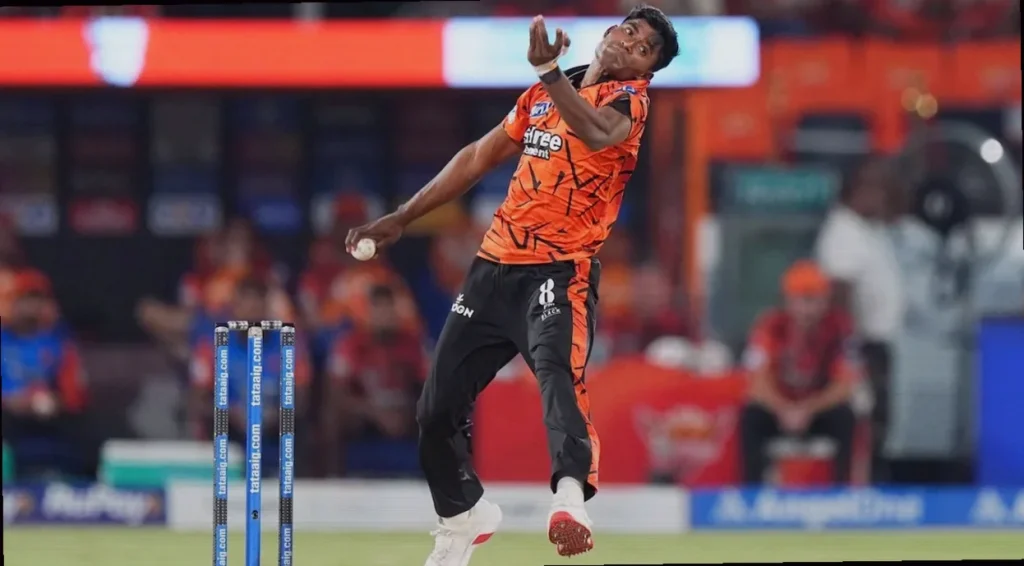
Sakib Hussain first learned to bowl fast not on manicured pitches or in bright city academies, but in the wheat fields of Gopalganj, Bihar—roughly halfway between Patna and the Nepal border. There, young cricketers carve out makeshift wickets by clearing roots and compacting the playing surface flat. It is a world removed from the organised cricket pathway most players know: no nets on schedule, no formal coaching pipeline, no selectors hovering over performances. Instead, it is an unfiltered tennis-ball culture powered by raw enthusiasm and only modest financial returns.
For Sakib, who is now 21, those small paydays once meant everything. In tennis-ball matches, a strong showing could earn him around Rs 300 to Rs 500 (about US$5). That money was crucial in a home that still relied on his father’s daily wages. Two IPL rounds later—after first featuring for Kolkata Knight Riders in 2024 and now becoming a regular with Sunrisers Hyderabad—the financial pressure has eased. Yet the tough early days remain a reminder of how far he has come.
Those tennis-ball contests, often played on unpredictable ground, helped sharpen the pace that defines Sakib’s bowling today. His stamina, meanwhile, was built through years of sprint work in his teens. He also believed the same running routine would stand him in good stead for army trials—something he seriously considered for a period of time.
“They called him Gopalganj’s Rabada,” says Robin Singh, a Bihar state coach who mentors Sakib and shares a close relationship with him. The bond is visible too: Sakib wears jersey number 18 as a tribute to Robin’s birth date.
****
Robin first came across Sakib in 2018, when the youngster was about 14.
“One of my nephews told me, ‘Chacha, I have a friend. He’s quick, but he only plays tennis-ball cricket. With proper guidance, he’ll become excellent,’” Robin recalls.
Curious, Robin invited Sakib to train at an academy he was linked with in Patna’s Anisabad area. What he noticed immediately was a wiry fast bowler with genuine pace, but also an unpolished, unusual action.
“If this were state trials, maybe I wouldn’t have been so interested,” Robin says. “But my instincts told me he is special. Even on a slow wicket, the ball was travelling well. It wasn’t losing pace after pitching—it was skidding. Batters were getting hurried.”
Robin believes the most impressive part was not just that Sakib could bowl fast, but that the natural pace and the skid he generated was rare—especially considering he had never received formal coaching and had even bowled without using a red ball.
“I told him, ‘Beta, we’ll offer you free practice.’ He said thank you, but later he told my nephew that even if coaching was free, he couldn’t afford the living expenses in Patna. So he went back to Gopalganj,” Robin remembers. “When my nephew told me this, I said, ‘We’ll find a way.’”
In 2019, the “way” finally appeared. A cricket facility opened in Gopalganj, and the person who played a key role in establishing it was the late Tunna Giri, then president of the district cricket association. Giri was also a long-time supporter of cricket in the region, and he happened to be a close friend of Robin’s family.
“I told [Sakib], ‘Now you don’t need to go anywhere. Train here,’” Robin says. “But I put one condition: you have to stop playing tennis-ball cricket. Whatever difficulties you face, tell me directly. Tunna Giri and his younger brother, Kumar Giri, also said they would do whatever they can to help him financially.”
By around mid-2020, the work started showing results. Although Sakib’s improvement was clear compared with when he first began—about a year earlier—still, it wasn’t simple to convince people inside the selection set-up. Robin pushed for recognition, only to receive dismissive replies.
The usual line was: “Arre, wohi bowler na? Jo dusre net pe ball phenkta hai?”—meaning, “Isn’t he the bowler who bowls into the other net?”
Robin also noticed something technical: Sakib had a hyperextended elbow, similar to Jasprit Bumrah. From a biomechanics perspective, his wrist movement, the use of his levers, and the way energy transferred through his delivery were fascinating. Even though tennis-ball cricket had shaped him entirely up to that point, Sakib still had traits that matched modern fast-bowling principles.
A major turning point arrived in 2021 with the launch of the Bihar Cricket League (BCL). Robin decided to stake his reputation to secure Sakib a chance. “At 10 pm, the night before the final shortlists for teams, I told one of the state coaches, Ashok Kumar, ‘If this boy turns out bad, I’ll stop coming to Patna for coaching.’”
Ashok had contacted Robin seeking a few names to suggest for BCL teams. Robin urged them to pick Sakib, and he was eventually selected for Gaya Gladiators. For Robin it felt like a personal win, but for Sakib, the significance did not land in quite the same way.
View this post on Instagram
He hesitated—not because he didn’t want to play, but because he lacked the money needed to travel to Patna for the tournament.
Robin and a few others organised his train tickets and ensured his kit was ready.
“Later I learned there was a tennis-ball match scheduled and he was going to be paid Rs 500,” Robin says. “I had to drill it into him that BCL was a big opportunity and his life could potentially change.”
Sakib eventually made the trip. After two sessions, the very people who had been unsure about him started paying close attention. The story shifted fast—from asking where he came from and how he managed to get there, to telling him not to bowl in the nets. The message was simple: keep that pace for the opposition and spare their own batters.
That reputation for blistering speed only grew further during an age-group tournament at Jamia in Delhi in late 2021. On a pitch that offered almost nothing to fast bowlers, Sakib still attacked with conviction. Robin says he finished the competition with 20 wickets across four matches, while the next-best wicket haul for a fast bowler was five.
Those displays brought him to the attention of S Sharath, chairman of the junior selection panel. Sakib was picked for a zonal camp run by the National Cricket Academy, where he trained under former India fast bowler Tinu Yohannan.
Next came time with the MRF Pace Foundation in Chennai, followed by work as a net bowler with Chennai Super Kings during the 2022 IPL. Later that same season, he earned his senior debut for Bihar in the Syed Mushtaq Ali Trophy, where he took 4 for 20 in the final league match against Gujarat.
“Batters kept getting rushed into their shots, and they were pulling to areas where the ball ended up—point or short third,” Robin recalls.
With a solid start to senior cricket, Sakib’s progress looked primed for IPL 2023. But a knee injury ruled out those plans. Had it not happened, he might have been brought in by CSK as a replacement for the injured Mukesh Choudhary. Instead, he had to begin again from scratch.
In late 2023, Robin joined JioHotstar as a commentator for the Bhojpuri feed. During that work, he ended up speaking with several IPL franchise scouts. One of them was Abhishek Nayar, then an assistant coach with Kolkata Knight Riders.
In conversation, Nayar asked Robin casually about how quick Sakib was. “I said, ‘Very quick.’ Then he told me to look him up,” Robin says. “Abhishek checked with the NCA, did his due diligence, reviewed the Mushtaq Ali footage, called him for trials, and Sakib did very well. That’s how he got picked by KKR for the 2024 season.”
During practice matches in that season, Sakib dismissed Andre Russell and Manish Pandey. In one such game, with a target of defending 21 off 12 balls, Sakib and Mitchell Starc were assigned to bowl in the final overs. In the 19th over, Sakib conceded just six runs.
Despite the signs, match chances were limited. Starc, Harshit Rana and Vaibhav Arora all delivered during a year when KKR went on to lift their third IPL title. Sakib was expected to play against CSK in Chennai, but KKR lost early wickets and chose all-rounder Anukul Roy as their Impact Sub instead.
“Maybe it was just meant to be that his debut would come later, in a bigger way,” Robin says.
After missing out in 2024, Sakib was released by KKR when the IPL moved into a new auction cycle. Another untimely injury meant he again struggled to find takers last year. He then relocated to Lucknow—Robin’s new base—and spent the off-season living with him and training.
****
At around that time, Varun Aaron—Sunrisers Hyderabad’s current fast-bowling coach—began to have a major impact on Sakib’s career. Aaron had heard about him from Sakib’s peers at the MRF Pace Foundation, where Sakib had been training until recently. Aaron saw in Sakib a rawness that needed direction.
“Varun bhai had already heard about him and seen some videos,” Robin says. “But when he saw him properly, he understood what he could become.” The mentorship that followed is the foundation Sakib is benefiting from now.
“Varun has put in a lot of effort,” Robin adds. “His understanding of biomechanics and modern fast bowling is exceptional. When I speak to him, I feel he’s next to no one in that space among young Indian coaches.”
Aaron’s plan for Sakib was straightforward: he wasn’t trying to reinvent the bowler. He did not force Sakib’s action into a textbook shape that would blunt his natural strengths. Instead, sessions became more targeted. Greater emphasis went into load management, recovery routines and small, steady improvements rather than constant high-intensity bursts.
He kept regular contact as well—monitoring Sakib’s progress and sending feedback remotely when busy with television duties. When continuity required it, Aaron ensured Sakib had access to other training setups. For example, when Aaron was occupied with broadcasting commitments for the T20 World Cup earlier this year, he sent Sakib to SS Rao, a former senior fast-bowling colleague in Jharkhand, based in Bhubaneswar, along with a custom programme for him to follow.
Even with the new structure in place—managed workloads, biomechanics focus and elite coaching support—the wheat-field roots still show in Sakib’s bowling. The skiddy rhythm, the bouncers, and the refusal to hold back remain. That was evident recently too, when he stuck to his approach of trying to target Vaibhav Sooryavanshi with the short ball in Jaipur.
In this year’s IPL, Sakib has produced spells where batters have been hurried, and he has delivered variations that carry the same deception as his most common ball. That pattern was visible in his debut match as well, when he took 4 for 24 against Rajasthan Royals—three of those wickets coming through slower variations.
“With Sakib, that slow ball is just brilliant,” Aaron said after Sunrisers Hyderabad’s win over Delhi Capitals last week. In that match, Sakib finished with 1 for 29 while the average economy rate was climbing towards 11. “He’s getting almost as much turn as an offspinner on that slower ball. Same arm speed, executes his yorkers, and can bowl 140-plus as well. With the way the game is headed, you need that range—you have to be able to go from 140-145 down to almost 107.”
The range that once emerged in Gopalganj’s fields is now being sharpened. Sakib’s story is not finished yet, but the direction is clear. Somewhere in his run-up still lives the boy who had to weigh a Rs 500 tennis-ball match against a shot at something bigger. Now, at last, he is charging towards it—unblocked and fully committed.
