
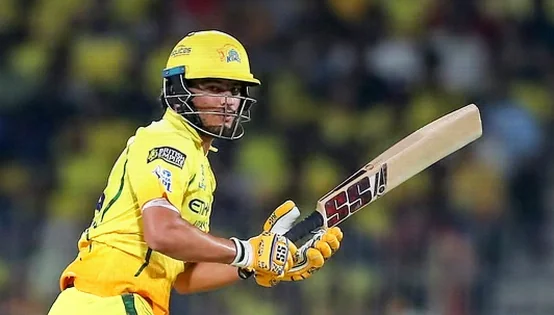
Chennai Super Kings’ deployment of Prashant Veer is quickly becoming one of the oddest tactical threads in IPL 2026. CSK paid a hefty ₹14.2 crore for him ahead of the season, expecting more than just a left-handed bat—he was acquired as a left-arm spin-bowling all-rounder whose worth was meant to come from balance, flexibility, and long-term usefulness. But with only two matches completed in his CSK stint, that original logic is already struggling to hold up.
Why CSK’s use of Veer is raising eyebrows
- Veer has appeared in IPL matches against Punjab Kings and Royal Challengers Bengaluru for CSK.
- Despite being part of the playing group in both games, CSK have not given him a single over—meaning his left-arm spin option has not been used at all.
- That is particularly striking because Veer’s profile is not that of a specialist batter who bowls only occasionally. He is meant to be a genuine slow left-arm orthodox option who also bats left-handed.
- Such dual-skill players are typically prized because they let captains reshape innings plans in two areas: with batting depth and with bowling match-ups.
- Yet CSK’s approach suggests they do not trust the second part of his skill set.
- Against Punjab Kings, Veer made his debut but did not bowl even though CSK were defending a total.
- Against RCB, he again remained in the XI despite not having bowled in the previous match, and he still was not used with the ball while CSK suffered a 250/3 kind of hammering.
The contradiction becomes harder to justify as the pattern repeats. If Veer is considered good enough to occupy a spot in the playing XI, why has he not been trusted to deliver even one over? And if the franchise is not using his bowling at all, what exactly is the rationale behind paying a premium for a player whose value is built around all-round contribution?
The financial angle: paying for bowling value and not using it
The money side of the story is just as uncomfortable. With CSK’s spend of ₹14.2 crore across the 14 league matches, Veer’s price works out to roughly ₹1.014 crore per match. If that total is split evenly between batting and bowling, the bowling component alone is about ₹50.7 lakh per game.
Over the two matches he has played, that effectively means CSK have sidelined something close to ₹1.014 crore worth of projected bowling value—while still selecting him in the XI. And this estimate is described as conservative, because in T20 cricket an all-rounder’s bowling often carries extra tactical weight.
In the shortest format, a captain benefits when there is an additional spin option available. It can change match-ups, provide cover if a frontline bowler is struggling, help stretch resources towards the end overs, or allow a specific phase to be attacked with more intent. When that option is never called upon, it is not merely a waste of money—it is also a forfeiture of a structural advantage the team has already paid for.
The bigger issue: possible role confusion
What should concern CSK more than the optics of the purchase is the possibility of role confusion. The way Veer is being used points to two uncomfortable interpretations: either CSK bought him as an all-rounder but have since decided they cannot rely on his bowling, or they originally planned to treat him primarily as batting depth—while still paying an all-rounder’s premium for him. Neither scenario makes the decision-making look especially sharp.
There is also a selection knock-on effect. If a side is not willing to bowl a spin-bowling all-rounder, then the player stops solving a balance problem. Instead of strengthening the team’s structure, the all-rounder occupies a spot while the captain looks for overs elsewhere. That can weaken squad architecture rather than improve it.
For CSK, the most bizarre part is that this is not only underuse of an expensive player—it is turning a ₹14.2 crore all-round investment into something closer to a one-dimensional selection. Right now, it is starting to feel less like shrewd long-term backing and more like money being lost one unused over at a time.
