
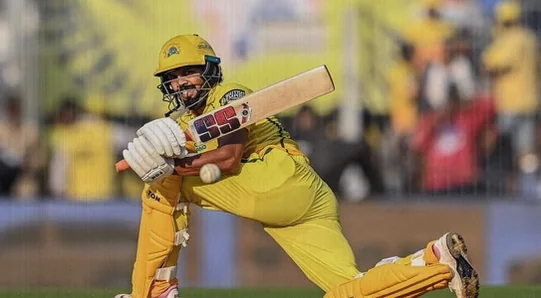
Chennai Super Kings’ Sunday at Chepauk turned into a classic case of two contrasting innings. The team looked rattled during the opening stretch, posting only 50 runs after the first 12 overs on a surface that played slowly and unevenly. Gujarat Titans’ fast bowling made full use of those conditions, striking early to put CSK on the back foot with four quick wickets. Then, after a well-timed strategic time-out, Chennai completely changed tempo, blasting 107 runs in the final eight overs to land in a defendable position.
How CSK reversed the momentum
At the centre of Chennai’s turnaround was captain Ruturaj Gaikwad, who steadied the chase of momentum rather than chasing boundaries from the first ball. He finished unbeaten on 74 off 60, marking his maiden fifty of IPL 2026 and offering a clear sign that he is finding his rhythm again after a difficult start to the season.
In the closing stages, Gaikwad’s acceleration became the difference. Over the last 18 deliveries, he added 29 runs, with Jamie Overton contributing a spark as well—hitting 18 off six balls to help CSK build speed and pressure.
The slow phase that drew debate
Despite the match-changing finish, the early part of Gaikwad’s innings attracted criticism. For the first 42 balls of his knock, he managed only 35 runs, including 24 dot balls. His boundary count was also limited during that period, with just two fours—both struck early in his innings when he was facing Mohammed Siraj in the third over.
What the experts said about Gaikwad’s approach
Murali Kartik questions the intent
Former India batter Murali Kartik said he struggled to understand the captain’s decision-making, pointing to the pace of the fifty. Kartik highlighted that Gaikwad reached a 49-ball half-century—described as the slowest by a batter in the Impact Sub era (from after 2023). He also questioned how Gaikwad concluded his innings, especially the middle phase.
- Kartik said he was “baffled” by what CSK were trying to do, particularly the middle portion of Gaikwad’s knock.
- He noted that the batter’s strike rotation seemed lacking, adding that the long period without taking singles was difficult to explain.
- He specifically questioned the idea of scoring “20 off 37” being acceptable, asking why Gaikwad couldn’t take at least one run to keep the innings moving.
Shaun Pollock defends the anchor-style plan
Shaun Pollock, who was also part of the discussion panel, pushed back on Kartik’s criticism. Pollock argued that the context of the game demanded Gaikwad to hold things together while wickets kept falling and the pitch remained tricky.
- Pollock said Gaikwad’s role was to stabilise while others were collapsing around him.
- He acknowledged that “anchor” may sound old-fashioned in modern T20 cricket, but insisted it still has value in certain match situations.
- He added that even if Gaikwad soaked up dot balls, the broader reality was that Chennai still got close to 160—something that gives them a platform to defend.
- Pollock concluded that while quicker scoring is ideal, the approach can be accepted when wickets fall and conditions don’t offer easy runs.
Sanjay Bangar points to intent and a pitch shift
Former India head coach Sanjay Bangar offered a more tempered explanation, suggesting the innings wasn’t driven by any explicit instruction to slow down. Instead, he described it as an internal restriction that eventually eased once Gaikwad found his range.
- Bangar said he didn’t believe management told Gaikwad to hold back; it was more of a self-imposed limitation.
- He argued that once Gaikwad started opening up, he produced “excellent shots,” and the pitch appeared less difficult than it had earlier.
- Bangar stressed that intent mattered most—when the captain shifted gears, the boundaries began to come.
- He added that Gaikwad will need to address the approach earlier in his innings so the acceleration can start sooner.
