
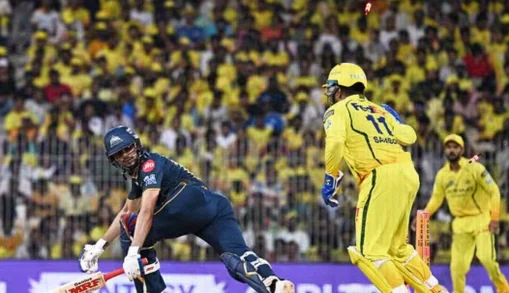
Sanju Samson didn’t need much time to work out what had happened. The instant Shubman Gill missed Noor Ahmad’s delivery down the leg side, Samson moved sharply, collected the ball and lit up the stumps in a flash. At Chepauk, it triggered an immediate throwback to an MS Dhoni moment—only this time in CSK’s colours and with newer gloves.
CSK needed that kind of strike badly. They were defending a modest 158, and the Gujarat Titans bowlers had pushed the home side into survival mode. Ruturaj Gaikwad finished unbeaten on 74 to take CSK to 158/7, but the innings had been in genuine trouble at 43/4 after ten overs, before CSK found momentum and scored 115 in the final ten.
Quick facts
- CSK defended 158 after being pressured by Gujarat Titans’ bowlers.
- Ruturaj Gaikwad made 74* and CSK finished on 158/7.
- Samson’s stumping came in the seventh over, removing Shubman Gill for 33.
- The game’s key turning point arrived when Gill missed Noor Ahmad and Samson broke the stumps quickly.
Gujarat started the chase with composure, reaching 55/0 during the powerplay. That control meant Samson’s breakthrough mattered even more, because it was CSK’s first real opening after Gujarat had looked set. The dismissal arrived in the seventh over, exactly when the chase had begun to settle into a rhythm.
How the stumping happened
Noor Ahmad delivered full and down the leg side, Gill went for the flick and missed, and Samson shifted quickly to his left. The execution was clean—fast hands, minimal fuss, and a decisive break. The third umpire also had to confirm the finer detail: Gill’s back foot was in the air when the bails came off, ensuring the wicket stood.
Gill made 33, and CSK removed the GT captain right as Gujarat were trying to build a platform. Noor Ahmad won’t get the wicket credited in the scorecard, but the moment belongs to Samson—because he converted a half-chance into immediate damage, and did it with speed that looked almost automatic.
The reason it brought Dhoni to mind wasn’t only the rapid movement. It was the efficiency of the keeper’s work. Samson didn’t collect, reset, and then attack the stumps; the gloves stayed extended, the hands moved only a short distance, and the bails were disturbed before Gill could regain balance. That “behind the stumps” language—timed, compact, and ruthless—has always been associated with Dhoni.
Gill has experienced that style before. In the IPL 2023 final, Dhoni stumped him off Ravindra Jadeja after the Gujarat opener raced to 39 off 20 and then added 67 for the first wicket. It was one of those quiet but decisive keeper interventions: the bowler created the chance, and the keeper turned it into a wicket. Dhoni produced a similar leg-side stumping against Bangladesh in the 2016 T20 World Cup as well, when Sabbir Rahman overbalanced while trying to work Suresh Raina down the leg side and Dhoni removed the bails before the batter could get back. India eventually won that Bengaluru thriller by one run, and Dhoni’s leg-side stumping was one of the passages that kept the match alive.
Samson’s dismissal of Gill fits into the same family of work. The ball itself wasn’t a textbook wicket-taking delivery—it was down leg and could have easily turned into a missed opportunity for runs. Yet Samson manufactured the wicket through positioning, balance and arm speed, turning what could have been benign into a decisive breakthrough.
That technical layer was picked up in the commentary too, where Katey Martin mentioned that Samson had spoken to Dhoni ahead of the season about boosting his arm speed behind the stumps. The guidance reportedly leaned toward keeping the gloves extended, rather than relying on the more old-school collect-and-break action.
Against Gill, that adjustment showed immediately. Samson’s hands were already in the danger zone, and the collection and breaking of the stumps became part of a single, continuous movement. Gill’s back foot had almost no time to return, and the wicket landed at exactly the right moment for CSK.
For CSK, it was a valuable breakthrough because Gujarat had managed the required rate early and Gill was controlling the chase. CSK needed pressure through dots and wickets, not just containment. Samson’s stumping delivered a wicket that didn’t come from a perfect ball—it came from a keeper manufacturing damage from a half-chance.
It wasn’t nostalgia for nostalgia’s sake, and it wasn’t a careless visual resemblance. The principle was the same: reduce the movement, stay ahead of the batter, and make the crease smaller than it appears. MS Dhoni made that skill famous in yellow for India, and with CSK, Samson produced a moment carrying the same signature—bat beaten, foot lifting for a fraction, and bails gone before Gill could negotiate his way back.
CSK were searching for a spark while defending 158, and Samson delivered it in a way that felt unmistakably Dhoni-esque. One sharp piece of wicketkeeping converted pressure into a turning point, and suddenly the chase looked less settled than it had been moments earlier.
