
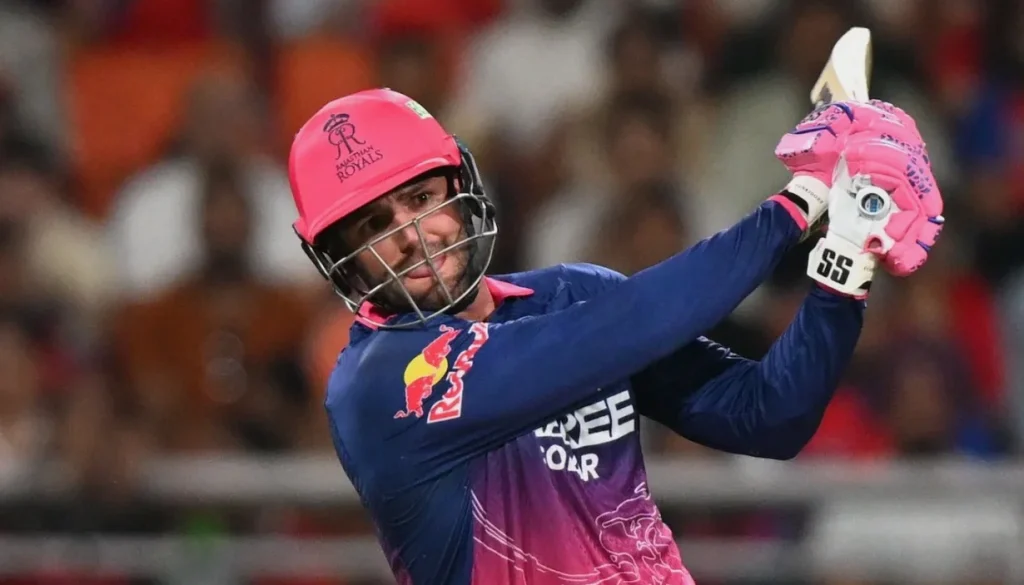
IPL 2026’s late-overs power game is being led by a familiar name, but the race behind the front-runner has its own twist. Between overs 16 and 20, Tim David currently tops the six-hitting charts with 13 maximums from 48 balls. Yet the player sitting directly behind him isn’t Heinrich Klaasen—it’s Rajasthan Royals finisher Donovan Ferreira, who is level with David on 13 sixes, though from 53 deliveries. Klaasen follows in third with 12 sixes off 101 balls.
Why the death overs have changed in IPL 2026
Boundary hitting has surged across the tournament, forcing bowlers to rethink their plans at the business end of innings. With batters repeatedly finding ways to clear the rope, several of IPL 2026’s leading bowlers have started using the yorker as their primary counter—an approach that has long been viewed as the steadiest defensive weapon in T20 cricket.
Still, batters are learning to punish even the best attempts. Eshan Malinga and Bhuvneshwar Kumar have been credited with unsettling batters through reverse-swinging yorkers at the death. Another notable tactic is Anshul Kamboj’s approach: once a new-ball specialist in T20 cricket, he now fires yorkers almost exclusively from around the wicket at the end of the innings, trying to keep the ball out of the swinging lanes that right-hand batters typically target.
Ferreira’s yorker demolition: from blockhole to six
Donovan Ferreira’s rise is especially striking because he can still launch maximums even when the ball is good. T Natarajan is widely regarded as one of the IPL’s finest yorker bowlers, but Ferreira has shown he can turn even the tightest lines into scoring opportunities—drilling through balls from the blockhole and sending them to the boundary.
A vivid example came in Jaipur on May 1 against Mitchell Starc. The final delivery of Starc’s spell was a yorker—or just short of the ideal yorker length—aimed on the fourth-stump line. Ferreira was so deep in his stance that he got underneath the ball and struck it over covers for six, timing it off the cue end of the bat.
Ferreira’s form is not confined to one match or one matchup. In recent franchise seasons across the world—including the Hundred—he has already established himself as a late-overs threat. Since the beginning of 2025, he has struck 52 sixes from 286 balls in T20 cricket specifically in the 16th to 20th over window. Only Sherfane Rutherford (71), Romario Shepherd (66) and Rovman Powell (62) have hit more during that period. That growing reputation has now translated directly into IPL impact, helped by his ability to punish yorkers from the very bowlers who are meant to prevent exactly that.
How his power is built—and how RR uses him
Albie Morkel, who has worked closely with Ferreira at multiple stops—including Joburg Super Kings in the SA20, Texas Super Kings in the USA’s MLC, and the Titans setup in South Africa domestic cricket—ties Ferreira’s finishing to a blend of natural hitting ability and refinement in training.
- Morkel points to Ferreira’s natural strength to strike the ball hard, then adds that structured drills help “perfect” the swing when bowlers miss their spots.
- He notes that batting intent has shifted: where batters once chased boundaries mainly through fours, the modern game rewards power and the willingness to go straight for six.
- When yorkers land well and remove the over-the-top route, Morkel highlights the limited options—such as the lap shot (which Ferreira is still developing), or slicing away—while stressing that Ferreira has already nailed one key plan against yorkers.
- He believes the foundation is power, because when yorkers take away the usual scoring angles, only a batter with real muscle can still convert those deliveries into maximums.
Ferreira’s power, in Morkel’s view, has been evident since his club days. Morkel and Mandla Mashimbyi—formerly Titans’ coach and currently leading South Africa women—were so impressed that they pulled him from ordinary work as a sales representative at a cricket company called IXU, bringing him into a full-time professional setup with Titans.
Morkel also described the path Ferreira had to take to reach that level. He recalled that Ferreira’s early transition wasn’t quick because the batter was managing an eight-to-five job alongside club cricket, and it took about a year or so before his first Titans contract arrived. Once that break came, Ferreira progressed strongly in domestic cricket, with a skill set that includes the ability to keep, bowl offspin, and of course finish innings—making him a high-value player.
Rajasthan Royals, however, got him for a relatively low price. RR acquired Ferreira via trade for INR 1 crore. Since joining, he has become their main finisher, keeping Shimron Hetmyer—described as more experienced—on the bench.
Morkel believes the confidence boost has been central to Ferreira’s development in the IPL. He said Ferreira is now in a position where he is making first-choice lineups, whereas earlier he often found himself watching from the side. In franchise cricket, that shift into regular selection has helped him build belief, and the added responsibility has made him a more prominent pick.
Taking on spin, and turning earlier setbacks into a weapon
Ferreira’s profile has traditionally been stronger against pace than spin, but the numbers show a clear improvement. From his T20 debut in 2018 until the end of 2024, his strike rate versus spin was 150.14. Since the start of 2025, that mark has risen to almost 165.
Just before RR’s previous match, Ferreira had been dismissed twice by Kuldeep Yadav in nine balls for 15 runs. In response, Delhi Capitals reportedly held an over back for the left-arm wristspinner at the death. However, when DC matched him up with Ferreira in this version of his game, Ferreira punished the plan—hitting 19 runs off five balls.
Morkel believes the key is how power-hitters adjust when batters face deliveries that slow the pace. He said it’s always a challenge when bowlers take away speed and the batter can become vulnerable to spin. Still, he believes Ferreira has worked out a solution—particularly step-hitting when bowlers feed full deliveries and put pressure on the batter. Morkel also added that the situation changes when wickets fall: if a batter is a couple down, the role becomes building an innings rather than only looking for instantaneous finishing, and that is one area Ferreira can continue to improve. Even so, he remains especially dangerous when the scoreboard situation gives him what he needs to attack.
In Morkel’s assessment, Ferreira is now at a stage where he trusts his own strengths. He understands both his strong points and his limitations, and he adapts his approach to suit the match situation and the bowling he faces.
