
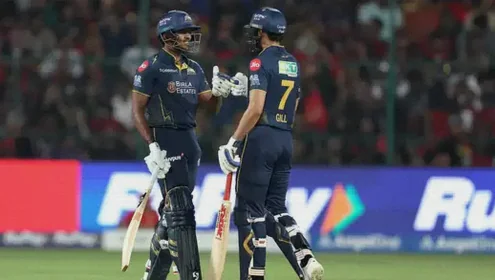
Gujarat Titans have faced early-season questions after deciding to slot Jos Buttler at No. 3 in IPL 2025, despite the England batter being released by Rajasthan Royals and having previously built much of his reputation as an opener. What followed, however, has helped reshape the narrative: the Titans have found a winning template built around the partnership at the top—anchored by captain Shubman Gill and Sai Sudharsan—while Buttler’s move has highlighted how much the franchise’s batting identity has evolved.
Key takeaways
- Gujarat Titans moved Jos Buttler into the No. 3 spot at the start of IPL 2025, a decision that raised eyebrows due to his typical role as an opener.
- The Titans have turned Gill and Sai Sudharsan’s opening alliance into a major strength, compiling 886 runs together at a run rate of 10.56 this season.
- A 54-run stand in Sunday’s final would put the pair past the long-standing IPL partnership mark set by Virat Kohli and AB de Villiers in 2016.
- Gill links the duo’s success to an off-field and on-field familiarity, including shared time in the IPL and conversations that carry into international setups.
- Sudharsan’s preparation routine—featuring yoga, meditation and visualisation, with reduced net exposure around matchdays—has been highlighted as a consistency driver.
- Gill expects Ahmedabad to be an advantage for Gujarat Titans, arguing that finals are decided primarily by mental readiness rather than travel fatigue.
Why Gill and Sudharsan have become the Titans’ defining duo
Concerns around IPL 2025 initially surfaced after Gujarat Titans announced that Jos Buttler would bat at No. 3. The Englishman, surprisingly let go by Rajasthan Royals, has long been regarded as one of the standout white-ball batters of his era, and much of his IPL legacy was shaped from the top of the order.
Yet the Titans’ planning has placed Sai Sudharsan and captain Shubman Gill at the centre of their batting framework. The franchise’s decision to promote Sudharsan alongside Gill has since emerged as one of the most consistent features of their campaign. Last season, the duo combined for 912 partnership runs at a run rate of 9.56. This year, they have accelerated even further—producing 886 runs together at 10.56—while maintaining the kind of reliability teams crave in the middle overs of a chase or the powerplay after a strong start.
In Sunday’s final, another 54-run partnership would take them beyond the all-time IPL record established by Virat Kohli and AB de Villiers during their landmark 2016 campaign. Gill believes the foundation of that kind of repeated success is not just technique, but a strong personal and cricketing equation that grows through constant shared time.
Speaking ahead of the title match, Gill explained that the two spend extensive time together in the IPL—on the field and away from it—and also share pathways through international cricket. That overlap, he suggested, creates a comfort level that naturally feeds into performances when it matters most.
“You know we spend a lot of time in the IPL together on the field, off field as well and then we are in the Test team as well, so we have a lot of conversations,” Gill said. “There are things that we talk about cricket, outside of cricket.”
He added that the team’s broader mix of players with international commitments makes it especially important to understand each other well. “But I think there are many players in our team who also play for the country and hopefully we are going to play together for a long period of time and it’s very important for us to have to know each other well to have a great equation that automatically translates to on-field performances.”
Sudharsan’s intensity, disciplined prep, and the mental side of consistency
Gill also pointed to Sudharsan’s unwavering intensity and discipline away from the game as key drivers behind the partnership’s output. He emphasised that sustaining the same level of focus across an IPL season—spread over roughly two months—remains one of the most difficult skills to master at the top level.
Before Sudharsan’s Orange Cap-winning run last year, the Gujarat Titans management had advised him to conserve energy across the campaign. While extended net sessions are largely limited to about two days before matchday, preparation does not end there. Instead, Gill highlighted a routine that includes yoga, meditation and visualisation in the lead-up to games, with Sudharsan often encouraged to stay away from the nets when the schedule calls for it.
Gill framed Sudharsan’s ability to keep intensity levelled across matches as the defining strength. “I think in a tournament like IPL, when I first started playing, one of the challenges that I faced was to keep playing the matches at the same intensity and I think that is one of his [Sai Sudharsan’s] biggest strength,” he said.
He continued: “You play so many matches there could be days where mentally you don’t feel up to the mark or physically you don’t feel up to the mark but to be able to have the same intensity in all of the matches and be consistent in your preparation [and] in your routine is not that easy. He is someone who is very consistent in his routines, in his life outside of cricket… so that is what makes him consistent on the field as well.”
Gill on batting fundamentals, evolving conditions, and the Impact Player era
With IPL increasingly linked to massive six-hitting and ever-rising totals, Gill argued that some of the game’s oldest batting principles still matter more than ever. He cited the ability to locate gaps, rotate strike efficiently, and reduce the number of dot balls as the traits that separate good sides from truly great ones.
“Sometimes the wicket tends to be a bit on the slower side. Then it is important to hit the gaps, still look to run well because I think that is the foundation of any format you are playing. The team that plays less number of dot balls has a better chance of getting a better score, so yes the T20 game has evolved, you see bigger scores but the wickets have also gone a little bit flatter…,” Gill said.
Gill also pointed to changes in scheduling and fresher surfaces as a meaningful reason behind the surge in high-scoring matches in recent seasons. He noted that before the league expanded with two new franchises in 2022, the tournament had eight teams and teams generally played on more similar wicket conditions. He contrasted that with the current reality where longer breaks between matches can result in better batting conditions.
“I think that not many people talk about this, before these two new teams [GT & LSG were added to the league in 2022] there used to be eight teams and we used to play on similar wickets. [But] back in the day in the second half of the IPL, we used to see 150, 160, 140 scores a lot more, in Eden Gardens and even in Bombay.
“In some of the venues now, because at least four or five times in a season, we get a five-day break or a seven-day break, which gives the chance to play on fresh wickets, better wickets. So I feel cricket is the same, it’s all about the kind of wickets that we play on, the kind of grounds that we play on… If we play on challenging wickets, the scores are going to be similar, maybe a 5-10 runs difference here and there but still I feel that cricket is pretty much similar.”
Gill believes he has had to adjust to modern T20 demands, particularly after the introduction of the Impact Player rule. He highlighted a clear change in his Powerplay performance: his strike rate has climbed from 143.14 last season to 159.20 this year.
Now leading India in Tests and ODIs, Gill also addressed his T20I situation after losing his spot in the team prior to this year’s successful World Cup defence. Still, he stressed that his mindset remains rooted in continual development across formats.
“I mean I’d be happy to play if I get picked for the T20 team but honestly I want to keep working on my game. It doesn’t matter what format it is. I want to keep getting better as a T20 batsman, as an ODI batsman, as a Test batsman… cricket is such a game you can never really get perfect but obviously you can strive for it and that’s what I try to do.”
Final preview: Gujarat’s travel stretch, RCB’s break, and Ahmedabad as an advantage
For now, Gill’s focus is firmly fixed on Gujarat Titans winning a second IPL title—and achieving that milestone with the added responsibility of captaining the side. The team heads into the final after a demanding run that took them from Dharamsala to Mullanpur and then onward to Ahmedabad within a span of five days.
Royal Challengers Bengaluru, having sealed their place through Qualifier 1, have had a longer break. Gill played down the importance of that physical disparity, insisting that finals are primarily a test of mental strength rather than legs.
“Yeah, I mean Dharamshala is kind of a difficult venue to get there and travel, but yes physically they might have an advantage but I think finals are all about mental [strength], so the team that is mentally up there for the challenge is the one that is going to win.”
Gill also framed familiarity as the balancing factor. With the title decider returning to the Titans’ home venue, he viewed Ahmedabad as a benefit instead of a burden. He said the absence of “expectations pressure” helps, while knowing the wicket and ground allows Gujarat to plan the required style of cricket to secure victory.
“Honestly I don’t really get burden of expectations. Obviously there are advantages, that’s how I see it. There’s familiarity when we play there, we know the wicket, we know the ground so we know what kind of cricket we need to play there to be able to win so in that context yes I see it as an advantage because there’s a little bit of familiarity.”
