
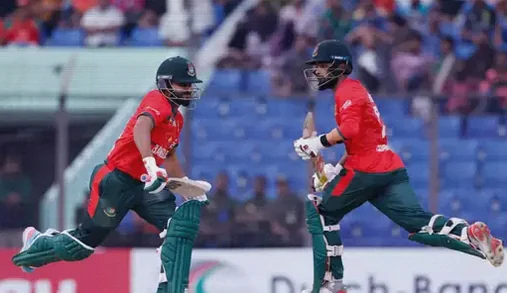
Bangladesh batter Towhid Hridoy said he went into Monday’s Chattogram opener of the three-match New Zealand series ready to take the attack early, believing the chase would have become significantly more difficult had he not tried to accelerate when the opportunity arrived. His unbeaten half-century, backed by Shamim Hossain’s rapid finish, powered the hosts to their top successful run chase in the game.
Key takeaways
- Towhid Hridoy entered the chase planning an early assault on New Zealand’s bowling, feeling it was necessary to keep Bangladesh on track.
- Bangladesh’s pursuit of 182 started steadily with Saif Hassan (17 off 16) and Tanzid Hasan Tamim (20 off 25) adding 41 before both were dismissed.
- Hridoy struck an unbeaten 51 from 27 balls and Shamim finished 31 not out off 13, including a late burst of 25 runs in the 17th over off Matthew Fisher.
- Bangladesh set a milestone by registering their highest successful run chase in the match.
- Hridoy stressed that lower-order impact can decide games when the top and middle fail, and that in T20 cricket, influence matters more than milestones.
Chase dynamics: from cautious starts to the finishing surge
Bangladesh began their run chase of 182 with caution, as Saif Hassan and Tanzid Hasan Tamim built a measured 41-run partnership. Saif contributed 17 off 16 deliveries and Tanzid made 20 off 25, but neither could convert the start into a longer stay at the crease.
After that, Bangladesh captain Litton Das raised the tempo with a quick 21 off 15. Parvez Hossain Emon then delivered an explosive cameo of 28 off 14, setting the platform for Hridoy and Shamim Hossain to complete the job with composure and pace.
Hridoy on his approach and the value of impact innings
Hridoy, who was named Player of the Match, explained that his batting plan is shaped by what the team requires in that moment. He said that in the chase, Bangladesh needed runs and the side was slightly behind the required pace, which pushed him toward an aggressive mindset. “Normally my plan depends on what the team demands. In that situation, we needed runs, and at that point we were a bit short of runs,” he said after the match. “So my plan was to attack because if I couldn’t attack, it might have become tough for the team. So I just tried to be as aggressive as possible,” he added.
He also highlighted Shamim’s ability to hit powerfully and the importance of that skill in the lower middle order. Hridoy said he genuinely enjoys Shamim’s batting because he plays shots that are difficult for many of Bangladesh’s batters. He noted that at number six, the role demands the capacity to score in different ways at any time, which also puts bowlers under serious pressure. Hridoy pointed to a standout six Shamim struck, saying they rarely hit shots of that kind, and expressed hope that the batter continues to progress while staying consistent.
On Bangladesh’s current group, Hridoy said the squad now has enough experience to take ownership in high-pressure moments. He remarked that every player has already featured in around 30-plus matches, and insisted that if Bangladesh cannot win games like this, it would not reflect well on the team’s mindset and readiness. He framed it as a responsibility that batsmen must embrace, especially when the innings demands calm decision-making under strain.
Hridoy further underlined the need for lower-order contributions when either the top order or the middle order has a poor day. He said there will be matches where the early batters don’t perform, and sometimes the middle order struggles as well; in those scenarios, the lower order has to take charge of the result. He added that Bangladesh is working to develop those skills quickly from within the group.
Finally, Hridoy addressed how impact is often more important than milestones for batters at No. 5 and No. 6 in T20 cricket. He clarified that those positions don’t typically offer frequent opportunities for big scores, and that when a batter at number six hits a fifty it usually indicates the team has already lost several wickets early. In his view, an innings like Shamim’s feels larger than a milestone because it changes the game’s direction. He also argued that in T20, even 10 runs can swing momentum, and he credited Shamim alongside Emon for putting Bangladesh in a position where sealing the win became easier.
