
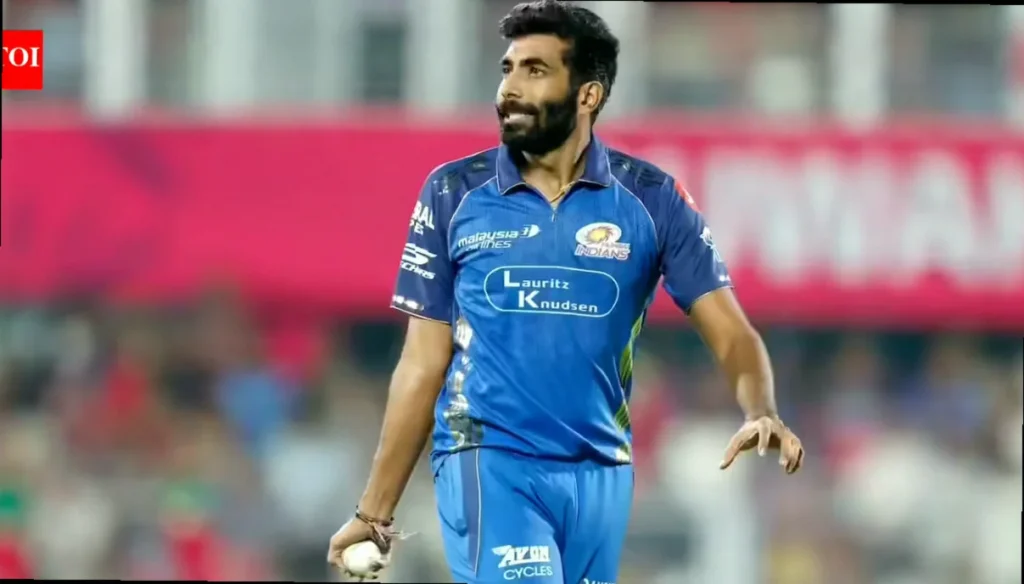
Mumbai Indians head coach Mahela Jayawardene said on Saturday that Jasprit Bumrah carried a minor niggle from India’s T20 World Cup campaign—where the Men in Blue lifted the trophy—into IPL 2026, and that continuity of discomfort played a key role in the pacer’s below-par run in the league. Jayawardene added that Bumrah did not receive enough recovery time after the global tournament, which, in his view, hampered his sharpness and rhythm early on.
Jayawardene’s remarks come as Bumrah managed only four wickets in 13 matches for Mumbai Indians, with his lack of impact being one of the major factors behind the franchise’s disappointing season. The five-time champions were eliminated from the competition after securing victories in just four of their 13 league games and suffering defeats in nine.
Speaking on the eve of MI’s final league fixture against Rajasthan Royals, Jayawardene said Bumrah was still dealing with the injury during the opening phase of IPL 2026. He explained that the fast bowler had a slight issue after returning from the T20 World Cup and had played through it during the tournament itself. Jayawardene said the side provided Bumrah adequate rest when he came back, but that the underlying challenge still influenced his early performances.
He also pointed to how late the India internationals joined the team setup for the season, noting that Mumbai Indians brought Bumrah, captain Hardik Pandya, Suryakumar Yadav and Tilak Varma into their pre-season camp only five days before the start of IPL 2026 on March 28. The combination of limited downtime and the need to manage his condition, Jayawardene suggested, contributed to a slower start in terms of pace and execution.
According to Jayawardene, the reduction in Bumrah’s pace in the first set of matches was due to a “gradual build-up” as the bowler worked his way back from the niggle. He said that during the opening four to five games, the priority was getting Bumrah fully over the problem, and that the drop in speed was visible. Jayawardene then stressed that the last four to five matches had been more productive, with Bumrah returning to his usual pace.
Jayawardene acknowledged that when a player is trying to manage an issue at the same time, it can slightly affect sharpness in execution, because attention is divided between the immediate skill demands and the body’s response to the niggle. Even so, he maintained that from a health standpoint Bumrah was fine, while regretting that the season ended for Mumbai at a point where they were still finding momentum. “Health-wise, it’s 100 per cent,” he said, before adding that it was unfortunate that MI’s campaign was over.
The coach also highlighted how demanding Bumrah’s calendar had been around the World Cup period. He had appeared in four of the five T20Is India played against New Zealand prior to the T20 World Cup. At the tournament itself, Bumrah finished as a joint-highest wicket-taker alongside Varun Chakravarthy with 14 wickets, including a decisive 4/15 in the final against New Zealand. Bumrah featured in eight of India’s nine matches throughout the World Cup.
Jayawardene further claimed that opposing teams had approached Bumrah with caution, even when his output wasn’t at his best. In his assessment, batters were not taking too many risks against him in certain situations, largely because Mumbai and India-style pressure wasn’t building around him—meaning the other bowlers were not consistently creating the surrounding pressure required to force errors.
To address workload and condition, Jayawardene said MI tried to manage Bumrah carefully across the season. He described ongoing discussions with Bumrah and the training staff about where the team could push him and how they could plan nets and preparation, pointing to workload management as part of the process. Initially, he added, MI also used tactical variations to limit the number of moments in which Bumrah was forced into high-pressure spells.
However, Jayawardene noted that as a lead bowler, Bumrah was inevitably under pressure, particularly at the death overs. To counter that, the coach said MI used him in different ways during the campaign to give him a bit more freedom, while also stressing that Bumrah remained receptive and solution-oriented. Jayawardene said the bowler understood the intent, returned to the group, and asked to try something different when a plan didn’t work.
Looking ahead, Jayawardene believes Bumrah is back in full rhythm and that there are no long-term concerns. He said he was not worried about Bumrah, describing him as being in good spirit and confident he would come back strongly. Jayawardene suggested that seasons like this also teach teams and players how to manage such periods better, and he pointed to the effort Bumrah put in over the six to eight weeks to return to his expected standards.
He added that in the final stretch of the IPL, Bumrah had been “top notch,” bowling around the 140 km/h mark and landing yorkers effectively. Jayawardene said any remaining problems with Bumrah’s run-up were connected to the niggle he had been carrying during the season.
Jayawardene also revealed that Bumrah worked on his no-ball issues while playing IPL 2026. He said Bumrah bowled a number of no-balls during the season, and that these were linked to his build-up, which meant the bowler returned to that aspect and worked on it—especially during extended breaks. Jayawardene concluded by praising Bumrah’s work ethic and the commitment he shows off the field, while admitting that the results on the field did not match those efforts. He said MI had productive conversations about what needs to be done next, and that the team now needs to move forward from what was a difficult campaign.
Stay updated with the latest IPL Live Score, IPL news on Times of India, follow the IPL schedule, check the IPL points table, and track the race for the IPL Orange Cap and IPL Purple Cap.
