
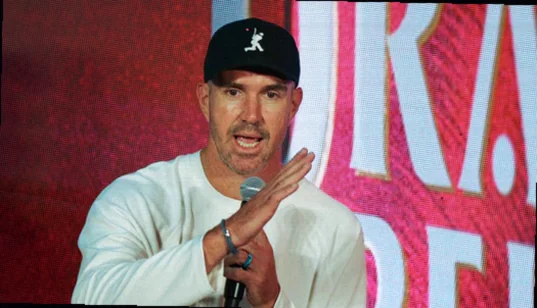
Kevin Pietersen believes one of England cricket’s most familiar internal disagreements was effectively reignited by his involvement in the Indian Premier League, and that the league ultimately cost him the chance to extend his England career much further than it did. In a conversation with Ranveer Allahbadia, the former England batter and Royal Challengers Bengaluru player argued that the consequences that followed his IPL association changed how the cricket establishment treated him.
“I made big sacrifices. I lost my career. That’s the reason why everybody in that establishment went against me,” Pietersen said, presenting his stance as a claim of systemic backlash rather than a simple personal disappointment.
His argument carries extra weight because Pietersen’s England Test career concluded in 2014, when he was still 33. He ended with 104 Tests, 8,181 runs and 23 centuries for England—figures that underline both his impact and the abruptness of the stop.
Pietersen says the IPL affected the endgame of his England career
Pietersen’s complaint is not limited to pride or regret; he frames it as a loss of “scale,” insisting his output should have continued at a higher level for longer. He suggested that his international numbers could have been significantly larger if his England stint had run its natural course.
“I was 33 when my England career finished, 104 Test matches. I should have played 150-160 Tests and got 12,000-13,000 runs. That’s what I should have got,” he said.
For a batter who still sits among England’s leading Test run-getters, the statement reads less like wistful nostalgia and more like a specific assessment of what he believes remained unrealised.
IPL as the trigger, media as a weapon
The sharpest part of Pietersen’s latest remarks is his insistence that the IPL was not merely a side chapter, but the key factor that pushed events toward a damaging rupture with the ECB. He also alleged that parts of the media were used in the process, saying: “The ECB used The Telegraph to go after me… I don’t want to go too deep into it.”
While Pietersen did not expand further on the details of those claims, his message was clear: he believes his IPL links became entangled with wider power dynamics, and that the fallout accelerated his exit from the England setup.
A complication he admits: the IPL also “saved” him
However, the full picture is more tangled than the straightforward headline “IPL ruined my career.” Pietersen had said only days earlier that the IPL also “saved” his career by opening doors—particularly by giving him access to relationships and learning opportunities. In that context, he pointed to Rahul Dravid as a key influence.
In other words, Pietersen’s view contains a contradiction: he argues the league strengthened him as a player and broadened his cricketing exposure, even while that same growing connection, in his telling, worsened the relationship with the authorities at the heart of English cricket.
That tension is why the story, as he frames it, carries more weight than a single-cause narrative. Pietersen is not claiming the IPL harmed his batting directly. Instead, he says it changed his priorities, highlighted a power struggle, and quickened a fallout that England’s system never fully repaired.
From his perspective, the IPL simultaneously enriched Kevin Pietersen’s cricket and shortened his time in England—an outcome that, in his telling, means the league was both the force that helped shape him and the factor that helped unsettle him.
