
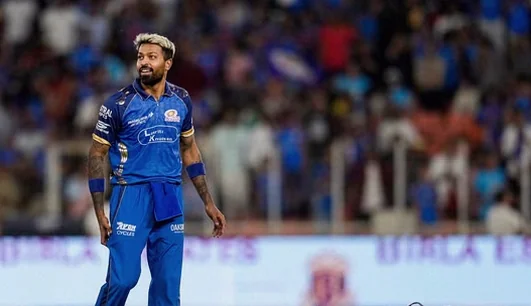
Three seasons have passed since the Mumbai Indians handed the captaincy to Hardik Pandya, taking the armband away from Rohit Sharma. The move looked logical on paper for a franchise that has won the IPL five times, especially given Hardik’s immediate triumph as Gujarat Titans skipper and their return to the final the very next year.
Yet the transition to Mumbai has not produced the same instant spark. Since Pandya rejoined the franchise in 2024, the results and the atmosphere around him have been far from smooth. In that season, the Mumbai Indians ended at the bottom of the points table, and Pandya was booed at multiple venues as sections of the crowd struggled to accept the leadership change.
Quick facts
- Hardik Pandya was appointed captain of the Mumbai Indians three years ago, replacing Rohit Sharma.
- In IPL 2024, Mumbai finished last in the points table and Pandya faced boos across venues.
- In IPL 2025, the franchise improved and reached Qualifier 2.
- In IPL 2026, Mumbai beat the Gujarat Titans at the Narendra Modi Stadium on Monday.
- Despite that win, Mumbai have lost four of their first six matches in IPL 2026.
- After seven matches in IPL 2026, Mumbai are seventh with 4 points.
- Former India batter Sanjay Manjrekar questioned Hardik’s captaincy, citing Ashish Nehra’s role with Gujarat.
In 2025, Mumbai’s campaign showed signs of recovery, finishing strongly enough to reach Qualifier 2. But IPL 2026 has opened with more turbulence than the franchise would like: even after the Monday win over Gujarat Titans at the Narendra Modi Stadium, the side has again started below expectations, dropping four of their first six games.
Manjrekar doubts the captaincy call
As Mumbai’s early-season struggles continued, former India batter Sanjay Manjrekar raised questions about Hardik Pandya’s captaincy credentials. His core argument was that much of Gujarat Titans’ success under Pandya had been driven by the environment created by head coach Ashish Nehra, rather than only by the skipper’s own impact.
Manjrekar also suggested that if Mumbai’s management chose to bring Hardik in, then they should have considered bringing Nehra along as well. In his view, the decision may have been more about creating a high-profile, headline-making moment than making a purely cricket-focused move.
Speaking on a discussion platform, he framed the trade as “interesting” because franchise decisions can sometimes be shaped by commercial considerations. He pointed to how franchises are valued and how certain appointments can be designed to place a player in the spotlight, even if it’s not necessarily the most sound cricketing strategy.
He then linked the Gujarat success directly to Nehra’s influence, arguing that Hardik’s winning run there was closely tied to a coach who was deeply involved and consistently impactful. From that perspective, the logic of taking Hardik without matching the coaching setup did not fully add up.
Manjrekar further described how Hardik’s leadership had looked effective because of the proactive support around him. He believed that success came from a clear, constant presence on the sidelines—someone who was right there alongside the captain’s every move and helped shape the match-day execution.
In the same breath, he emphasised that the issue might not be about Hardik alone. Instead, it could be about whether the appointment and surrounding structure were sensible, or whether it was driven by a desire to do something “out of the box” purely for sensational impact.
After the win over the Gujarat Titans, Mumbai Indians climbed to seventh place in the points table, collecting 4 points from seven matches. Still, with the season reaching its halfway mark of seven games, Hardik Pandya remains without the kind of momentum the franchise would expect—both with the bat and with the ball.
