
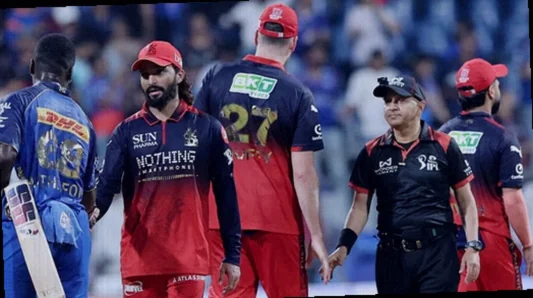
The Indian Premier League’s 2026 campaign has drawn fresh criticism for the pace at which matches are being played, with many voices—broadcast commentators, active players, and supporters—frustrated by the way games are stretching well into the late hours. One high-profile figure who witnessed a slow-burning contest firsthand during the Wankhede Stadium clash between Royal Challengers Bengaluru and Mumbai Indians was current MCC Head of Cricket Fraser Stewart, who has now spoken openly about what he believes is driving the delays.
What Fraser Stewart observed in the RCB vs MI game
Stewart attended the 4 hours and 22 minutes contest between RCB and MI at Wankhede, and he highlighted that the match did not simply feel slow—it was slowed by repeated interruptions. Speaking in Mumbai, he argued that delays are no longer a minor inconvenience, but a major concern that affects how the game is experienced on the ground and on screen.
- The RCB–MI match ran for 4h22m, with the second half particularly shaped by frequent pauses.
- Stewart pointed to multiple injury-related stoppages and breaks in play as key contributors to the overall sluggish tempo.
- He said what stood out to those present was the “pace”—specifically how drawn out the proceedings became due to the number of interruptions.
Stewart’s diagnosis: why matches lose momentum
In conversation at the Bombay Yacht Club with the Mumbai Cricket Association, Stewart linked the problem to a combination of game-management factors. He singled out timeouts, slow fielding changes, and a general lack of urgency, while also stressing a crucial issue he believes lies with enforcement of the over-rate rules.
- Stewart said timeouts and slow fielding adjustments repeatedly sap the flow of overs.
- He argued there is insufficient urgency in how teams execute between phases of play.
- He identified a “reluctance to enforce” the over-rate on the officials’ side as a root cause behind matches moving at a glacial pace.
Stewart’s view was blunt: he believes umpires should actively help keep the game moving. He also drew attention to the commercial impact of constant breaks, noting that every stoppage can become an advertising window for the large viewing audience.
“The umpires were letting it be slow,” Stewart said. “I think it’s an umpire’s job to try to keep the game moving, but when every break is an advertising potential for the billions that are watching, you can see why.”
Potential solutions: warnings, penalties, and a tougher stance on officials
Stewart acknowledged that cricket’s existing framework already offers tools to manage over-rate issues, including warnings and five-run penalties. However, he argued those mechanisms are not being used with enough consistency, and he floated a more direct approach—penalising umpires if over-rates are not kept under control.
- Stewart noted that the laws permit warnings and five-run penalties when over-rates fall behind.
- He maintained that umpires are reluctant to apply these measures when needed.
- One proposal he raised was to fine umpires for poor over-rate performance, suggesting it could drive better compliance and faster play.
At the same time, Stewart stressed that if stricter enforcement is introduced, the ripple effects could be significant. In his view, the current situation already places pressure on captains, who face fines and penalties if their sides fail to complete overs on time—along with further in-game consequences such as reduced boundary fielders and possible penalty runs.
Still, he suggested that tightening timekeeping standards could benefit the sport overall.
Stewart’s comparison with The Hundred and the realities of playing in India
To illustrate an alternative model, Stewart referenced The Hundred, where he said a clear, time-based system is used after wickets. He then contrasted that approach with conditions in India—while still arguing that urgency should not disappear even when the weather is hot.
- In The Hundred, Stewart said a wicket triggers a 60-second clock, and the next batter must be prepared immediately.
- He explained that if the next batter is not ready within that window, the batting team can concede five penalty runs.
- Stewart acknowledged India’s differences, including the heat and the need for drinks.
- However, he said the match he attended still featured too many people coming on and off the pitch repeatedly, reflecting a lack of urgency.
Stewart’s message was consistent throughout: the pace problem is not only about the rules, but about how they are applied in practice. He believes stronger enforcement—especially around time and over-rates—could make matches easier to follow and more watchable for fans, instead of turning games into long, stop-start marathons.
“It’s a real issue. We were there for the game. What struck us was the pace — how slow it was, with so many stoppages,” Stewart said earlier in reference to the RCB–MI contest, adding that the match’s rhythm deteriorated as it progressed into the second half.
And while he recognised local conditions, Stewart argued that the frequency of interruptions should not be accepted as normal.
“I know it’s hotter here and people have to have drinks and stuff, but there were just so many people running on and off the pitch all the time. There was no urgency,” he said.
