
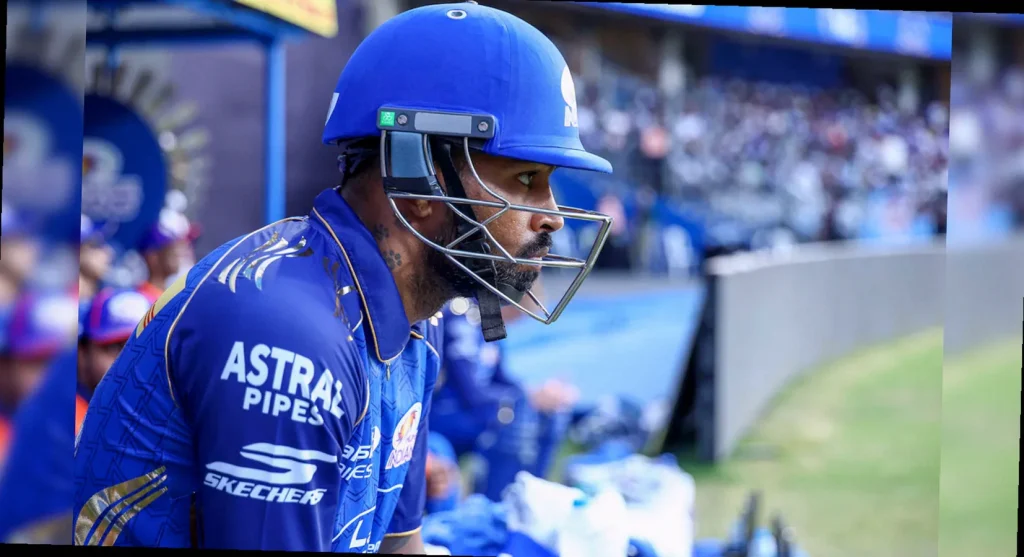
Mumbai Indians’ captaincy and squad-building questions are now likely to grow louder after the franchise ended the IPL 2026 season in ninth place, a finish that brought fresh scrutiny on Hardik Pandya’s time as skipper. Hardik, who was expected to steer the side both in the dressing room and on the field, struggled to deliver consistently, leaving MI feeling that they didn’t get the performances they needed with the bat or the ball. Speaking at the press conference following Mumbai’s loss to the Rajasthan Royals in their last match of the campaign on Sunday, batting coach Kieron Pollard acknowledged that the leadership spell “has not gone as well” as the team would have wanted.
Pollard was candid about the impact of the season on the group’s plans, while also refusing to frame the failures as the work of a single individual. “From a leadership perspective on Hardik, yes, it has not gone as well as he would have wanted as an individual,” Pollard said. He added that the responsibility could not be pinned solely on the captain, stressing that the franchise’s collective process did not reach the standard required. “It might not have gone how we would have wanted as a management staff,” he explained. “But one thing you (should) know that we have tried each and everything to give him the best opportunity to lead the franchise, to do well.” Pollard then underlined that, in his view, the outcome was a shared shortcoming. “Pollard said it was a collective failure of the Mumbai Indians group.”
When asked about whether any blame should be directed at specific people, Pollard said he would rather take a broader view of what went wrong. “No one is going to sit here and put blame on point fingers. When you lose, especially, you have to look at it from a collective perspective. You win some, you lose some,” he said. “But, at the end of the day, I wouldn’t question certain things.” He maintained that everyone associated with the team tried, but results did not follow. “He (Pandya) was trying; we all were trying, and it just didn’t work out for us,” Pollard added. “You sit, you talk, (and) see what is (for the) best. Never know what is going to happen. For us, let us just lick our wounds in (this) time and hopefully come back stronger in the 12 months.”
Pollard also indicated that changes to the squad are likely ahead of the next season, but he pushed back against any idea of acting in haste. Asked whether MI required a “reboot” given the number of senior players in the side, he said it was too soon to start making emotional calls. “Right now, is not the time and place to talk about that,” Pollard replied. He argued that any adjustments must be based on careful evaluation rather than immediate reactions. “All these things would be sort of emotional decisions and thinking of every aspect of what is needed,” he said. “Everyone needs that time and space to go sit down, recollect, have a fair assessment as to where everything actually went wrong for us.”
According to Pollard, taking time is the only way to ensure more sound decision-making. “That is where better decision-making is going to come about. If you sit here right now and say you need to do this, you need to do that, that would be irresponsible from a management perspective,” he added.
The press conference also turned to MI’s decision to rest Jasprit Bumrah for Sunday’s match. Pollard described the call as the “smarter option,” explaining that the context of the final game of the season and Bumrah’s role in the team influenced the thinking. “Jasprit is an individual who wears his heart on his sleeve,” Pollard said. “When you look at this match today, you’re going to get two points if you play (well). Then what’s that going to do for us if we finish on a win, finish on a high?”
He further clarified that selection decisions are not always about what seems best on paper, but about what is right at that moment for both the player and the franchise. “Sometimes, you need to understand the player, understand what is necessary at this point in time,” Pollard said. “From a selection perspective, we didn’t know that today would have been right for him to play with the other guys on the bench.” Pollard pointed to MI’s depth, adding that the team is also in the process of building younger talent. “We have depth and we are building young guys, so trying something different. I don’t see anything wrong with that from our perspective.”
Pollard stressed that the match was the last of the season and that the situation did not demand a risk-heavy approach with a player he described as a prized asset for Indian cricket. “Let’s not look too much into that. It’s the last game of the season,” he said. “It’s not that we could have qualified as well, and he is a prized possession for Indian cricket. Sometimes you have to take the smarter option.”
Looking back on the campaign, Pollard framed MI’s season as a recurring story of missed momentum and unresolved “what-ifs,” particularly for a side that has won the title five times. “It has been a season of what-ifs and overall disappointing for all of us,” he said. “Everyone would have felt the same way. There’s no hiding from that. We weren’t good throughout the entire tournament.” He added that the team could not string together results in the periods when it needed to convert good phases into sustained runs. “We weren’t able to string together wins and use the momentum when we got it,” Pollard said. “At the end of it, when you look at it rationally, we got the position that we deserved in terms of the type of cricket that we played throughout the tournament.”
